
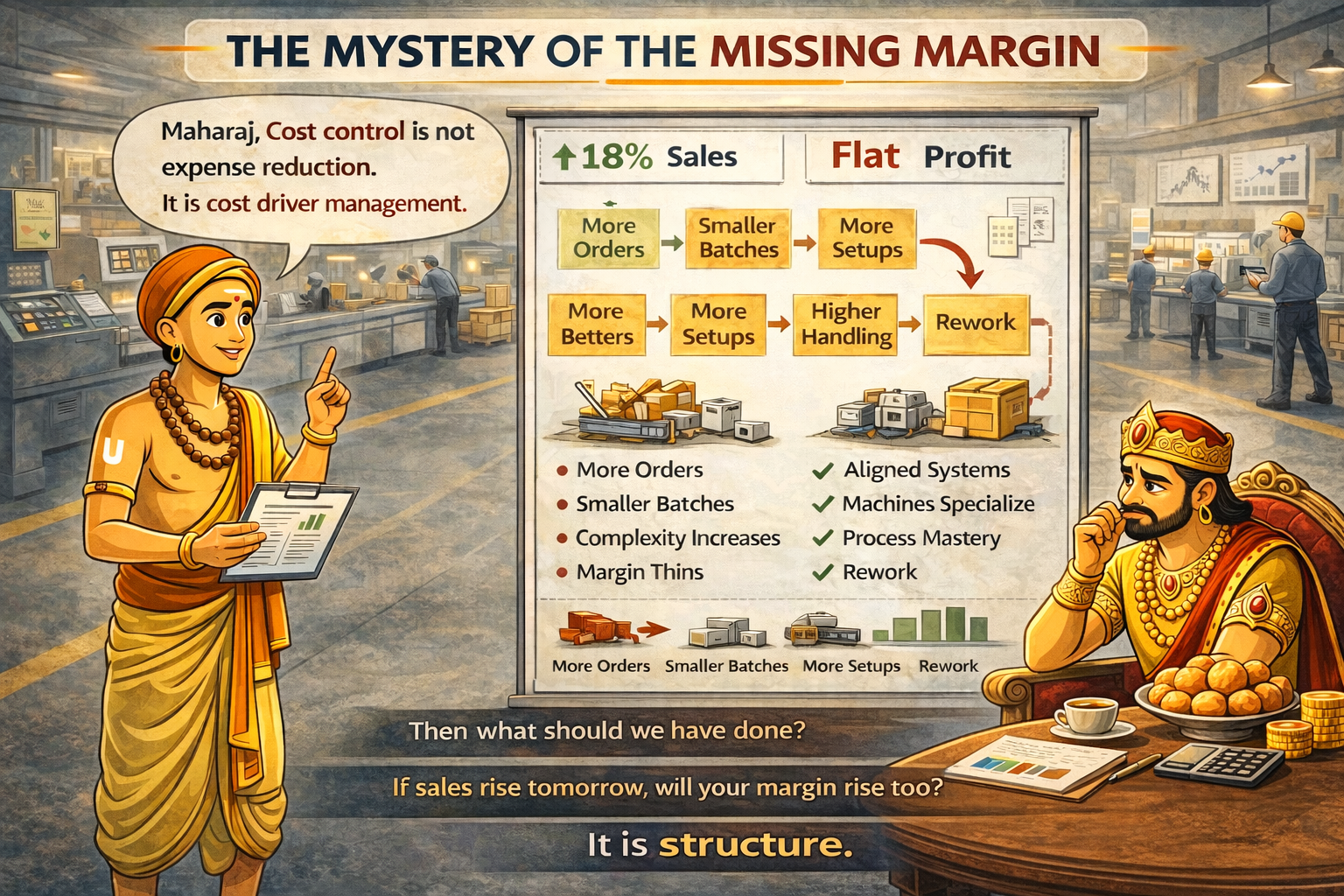
Maharaj welcomed Tenali with sweets.
“Sales are up 18%!” he declared proudly.
“But profit… has not moved.”
Tenali tasted the sweet.
“And what did you do next, Maharaj?”
Maharaj – “We decided to control overheads.”
Tenali raised an eyebrow.
“Ah. When profit hides… overheads are always blamed.”
He walked the shop floor.
He noticed:
Smaller batch sizes.
Frequent machine setups.
Material trolleys moving constantly.
Supervisors handling rework.
Tenali turned.
“Maharaj, did sales increase?”
Maharaj – “Yes.”
Tenali – “Did complexity increase?”
Silence.
Tenali continued:
“When you chase every order,
you increase variety.
When variety increases,
batch size falls.
When batch size falls,
setup cost rises.
When setups rise,
hidden cost multiplies.”
Maharaj looked concerned.
“But revenue has grown!”
Tenali nodded.
“Revenue grew.
But structure changed.”
He drew a simple chain on the board:
More Orders → Smaller Batches → More Setups → Higher Handling → Rework → Margin Shrinks
“Cost does not rise randomly, Maharaj, It follows drivers.
If you cut visible expenses,
but ignore structural leakage,
profit will continue to hide.”
Maharaj leaned forward.
“Then what should we have done?”
Tenali replied:
“First, map your entire value chain.
See where effort increases.
Identify which activities add value — and which only add motion.
Measure the impact of complexity.
Cost control is not expense reduction.
It is cost driver management.”
The sweets on the table suddenly felt less sweet.
Tenali’s Takeaway:
If sales rise tomorrow,
will your margin rise too?
If the answer is uncertain, Maharaj…
the problem is not revenue.
It is structure.