
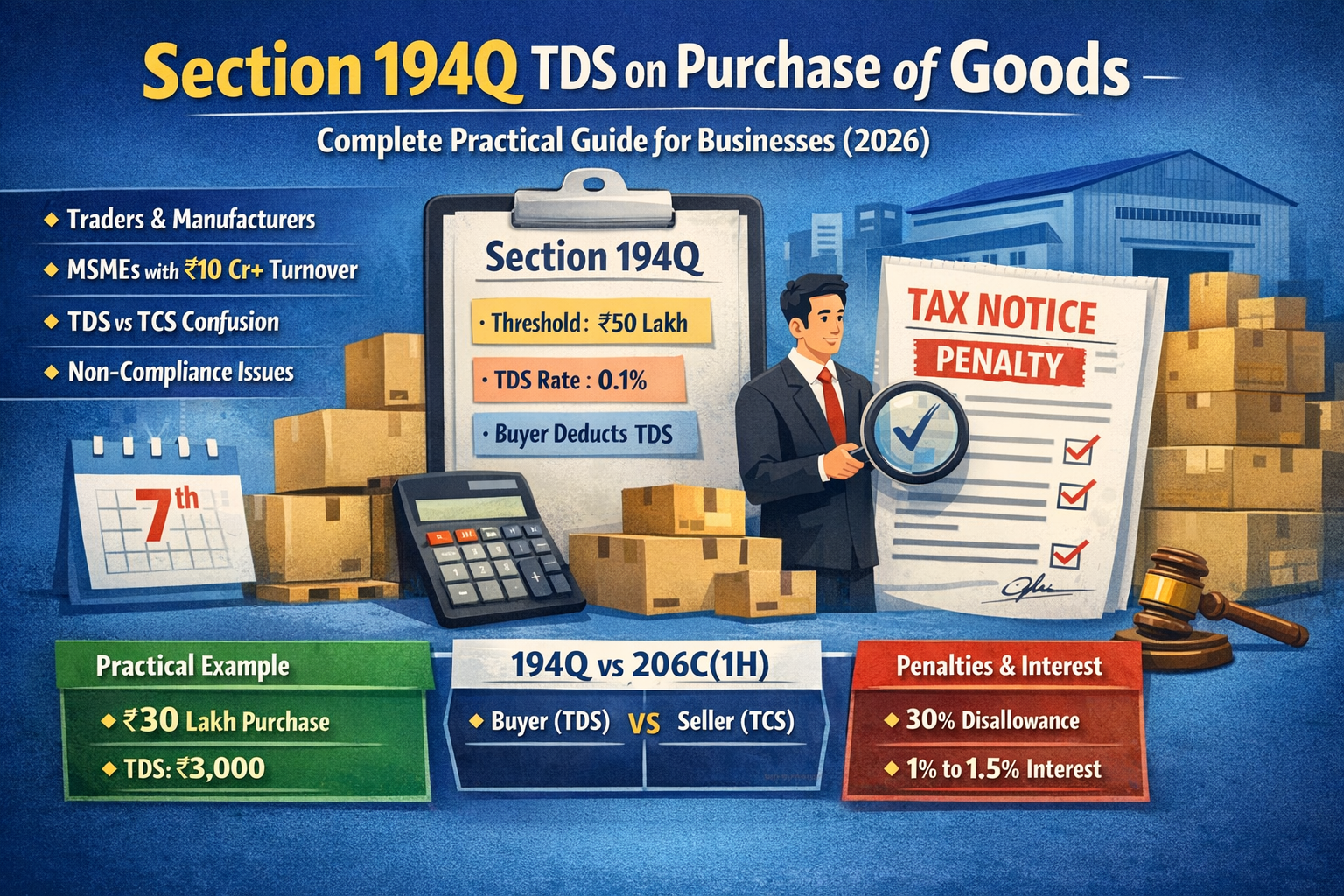
1. Why This Topic is Important?
Section 194Q is one of the most confusing and frequently searched provisions under Income Tax, especially for:
- Traders and wholesalers
- Manufacturers
- MSMEs dealing in bulk purchases
- Businesses crossing ₹10 crore turnover
Even today, many businesses are:
- Deducting TDS incorrectly
- Confused between 194Q vs 206C(1H)
- Facing notices due to non-compliance
2. Basic Overview of Section 194Q
| Particulars | Details |
|---|---|
| Applicable From | 1st July 2021 |
| Who Deducts TDS | Buyer |
| Threshold Turnover | Buyer turnover > ₹10 crore (previous year) |
| Transaction Covered | Purchase of goods |
| Threshold Limit | ₹50 lakh per seller (per year) |
| TDS Rate | 0.1% |
3. Applicability Conditions (All Must Be Satisfied)
Section 194Q applies only if:
- Buyer’s turnover in previous year > ₹10 crore
- Purchase from a seller exceeds ₹50 lakh in current year
- Seller is a resident
- Goods are purchased (not services)
4. When to Deduct TDS?
TDS should be deducted at:
- Earlier of:
- Payment OR
- Credit in books
This creates practical challenges in accounting systems.
5. Practical Example
- Buyer turnover (FY 2024-25): ₹15 crore
- Purchase from Supplier A (FY 2025-26): ₹80 lakh
TDS applicability:
- Threshold: ₹50 lakh
- Taxable amount: ₹30 lakh
- TDS @0.1% = ₹3,000
6. Section 194Q vs Section 206C(1H) (Very Important)
| Particulars | 194Q | 206C(1H) |
|---|---|---|
| Who deducts/collects | Buyer (TDS) | Seller (TCS) |
| Applicability | Purchase | Sale |
| Priority | 194Q overrides | Secondary |
| Rate | 0.1% | 0.1% |
Key Rule:
- If both sections apply → Only 194Q applies (TDS by buyer)
7. Transactions Covered / Not Covered
Covered:
- Raw material purchases
- Trading goods
- Capital goods
Not Covered:
- Import of goods
- Non-resident sellers
- Services
- Transactions already covered under other TDS sections
8. Common Practical Issues
- Advance Payments
- TDS applicable even on advance
- GST Inclusion
- If invoice booked → TDS on amount excluding GST
- If advance → TDS on full amount
- Purchase Returns
- Adjustment allowed in future transactions
- Multiple Branch Accounting
- PAN-wise threshold to be considered
9. Compliance Requirements
| Compliance | Due Date |
|---|---|
| TDS Deposit | 7th of next month |
| TDS Return (26Q) | Quarterly |
| TDS Certificate (Form 16A) | Quarterly |
10. Consequences of Non-Compliance
- Disallowance of 30% of purchase expense
- Interest:
- 1% (non-deduction)
- 1.5% (non-payment)
- Penalty and notices from Income Tax Department
11. Practical Implementation Tips
- Maintain vendor-wise purchase tracking system
- Automate threshold alerts in accounting software
- Obtain vendor PAN and residency confirmation
- Reconcile with AIS and TDS returns
- Train accounts team specifically on 194Q
12. Expert Insight
From a practical standpoint, Section 194Q is not just a compliance provision—it directly impacts:
- Working capital
- Vendor relationships
- Audit risk
Businesses that proactively implement systems for 194Q:
- Avoid notices
- Improve financial discipline
- Strengthen compliance credibility
13. Conclusion
Section 194Q has significantly changed how businesses handle purchase transactions. While the provision looks simple, its execution requires:
- Strong accounting controls
- Continuous monitoring
- Clear understanding of overlapping provisions
Section 194Q TDS on Purchase of Goods – Complete Practical Guide for Businesses