
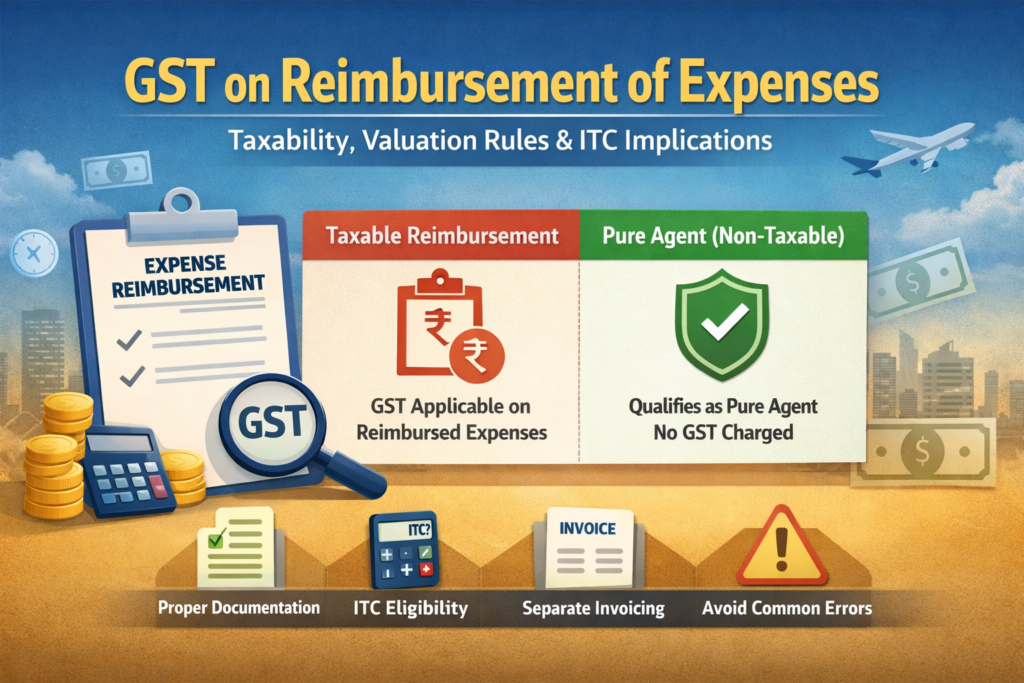
In cities like Pune, PCMC, and across Maharashtra, businesses frequently incur expenses on behalf of clients—such as travel, legal fees, or statutory payments—and later recover them. A common question arises: Is GST applicable on reimbursement of expenses? Misunderstanding this can lead to excess tax payment or non-compliance. This blog explains the taxability, valuation rules, and input tax credit (ITC) implications of reimbursements under GST.
Are Reimbursements Taxable Under GST?
Under GST, reimbursement is generally treated as part of the value of supply, unless it qualifies as a pure agent transaction.
1. Taxable Reimbursement (Default Rule):
- If expenses are incurred in the course of providing service, they are included in taxable value
- GST is charged on total amount (service + reimbursement)
Example:
- Consultant charges ₹50,000 fees + ₹10,000 travel reimbursement
- GST is applicable on ₹60,000
2. Non-Taxable (Pure Agent Concept):
Reimbursement is excluded from GST only if all conditions of pure agent are satisfied:
- Payment made on behalf of client
- Separate indication in invoice
- No markup or profit element
- Actual amount recovered
Pure Agent Concept – Key Conditions
To claim exclusion from GST, ALL conditions must be fulfilled:
- Supplier acts as a pure agent of recipient
- Expense is separately indicated in invoice
- Supplier does not use the goods/services for own interest
- Only actual cost is recovered
Practical Examples:
- ROC filing fees paid by CA on behalf of client → Not taxable (if conditions met)
- Hotel stay booked by consultant for client → Taxable (if used by consultant)
Valuation Rules & Documentation Requirements
GST valuation rules play a critical role in reimbursement cases.
Key Compliance Points:
1. Proper Invoicing
- Clearly bifurcate:
- Professional fees
- Reimbursement (pure agent, if applicable)
2. Supporting Documents
- Maintain third-party invoices in client’s name
- Agreements should specify pure agent role
3. GST Rate Applicability
- If taxable → same GST rate as main service
- No separate classification for reimbursement
Input Tax Credit (ITC) on Reimbursed Expenses
ITC eligibility depends on how reimbursement is treated:
If Treated as Taxable Supply:
- ITC can be claimed by service provider
- GST charged to client on full amount
If Treated as Pure Agent:
- ITC cannot be claimed by service provider
- ITC may be claimed by client (if invoice in their name)
Common Errors in Practice
- Treating all reimbursements as non-taxable
- Not maintaining proper documentation for pure agent
- Claiming ITC incorrectly
- Not showing reimbursement separately in invoice
- Applying wrong GST rate
WH Questions
What is reimbursement under GST?
It is recovery of expenses incurred by a supplier on behalf of a client during the course of providing services.
Why are reimbursements taxable in most cases?
Because GST law includes all expenses incurred in relation to supply in the value of supply.
How to avoid GST on reimbursement?
By qualifying as a pure agent and fulfilling all prescribed conditions.
When is reimbursement excluded from GST?
Only when it meets pure agent criteria under GST valuation rules.
Where should reimbursement be shown in invoice?
Separately, with clear indication and supporting documents.
FAQs
1. Is GST applicable on salary reimbursement?
Yes, if billed as part of service; otherwise depends on structure.
2. Can markup be added to reimbursement?
If markup is added, entire amount becomes taxable.
3. Is GST applicable on statutory fees reimbursed?
Not if paid as pure agent and conditions are satisfied.
4. Can ITC be claimed on reimbursed expenses?
Yes, only if treated as part of taxable supply.
5. Is reimbursement between group companies taxable?
Yes, if it qualifies as supply under GST.
6. What if reimbursement is not shown separately?
It will be treated as taxable value of supply.
7. Is GST applicable on out-of-pocket expenses?
Yes, unless covered under pure agent conditions.
Conclusion
Reimbursement of expenses under GST is a highly litigative area where incorrect treatment can result in tax demands or ITC denial. Businesses and professionals in Pune and PCMC must carefully evaluate whether expenses qualify under the pure agent concept. Proper documentation, invoicing, and understanding valuation rules are key to ensuring compliance and optimizing tax liability.