
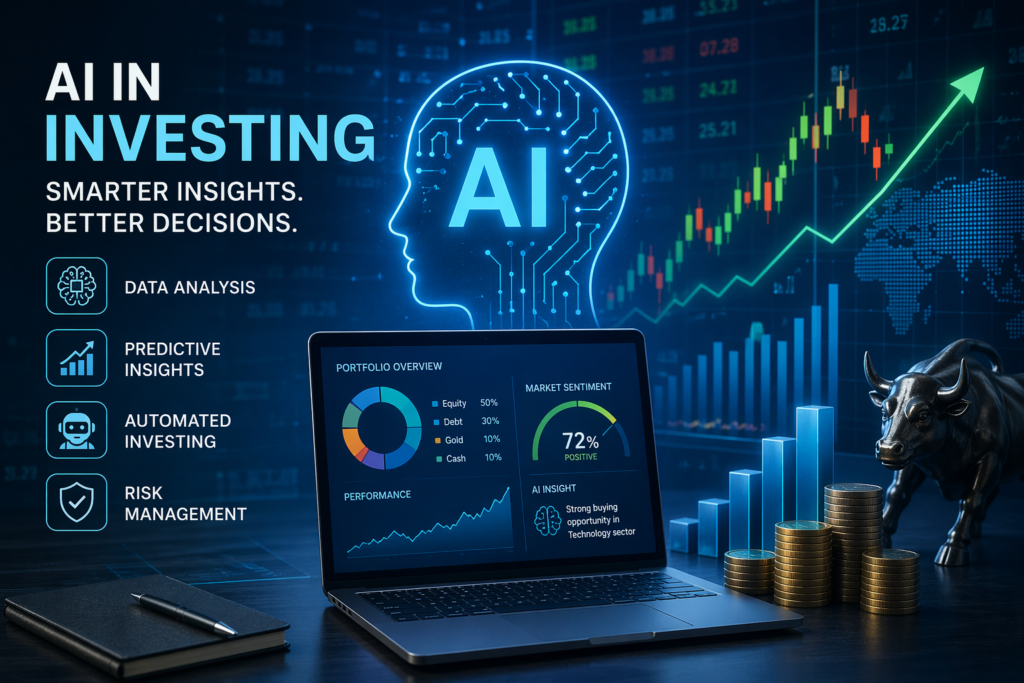
Artificial Intelligence (AI) is rapidly transforming the global investment landscape, reshaping how markets are analyzed, decisions are made, and portfolios are managed. A recent article published in The Times of India highlights the growing influence of AI across multiple layers of investing—from retail investors to large institutional funds. As AI adoption accelerates, it is becoming essential to understand both its potential and its limitations in modern financial markets.
How AI is Transforming Investment Strategies
AI has significantly enhanced the ability to process large volumes of financial data in real time. Traditional investing relied on historical analysis and human interpretation, whereas AI models can now identify patterns, correlations, and anomalies at a much faster pace.
One of the key applications is predictive analytics. AI systems use machine learning algorithms to forecast market trends based on structured and unstructured data, including economic indicators, corporate disclosures, and even global news sentiment. This allows investors to make more informed and timely decisions.
Another major development is algorithmic trading. AI-driven systems can execute trades automatically based on predefined strategies, reducing human intervention and improving execution efficiency. These systems can react instantly to market changes, which can both enhance liquidity and contribute to short-term volatility.
Different “Worlds” of AI in Investing
The investment ecosystem is witnessing multiple layers of AI integration, each serving a distinct purpose. At one level, robo-advisors are providing automated portfolio management services, making investment planning more accessible. At another level, hedge funds and institutional investors are deploying advanced AI models for high-frequency trading and complex risk modeling.
There is also a growing use of AI in qualitative analysis. Natural language processing (NLP) tools can analyze earnings calls, management commentary, and news reports to gauge market sentiment. This adds a new dimension to investment analysis beyond traditional numerical data.
However, these different “worlds” operate with varying levels of transparency and complexity. While retail-facing tools are relatively simplified, institutional AI systems are highly sophisticated and often operate as “black boxes,” making it difficult to fully understand their decision-making processes.
Risks and Limitations of AI in Financial Markets
Despite its advantages, AI in investing is not without risks. One of the primary concerns is model risk—AI systems depend heavily on the quality and relevance of data. If the data is biased, incomplete, or outdated, the resulting predictions can be misleading.
Another key issue is over-reliance on automation. As more market participants use similar AI-driven strategies, it can lead to herd behavior, amplifying market movements and increasing systemic risk. Sudden corrections or flash crashes may occur when algorithms react simultaneously to market signals.
Additionally, the lack of transparency in complex AI models raises governance and regulatory concerns. Investors may find it difficult to assess how decisions are being made, which can impact trust and accountability.
The Evolving Role of Human Judgment
While AI is enhancing efficiency and analytical depth, human judgment continues to play a critical role in investing. Strategic decision-making, risk assessment, and long-term planning require contextual understanding that AI cannot fully replicate.
A balanced approach is emerging, where AI is used as a tool to support decision-making rather than replace it. Investors increasingly rely on AI for data-driven insights while retaining control over final investment choices.
What is AI in investing?
AI in investing refers to the use of machine learning, data analytics, and algorithms to analyze markets, predict trends, and automate investment decisions.
Why is AI gaining importance in financial markets?
Because it can process large datasets quickly, identify patterns, and improve decision-making efficiency compared to traditional methods.
How does AI impact trading activities?
AI enables algorithmic trading, allowing faster execution and real-time responses to market changes, which can increase efficiency but also volatility.
When did AI become prominent in investing?
AI adoption has grown significantly over the past decade, with rapid acceleration in recent years due to advancements in computing power and data availability.
Where is AI most widely used in investing?
It is used across portfolio management, risk assessment, trading strategies, and sentiment analysis.
FAQs
1. Does AI guarantee better investment returns?
No, AI improves analysis and efficiency but does not eliminate market risks or guarantee returns.
2. What is the biggest advantage of AI in investing?
Its ability to process and analyze vast amounts of data quickly and identify patterns not easily visible to humans.
3. What are “black box” AI models?
These are complex algorithms whose internal decision-making processes are not easily understandable or transparent.
4. Can AI reduce market risks?
It can help in risk identification and management, but it cannot completely eliminate risks.
5. Is AI replacing human investors?
No, AI is augmenting human decision-making rather than replacing it entirely.
6. What is the main concern with AI-driven trading?
The potential for increased volatility and systemic risk due to automated and synchronized trading strategies.
Conclusion
AI is redefining the investment landscape by introducing speed, scale, and sophistication into financial decision-making. However, its growing influence also brings challenges related to transparency, risk, and over-reliance on automation. The future of investing is likely to be shaped by a hybrid approach—where AI-driven insights and human judgment work together to navigate increasingly complex financial markets.