
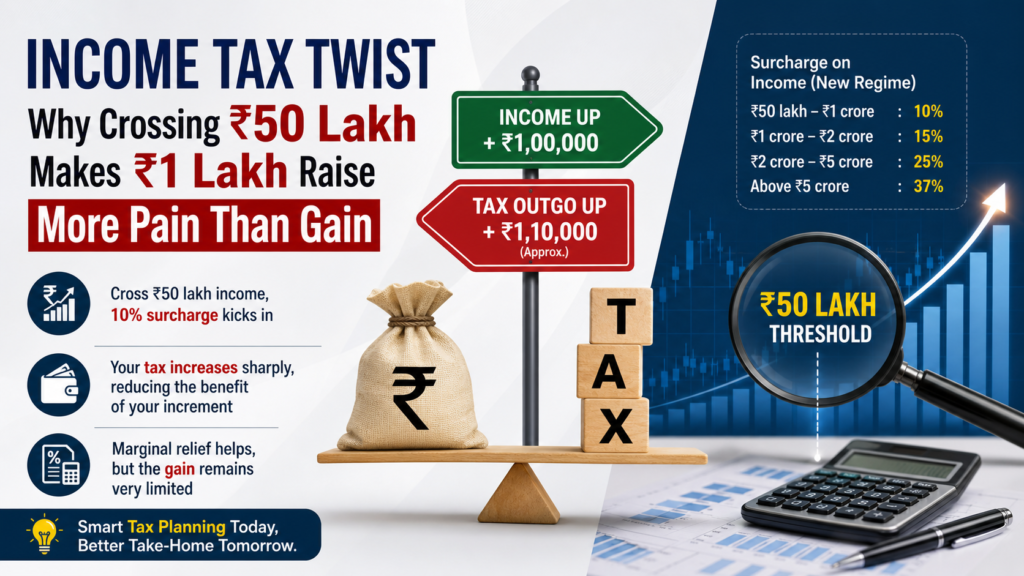
For many taxpayers in India, especially professionals and business owners in regions like Pune, Mumbai, and Lonavala, a salary hike is always welcome. However, when your total income crosses ₹50 lakh, the tax implications can turn a seemingly positive increment into a financially inefficient outcome. This “income tax twist” is becoming a highly searched topic, as taxpayers try to understand why earning more does not always mean taking home more.
What Happens When Your Income Crosses ₹50 Lakh?
Crossing ₹50 lakh triggers an additional tax burden in the form of surcharge under the Income Tax Act.
- Surcharge Applicability:
- Income ₹50 lakh to ₹1 crore → 10% surcharge
- ₹1 crore to ₹2 crore → 15%
- ₹2 crore to ₹5 crore → 25%
- Above ₹5 crore → 37% (restricted under new regime)
This surcharge is applied on the tax amount, not on income directly, which significantly increases your effective tax rate.
For example:
- Income = ₹49 lakh → No surcharge
- Income = ₹51 lakh → 10% surcharge applies on total tax
This creates a sudden jump in tax liability, reducing the benefit of the additional income.
Why a ₹1 Lakh Increment Can Feel Like a Loss
This phenomenon is often called the “marginal relief issue”.
- When income crosses ₹50 lakh:
- Your tax liability increases sharply due to surcharge
- The additional tax can sometimes be more than the extra income earned
Practical Insight:
- Increment: ₹1,00,000
- Additional tax (due to surcharge): ₹1,10,000 (approx in some cases)
- Net effect: Loss instead of gain
To address this, the government provides marginal relief, ensuring that:
- The extra tax payable does not exceed the income exceeding ₹50 lakh
However, even with marginal relief:
- The effective gain remains very limited
- The incremental benefit becomes negligible
Understanding Marginal Relief Mechanism
Marginal relief ensures fairness in taxation.
How it Works:
- It caps the additional tax payable to the amount of income exceeding ₹50 lakh
Example:
- Income: ₹51 lakh
- Excess income: ₹1 lakh
- Tax increase cannot exceed ₹1 lakh
This prevents extreme tax spikes but does not eliminate the issue entirely.
Impact on High-Income Professionals and Business Owners
This tax structure affects:
- Doctors, consultants, and freelancers
- Business owners crossing profit thresholds
- Senior corporate employees receiving bonuses
Key Implications:
- Bonuses may push income into surcharge bracket
- Poor tax planning leads to reduced net income
- Cash flow planning becomes critical
Strategic Tax Planning to Avoid the Trap
To manage this situation effectively, taxpayers should adopt structured planning:
1. Income Structuring
- Defer income where possible
- Split income across financial years
2. Use of Deductions
- Maximize deductions under:
- Section 80C
- 80D (health insurance)
- 80CCD(1B) (NPS)
3. Business Structuring
- Consider LLP/company structures for tax efficiency
- Optimize salary vs dividend mix
4. Capital Gains Planning
- Time sale of assets to avoid crossing threshold
5. Bonus Planning
- Negotiate staggered payouts instead of lump sum
What Should You Do If You Are Close to ₹50 Lakh Income?
- Review income projections before year-end
- Avoid sudden spikes due to bonuses or capital gains
- Consult us for tax optimization
- Consider switching between old vs new tax regime strategically
What is surcharge in income tax?
Surcharge is an additional tax levied on individuals whose income exceeds specified thresholds like ₹50 lakh or ₹1 crore.
Why does tax increase sharply after ₹50 lakh?
Because a 10% surcharge applies on the total tax amount once income crosses ₹50 lakh.
How does marginal relief help taxpayers?
It ensures that additional tax payable does not exceed the income exceeding ₹50 lakh.
When should taxpayers plan for surcharge impact?
Ideally before the financial year ends, especially when expecting bonuses or capital gains.
Where does this impact most taxpayers?
In high-income urban areas like Mumbai, Pune, and other metro cities where salaries and business profits frequently cross ₹50 lakh.
FAQs
1. Does surcharge apply under both old and new tax regimes?
Yes, surcharge applies under both regimes, though effective tax rates may differ.
2. Is marginal relief automatic or needs to be claimed?
It is automatically calculated while computing tax liability.
3. Can deductions reduce surcharge applicability?
Yes, reducing total income below ₹50 lakh avoids surcharge completely.
4. Does capital gain income also count for surcharge?
Yes, total income including capital gains is considered for surcharge applicability.
5. Is it better to avoid crossing ₹50 lakh?
Not necessarily, but proper tax planning is essential to ensure optimal net income.
6. Can business owners plan income to avoid surcharge?
Yes, through timing of income recognition and expense planning.