
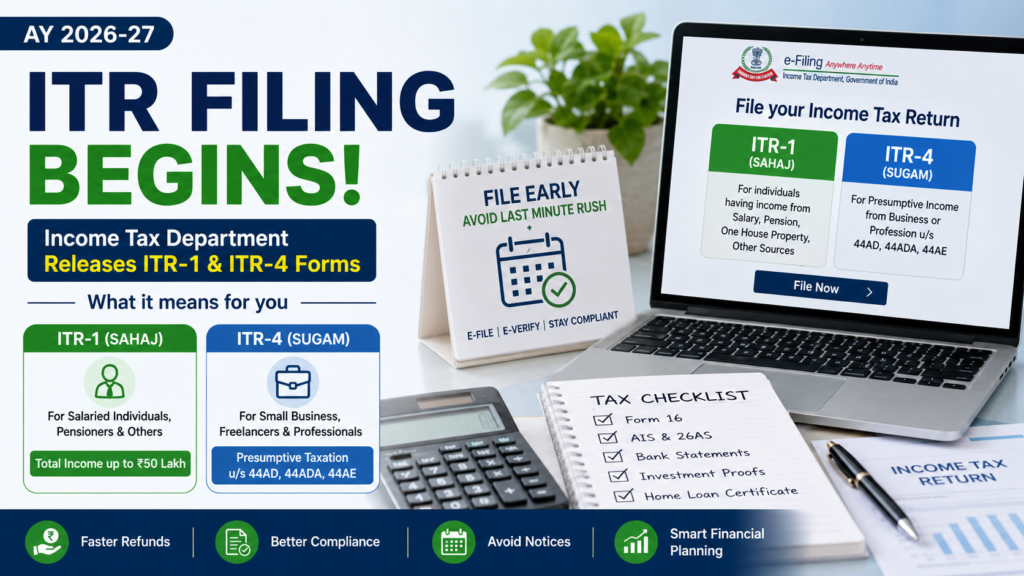
The Income Tax Return (ITR) filing season for Assessment Year (AY) 2026-27 has officially started, as the Income Tax Department has released the ITR-1 (Sahaj) and ITR-4 (Sugam) forms. This is an important update for salaried individuals, freelancers, small business owners, and professionals across India who are preparing to file their income tax returns for Financial Year (FY) 2025-26.
With the government focusing more on digital compliance, AIS reconciliation, and accurate income reporting, taxpayers in Pune, Pimpri-Chinchwad, and across Maharashtra should begin tax preparation early to avoid last-minute errors and notices. The release of ITR forms also gives clarity regarding eligibility, disclosures, and filing requirements under the old and new tax regimes.
What Does the Release of ITR-1 and ITR-4 Mean?
The notification of ITR forms means taxpayers can now begin compiling documents and preparing their income tax returns for AY 2026-27. The Income Tax Department generally releases forms in phases, beginning with simpler return forms applicable to small taxpayers.
The release of ITR-1 and ITR-4 is particularly significant because these forms cover a large portion of taxpayers in India, including:
- Salaried employees
- Pensioners
- Freelancers
- Small business owners
- Professionals under presumptive taxation
- Individuals with interest income
- Small taxpayers opting for simplified return filing
This early release helps taxpayers plan tax filing in advance instead of waiting for the deadline rush.
Who Can File ITR-1 (Sahaj)?
The ITR-1 form is one of the most commonly used income tax return forms in India. It is applicable to resident individuals having:
- Salary or pension income
- Income from one house property
- Income from other sources such as bank interest
- Total income up to ₹50 lakh
ITR-1 cannot be used by individuals having:
- Capital gains income
- Foreign assets or foreign income
- Business income
- Agricultural income above prescribed limits
- Multiple house properties
For many salaried taxpayers in Pune and nearby industrial regions, ITR-1 remains the simplest option for tax filing.
Who Can File ITR-4 (Sugam)?
ITR-4 is meant for taxpayers opting for presumptive taxation under sections 44AD, 44ADA, and 44AE of the Income Tax Act.
This form is generally suitable for:
- Small businesses
- Consultants
- Doctors
- Architects
- Freelancers
- Traders
- Transport businesses
Taxpayers with total income up to ₹50 lakh can use ITR-4 if they opt for presumptive taxation provisions.
Many MSME owners and professionals in Maharashtra prefer ITR-4 because it simplifies tax compliance and reduces detailed bookkeeping requirements.
Important Changes Taxpayers Should Watch for in AY 2026-27
The Income Tax Department has increased focus on data matching and automated verification. Taxpayers should carefully reconcile their information before filing returns.
1. AIS and Form 26AS Reconciliation
The Annual Information Statement (AIS) now captures:
- Bank interest
- Dividend income
- Mutual fund transactions
- Securities transactions
- Foreign remittances
- TDS details
Mismatch between AIS and ITR can trigger notices or defective return communications.
2. New Tax Regime Default Option
The new tax regime continues as the default regime for many taxpayers. Individuals opting for the old regime must carefully evaluate deductions and exemptions before making the choice.
Taxpayers should compare:
- Tax liability under old regime
- Tax liability under new regime
- Available deductions
- HRA, 80C, 80D benefits
- Home loan deductions
Choosing the wrong regime can increase tax outflow unnecessarily.
3. Increased Verification of High-Value Transactions
The department continues to monitor:
- Large cash deposits
- High-value property purchases
- Credit card spends
- Share trading
- Crypto transactions
- Foreign travel expenses
Proper disclosure in ITR is becoming increasingly important.
Why Early ITR Filing Is Important
Many taxpayers delay filing returns until the last moment, which often results in:
- Wrong disclosures
- Missed deductions
- AIS mismatches
- Delayed refunds
- Higher chances of notices
Filing early offers several benefits:
- Faster income tax refunds
- Better financial planning
- Easier loan processing
- Reduced compliance stress
- More time to correct errors if needed
Businesses and professionals also benefit from early tax planning and advance tax computation.
Documents Required Before Filing ITR for AY 2026-27
Before filing the return, taxpayers should keep the following documents ready:
- PAN card
- Aadhaar card
- Form 16
- Bank statements
- AIS and Form 26AS
- TDS certificates
- Investment proofs
- Home loan certificate
- Capital gains statement
- Business income records
Freelancers and professionals should also maintain:
- Invoice records
- Expense summaries
- GST details where applicable
Common Mistakes Taxpayers Should Avoid
Incorrect Tax Regime Selection
Many taxpayers forget to evaluate which regime is beneficial before filing.
Ignoring AIS Mismatches
Even small differences in interest income can trigger notices.
Wrong Bank Account Details
Incorrect account details may delay refunds.
Missing Income Disclosure
Interest income from savings accounts and FDs is often missed.
Filing Incorrect ITR Form
Using the wrong form can make the return defective.
Professional review before filing can help avoid these issues.
How Professionals and Businesses Should Prepare
For consultants, doctors, traders, and MSME owners, AY 2026-27 filing requires proper financial planning.
Important focus areas include:
- Presumptive taxation evaluation
- GST reconciliation
- TDS compliance
- Expense documentation
- Advance tax review
- Cash flow planning
Small business owners should also verify whether presumptive taxation continues to remain beneficial compared to normal taxation.
What Happens After Filing the Return?
After submitting the ITR:
- Verify the return through Aadhaar OTP, net banking, or DSC
- Track refund status
- Respond promptly to notices if any
- Preserve computation and supporting documents
An unverified return is treated as invalid, so e-verification is essential.
Frequently Asked Questions (FAQs)
What is the last date to file ITR for AY 2026-27?
The due date depends on the category of taxpayer and whether audit is applicable. Salaried individuals generally have a July deadline unless extended by the government.
Who can use ITR-1?
Resident individuals earning salary, pension, one house property income, and other income up to ₹50 lakh can generally use ITR-1.
Can freelancers file ITR-4?
Yes, eligible freelancers and professionals opting for presumptive taxation under section 44ADA can file ITR-4.
Is AIS mandatory for ITR filing?
While AIS itself is not separately filed, taxpayers should reconcile their income with AIS to avoid mismatches and notices.
Which tax regime is better for salaried employees?
It depends on deductions, exemptions, salary structure, and investments. Proper comparison should be done before filing.
Can I revise my return after filing?
Yes, revised returns can generally be filed within the prescribed timeline if mistakes are identified.
Why is professional assistance useful in ITR filing?
Professional review helps in correct form selection, tax regime comparison, deduction optimization, and reducing notice risk.