
Introduction
Determining the correct Place of Supply (POS) is one of the most important aspects of GST compliance. A wrong determination can result in charging CGST and SGST instead of IGST (or vice versa), denial of Input Tax Credit (ITC), refund disputes, interest liability, and GST notices.
For manufacturers, traders, consultants, contractors, software companies, exporters, and e-commerce businesses operating across multiple states, understanding Place of Supply provisions is essential for correct GST compliance.
This practical guide explains the most commonly applicable Place of Supply rules under the IGST Act, 2017 through examples, summary tables, and quick-reference charts.
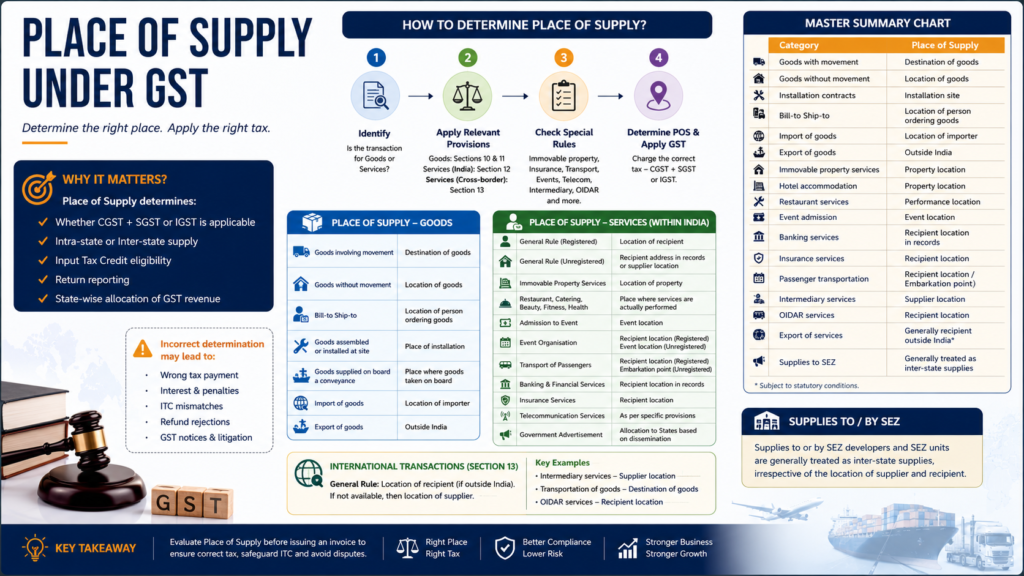
Why is Place of Supply Important?
Place of Supply determines:
- Whether CGST + SGST or IGST is applicable.
- Whether a transaction is intra-state or inter-state.
- Eligibility of Input Tax Credit.
- Reporting in GST returns.
- State-wise allocation of GST revenue.
Incorrect determination may lead to:
- Wrong tax payment.
- Interest and penalties.
- ITC mismatches.
- Refund rejections.
- Customer disputes.
- GST litigation.
Quick Decision Tree for Determining Place of Supply
Step 1
Identify whether the transaction involves:
- Goods, or
- Services
Step 2
For Goods:
- Apply Place of Supply provisions relating to goods.
For Services:
- Determine whether both supplier and recipient are located in India or whether the transaction involves a cross-border element.
Step 3
Check whether any special rule applies.
Examples:
- Immovable property
- Installation contracts
- Hotel accommodation
- Event services
- Transportation services
- Banking services
- Insurance services
- Telecom services
- Intermediary services
- OIDAR services
Step 4
Determine the Place of Supply and charge the correct GST.
Understanding Intra-State and Inter-State Supplies
Intra-State Supply
Generally, when the Location of Supplier and Place of Supply are in the same State or Union Territory, the transaction is treated as an intra-state supply and attracts:
- CGST
- SGST/UTGST
Inter-State Supply
Generally, when the Location of Supplier and Place of Supply are in different States or Union Territories, the transaction is treated as an inter-state supply and attracts:
- IGST
However, supplies to or by Special Economic Zones (SEZs), imports, exports, and certain other transactions specifically covered under the IGST Act are treated as inter-state supplies irrespective of the above general rule.
Place of Supply for Goods
1. Goods Involving Movement
Where goods are transported from one location to another, the Place of Supply is the location where the movement of goods terminates for delivery.
Example
Supplier: Maharashtra
Recipient: Karnataka
Delivery Location: Karnataka
Place of Supply: Karnataka
Tax Applicable: IGST
2. Goods Not Involving Movement
Where goods are not moved, the Place of Supply is the location of the goods at the time of delivery.
Example
A machine installed in Gujarat is sold without movement.
Place of Supply: Gujarat
3. Bill-to Ship-to Transactions
A special deeming provision applies where goods are delivered to a third person on the instructions of the buyer.
Example
A company in Maharashtra places an order on a supplier in Gujarat and instructs the supplier to directly deliver the goods to its customer in Tamil Nadu.
For the supply between the supplier and the Maharashtra company:
Place of Supply = Maharashtra.
The subsequent supply between the Maharashtra company and the Tamil Nadu customer is examined separately under the normal Place of Supply provisions.
4. Goods Assembled or Installed at Site
Where goods are assembled or installed at a site, the Place of Supply is the location of installation.
Example
A machinery manufacturer from Pune installs equipment at a factory in Gujarat.
Place of Supply: Gujarat
5. Goods Supplied on Board a Conveyance
Where goods are supplied on board a vessel, aircraft, train, or motor vehicle, the Place of Supply is the location where the goods were taken on board.
Example
Food loaded in Mumbai and sold during a flight.
Place of Supply: Maharashtra
Import and Export of Goods
Import of Goods
Place of Supply = Location of Importer.
Export of Goods
Place of Supply = Outside India.
Exports are treated as zero-rated supplies subject to fulfillment of prescribed conditions.
Quick Reference Chart – Goods
| Type of Supply | Place of Supply |
|---|---|
| Goods involving movement | Location where movement terminates |
| Goods without movement | Location of goods at delivery |
| Bill-to Ship-to | Location of person ordering goods |
| Goods installed at site | Place of installation |
| Goods supplied on board conveyance | Place where goods taken on board |
| Import of goods | Location of importer |
| Export of goods | Outside India |
Place of Supply for Services Within India
General Rule
Registered Recipient
Place of Supply = Location of Recipient.
Unregistered Recipient
Place of Supply = Address of recipient available in supplier’s records.
If address is unavailable:
Place of Supply = Location of Supplier.
Services Related to Immovable Property
Includes:
- Construction services
- Architectural services
- Interior decoration
- Property management
- Hotel accommodation
- Guest houses
- Resorts
- Clubs
- Campsites
- Houseboats
Place of Supply = Location of Property.
Example
A Pune-based architect designs a hotel in Goa.
Place of Supply: Goa
Restaurant and Catering Services
Place of Supply = Location where services are actually performed.
Personal Grooming, Beauty, Fitness and Health Services
Includes:
- Salons
- Beauty parlours
- Fitness centres
- Health clubs
Place of Supply = Location where services are actually performed.
Training and Performance Appraisal Services
Registered Recipient
Place of Supply = Recipient Location.
Unregistered Recipient
Place of Supply = Place where services are actually performed.
Admission to Events
Includes:
- Conferences
- Exhibitions
- Trade fairs
- Sporting events
- Cultural events
Place of Supply = Event Location.
Organisation of Events
Registered Recipient
Place of Supply = Recipient Location.
Unregistered Recipient
Place of Supply = Event Location.
Passenger Transportation Services
Registered Recipient
Place of Supply = Recipient Location.
Unregistered Recipient
Place of Supply = Place where the passenger embarks on the conveyance for a continuous journey.
Services on Board a Conveyance
Place of Supply = First scheduled point of departure of the conveyance.
Banking and Financial Services
Place of Supply = Location of Recipient available in the records of the supplier.
If such location is unavailable:
Place of Supply = Location of Supplier.
Insurance Services
Registered Recipient
Place of Supply = Recipient Location.
Unregistered Recipient
Place of Supply = Location of Recipient available in supplier’s records.
Telecommunication Services
Telecommunication services are governed by special Place of Supply provisions depending on the nature of the service, such as:
- Fixed line connections
- Mobile post-paid services
- Mobile pre-paid services
- DTH services
- Internet leased circuits
Businesses should evaluate the specific telecom provision applicable to the transaction.
Advertisement Services to Government
Where advertisement services are provided to the Central Government, State Government, statutory bodies, or local authorities and the advertisement is disseminated across multiple States, the Place of Supply is allocated to the respective States in proportion to dissemination.
Quick Reference Chart – Services Within India
| Service Type | Place of Supply |
|---|---|
| General Rule (Registered) | Recipient Location |
| General Rule (Unregistered) | Recipient Address / Supplier Location |
| Immovable Property | Property Location |
| Restaurant & Catering | Performance Location |
| Beauty/Fitness/Health | Performance Location |
| Training (Registered) | Recipient Location |
| Training (Unregistered) | Performance Location |
| Admission to Event | Event Location |
| Event Organisation | Recipient Location / Event Location |
| Passenger Transportation | Recipient Location / Embarkation Point |
| Banking Services | Recipient Location on Records |
| Insurance Services | Recipient Location |
| Telecom Services | Special Rules |
| Government Advertisement | State-wise Allocation |
Place of Supply for International Transactions
Where either the supplier or recipient is located outside India, special Place of Supply provisions apply.
General Rule
Place of Supply = Location of Recipient.
If recipient location is unavailable:
Place of Supply = Location of Supplier.
Services Related to Goods
Where services are performed on goods physically made available by the recipient:
Place of Supply = Place where services are actually performed.
Services Related to Immovable Property
Place of Supply = Location of Property.
Admission to Events
Place of Supply = Place where the event is actually held.
Banking Services
Place of Supply = Location of Supplier.
Intermediary Services
Place of Supply = Location of Supplier.
Example
An Indian commission agent facilitates a transaction between a foreign buyer and a foreign seller.
Place of Supply = India.
Such transactions generally do not qualify as exports merely because the customer is located outside India.
Short-Term Hiring of Means of Transport
Place of Supply = Location of Supplier.
Transportation of Goods
Place of Supply = Destination of Goods.
OIDAR Services
Online Information and Database Access or Retrieval (OIDAR) services include:
- Cloud computing
- Streaming platforms
- SaaS software
- Online databases
- Digital subscriptions
Place of Supply = Location of Recipient.
Special compliance provisions may apply where foreign suppliers provide OIDAR services to non-taxable online recipients in India.
Export of Services – A Frequently Litigated Area
Many businesses assume that invoicing a foreign customer automatically qualifies a transaction as an export of services. This is incorrect.
A service qualifies as an export only when all conditions prescribed under GST law are satisfied, including the condition that the Place of Supply is outside India.
Merely receiving payment in foreign currency does not automatically make a transaction an export of services.
Businesses providing consultancy, software development, marketing support, commission agency services, and other cross-border services should carefully evaluate the Place of Supply provisions before claiming export benefits.
Supplies to or by SEZ Units
Under the IGST Act, supplies to or by a Special Economic Zone (SEZ) developer or SEZ unit are generally treated as inter-state supplies irrespective of the location of the supplier and recipient.
Businesses dealing with SEZ units should evaluate the special GST provisions applicable to such transactions.
Software, SaaS and Cloud-Based Services
With the rapid growth of digital businesses, Place of Supply provisions have become increasingly important for software companies.
Example
A software company in Pune provides cloud-based software access to a customer in Karnataka.
The Place of Supply is generally determined based on the applicable provisions relating to the location of the recipient and the nature of the service being supplied.
Businesses offering SaaS products, cloud platforms, subscriptions, and digital solutions should carefully examine the Place of Supply implications before invoicing customers.
Master Place of Supply Summary Chart
| Category | Place of Supply |
|---|---|
| Goods with movement | Destination of goods |
| Goods without movement | Location of goods |
| Installation contracts | Installation site |
| Bill-to Ship-to | Location of person ordering goods |
| Import of goods | Location of importer |
| Export of goods | Outside India |
| Immovable property services | Property location |
| Hotel accommodation | Property location |
| Restaurant services | Performance location |
| Event admission | Event location |
| Banking services | Recipient location in records |
| Insurance services | Recipient location |
| Passenger transportation | Recipient location / Embarkation point |
| Intermediary services | Supplier location |
| OIDAR services | Recipient location |
| Export of services | Generally recipient outside India, subject to statutory conditions |
| Supplies to SEZ | Generally treated as inter-state supplies |
Common GST Notice Triggers Related to Place of Supply
GST authorities frequently scrutinize:
- Incorrect charging of IGST instead of CGST and SGST.
- Incorrect charging of CGST and SGST instead of IGST.
- Wrong treatment of export transactions.
- Incorrect classification of intermediary services.
- Errors in bill-to ship-to transactions.
- Wrong GST treatment of installation contracts.
- Incorrect Place of Supply for software and digital services.
- Event management transactions conducted across multiple States.
- Supplies involving SEZ units.
Frequently Asked Questions (FAQs)
1. Is GST applicable if my client is located outside India?
Not necessarily. The GST treatment depends on whether the transaction qualifies as an export of services and whether all prescribed conditions under GST law are satisfied.
2. What is the Place of Supply for software and SaaS services?
The Place of Supply depends on the nature of the service and the applicable GST provisions, but in many cases it is linked to the location of the recipient.
3. Are intermediary services treated as exports?
Not automatically. Under the Place of Supply provisions, intermediary services often have the Place of Supply at the supplier’s location, which may affect export eligibility.
4. How is GST charged in bill-to ship-to transactions?
A special deeming provision applies. The Place of Supply for the supplier-to-buyer transaction is generally the location of the person who places the order.
5. What happens if I charge CGST and SGST instead of IGST?
The taxpayer may need to correct the tax treatment, pay the appropriate tax, and seek refund or adjustment of the tax incorrectly paid, subject to GST provisions.
6. What is the Place of Supply for hotel accommodation services?
The Place of Supply is generally the location of the hotel, resort, guest house, campsite, or other accommodation property.
7. Are supplies to SEZ units treated as inter-state supplies?
Yes. Supplies to or by SEZ developers and SEZ units are generally treated as inter-state supplies under the IGST Act.
Conclusion
Place of Supply is the foundation of GST taxation and directly impacts the type of GST to be charged, ITC eligibility, refund claims, and overall compliance. While the general rules are relatively straightforward, special provisions apply to immovable property, accommodation services, events, transportation, banking, insurance, telecom services, software services, intermediary services, exports, imports, and SEZ transactions. Businesses should evaluate Place of Supply implications before issuing invoices to avoid disputes, safeguard Input Tax Credit, and ensure accurate GST compliance.