
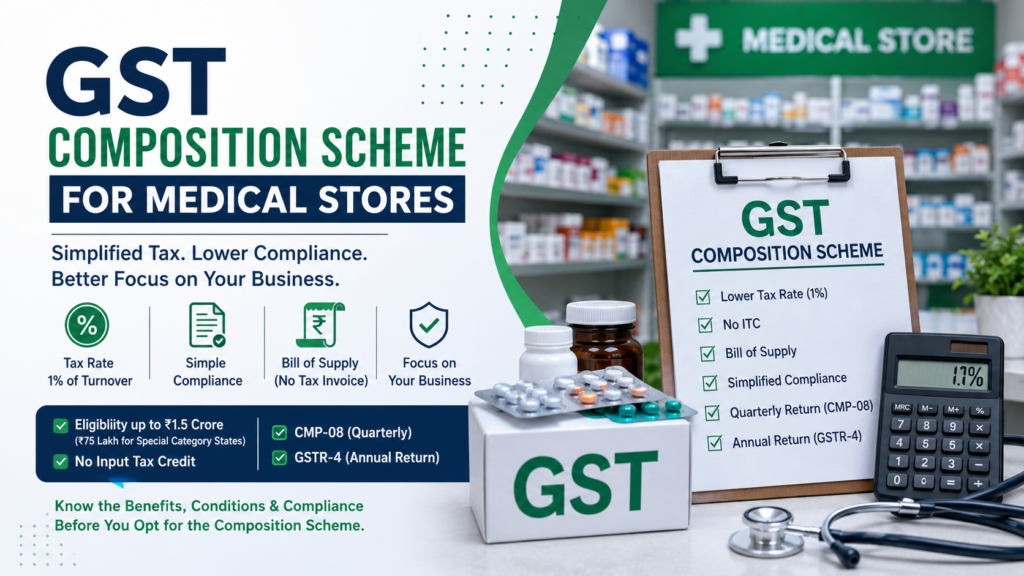
Running a medical store involves much more than dispensing medicines. Pharmacy owners must manage inventory with varying GST rates, comply with drug regulations, maintain proper records, and ensure timely GST compliance. For small and medium-sized medical stores, the GST Composition Scheme appears to be an attractive option because of its simplified tax compliance. However, choosing the scheme without understanding its implications can adversely affect profitability, particularly due to the loss of Input Tax Credit (ITC).
If you own a pharmacy, chemist shop, or retail medical store in Pune, PCMC, Chakan, Bhosari, or anywhere in India, this guide explains whether the GST Composition Scheme is suitable for your business, the conditions for eligibility, applicable tax rate, compliance requirements, and the practical factors to consider before opting for the scheme.
What is the GST Composition Scheme?
The GST Composition Scheme is a simplified taxation mechanism introduced under Section 10 of the Central Goods and Services Tax (CGST) Act, 2017 for eligible small taxpayers.
Instead of paying GST at the normal rates applicable to individual products and claiming Input Tax Credit (ITC), a composition taxpayer pays tax at a prescribed percentage of turnover and follows a simplified compliance mechanism.
The scheme is primarily intended to reduce the compliance burden for small businesses that predominantly deal with end consumers.
Can a Medical Store Opt for the GST Composition Scheme?
Yes. A retail medical store dealing in taxable medicines can opt for the GST Composition Scheme, provided it satisfies the prescribed eligibility conditions under the GST law.
A medical store is generally treated as a supplier of goods (trader) and is eligible to pay GST under the composition scheme applicable to traders.
However, before opting for the scheme, pharmacy owners should carefully evaluate the impact of losing Input Tax Credit, customer profile, business expansion plans, and procurement costs.
Eligibility Conditions for Medical Stores
A medical store can opt for the Composition Scheme if:
- Its aggregate turnover in the preceding financial year does not exceed ₹1.5 crore (₹75 lakh for specified Special Category States).
- It complies with the conditions prescribed under Section 10 of the CGST Act and the CGST Rules.
- All registrations obtained under the same Permanent Account Number (PAN) opt for the Composition Scheme together.
- It is not engaged in activities that make it ineligible under the GST law.
Eligibility should be reviewed every financial year before exercising the option.
GST Rate Applicable to Medical Stores under the Composition Scheme
Medical stores fall under the category of traders.
| Particulars | Composition Scheme |
|---|---|
| Category | Trader / Supplier of Goods |
| GST Rate | 1% of turnover (0.5% CGST + 0.5% SGST) |
| Input Tax Credit | Not available |
| GST Collection from Customers | Not permitted |
| Tax Invoice | Not allowed |
| Bill of Supply | Mandatory |
The composition tax is payable out of the dealer’s own pocket and cannot be collected separately from customers.
Major Benefits of the Composition Scheme for Medical Stores
1. Simplified GST Compliance
The scheme significantly reduces the compliance burden compared to the regular GST scheme.
Composition taxpayers are generally required to furnish:
- Form GST CMP-08 (quarterly statement-cum-payment)
- Form GSTR-4 (annual return)
This is substantially simpler than the return filing requirements applicable under the regular scheme.
2. Easier Accounting
Since Input Tax Credit is not available, there is no need for complex ITC reconciliations, vendor follow-ups, or matching of purchase invoices for ITC purposes.
This is particularly beneficial for small standalone pharmacies with limited accounting resources.
3. Predictable Tax Liability
The tax payable is calculated as a fixed percentage of turnover, making tax planning simpler.
4. Lower Compliance Cost
Reduced return filing and simplified record maintenance often lower professional and administrative costs.
Major Disadvantages Every Pharmacy Owner Should Understand
The Composition Scheme is not always the most economical option.
No Input Tax Credit
This is the most significant drawback.
Medical stores typically purchase medicines and related products attracting GST at rates such as 5%, 12%, and 18%.
Under the Composition Scheme:
- GST paid on purchases cannot be claimed as Input Tax Credit.
- The tax paid becomes part of the purchase cost.
- Profit margins may reduce unless selling prices are adjusted.
For pharmacies with substantial taxable purchases, the loss of ITC can outweigh the compliance benefits.
GST Cannot Be Collected Separately
Composition dealers cannot charge GST separately on their invoices.
Instead, they must issue a Bill of Supply.
Consequently, the composition tax is borne by the business itself.
Limited Appeal for Business Customers
Hospitals, nursing homes, clinics, diagnostic centres, and other GST-registered recipients generally prefer purchasing from regular taxpayers because they can claim Input Tax Credit only when the supplier issues a valid tax invoice charging GST.
Since a composition dealer issues a Bill of Supply, the recipient cannot claim ITC on such purchases.
Business Expansion May Become Difficult
As businesses grow, requirements such as interstate supplies, institutional customers, or expansion into multiple States may make the regular GST scheme more suitable.
Compliance Requirements for Composition Medical Stores
A medical store registered under the Composition Scheme should:
- Issue Bills of Supply instead of tax invoices.
- Mention the prescribed declaration on the Bill of Supply.
- Pay composition tax within the prescribed timelines.
- Furnish Form GST CMP-08 every quarter.
- File Form GSTR-4 annually.
- Display the words “Composition Taxable Person” prominently at every place of business.
- Mention “Composition Taxable Person” on every Bill of Supply as prescribed.
Failure to comply may result in penalties or denial of composition benefits.
How to Opt for the Composition Scheme
Existing registered taxpayers can opt for the Composition Scheme by filing Form GST CMP-02 within the prescribed time before the beginning of the financial year from which the option is intended to be exercised.
A person applying for fresh GST registration may also opt for the Composition Scheme at the time of obtaining registration, subject to fulfilling the prescribed conditions.
Businesses should evaluate the financial impact before exercising the option, as switching between schemes affects Input Tax Credit eligibility and pricing strategy.
Practical Illustration
Consider a retail medical store having:
- Annual aggregate turnover: ₹90 lakh
- Majority of customers: Individual retail consumers
- GST paid on purchases during the year: Significant due to procurement of medicines and healthcare products
If the store opts for the Composition Scheme:
- Composition tax is payable at 1% of turnover.
- GST cannot be collected separately from customers.
- Input Tax Credit on purchases is not available.
If the store remains under the Regular Scheme:
- GST is charged on outward supplies at applicable rates.
- Eligible Input Tax Credit on purchases can be claimed.
- Net tax liability depends upon the output tax collected and eligible ITC available.
Accordingly, merely comparing tax rates is insufficient. The decision should be based on a detailed financial analysis of purchase taxes, gross margins, customer profile, and business model.
Composition Scheme vs Regular GST Scheme
| Particular | Composition Scheme | Regular Scheme |
|---|---|---|
| GST Collection | Not permitted | Permitted |
| Input Tax Credit | Not available | Available (subject to conditions) |
| Tax Invoice | No | Yes |
| Bill of Supply | Yes | No |
| GST Rate | Fixed 1% of turnover | Product-wise GST rates |
| Quarterly Compliance | Simpler | Comparatively higher |
| Suitable for Retail Consumers | Yes | Yes |
| Suitable for Institutional Buyers | Usually less preferred | More suitable |
Which Medical Stores Should Consider the Composition Scheme?
The scheme may be suitable where:
- Customers are predominantly walk-in retail consumers.
- Business is confined largely to one State.
- Annual aggregate turnover remains within the prescribed limit.
- Compliance simplicity is a priority.
- The financial impact of foregoing ITC is not significant.
When is the Regular GST Scheme Generally Better?
The regular scheme is generally more appropriate where:
- Purchases involve substantial GST resulting in significant Input Tax Credit.
- Customers include hospitals, nursing homes, diagnostic centres, clinics, companies, or other GST-registered businesses.
- Business expansion is planned.
- Institutional supplies form a major portion of turnover.
- Detailed profitability analysis indicates that ITC benefits exceed the compliance savings under the Composition Scheme.
Common Mistakes Made by Medical Store Owners
Many pharmacy owners opt for the Composition Scheme solely because the tax rate appears lower. However, the following mistakes can prove costly:
- Ignoring the loss of Input Tax Credit on purchases.
- Comparing only tax rates without analysing overall profitability.
- Assuming compliance requirements are completely eliminated.
- Not reviewing eligibility conditions every financial year.
- Failing to issue Bills of Supply instead of tax invoices.
- Not displaying the mandatory “Composition Taxable Person” declaration at the place of business.
- Opting for the scheme without considering future business expansion.
A professional comparison of both schemes before opting can prevent unnecessary tax costs.
Decision Matrix for Pharmacy Owners
| Business Profile | Generally More Suitable |
|---|---|
| Small neighbourhood pharmacy selling mainly to retail consumers | Composition Scheme (subject to ITC analysis) |
| Pharmacy supplying hospitals or corporate customers | Regular GST Scheme |
| Wholesale medicine distributor | Regular GST Scheme |
| Pharmacy claiming substantial Input Tax Credit | Regular GST Scheme |
| Pharmacy planning significant business expansion | Regular GST Scheme |
Should every medical store opt for the GST Composition Scheme because the tax rate is only 1%?
No. The composition tax rate of 1% should not be the sole deciding factor. Pharmacy owners should compare the loss of Input Tax Credit, customer profile, pricing strategy, purchase GST, compliance costs, and future business plans before opting for the scheme. In many cases, the Regular GST Scheme may result in a lower effective tax cost despite higher compliance requirements.
Frequently Asked Questions
1. Can a medical store claim Input Tax Credit under the Composition Scheme?
No. A composition taxpayer cannot claim Input Tax Credit on purchases. The GST paid on medicines and other inputs becomes part of the cost.
2. Can a medical store issue a GST tax invoice under the Composition Scheme?
No. A composition dealer must issue a Bill of Supply and cannot collect GST separately from customers.
3. Can hospitals claim ITC on medicines purchased from a composition dealer?
No. Since the supplier issues a Bill of Supply instead of a tax invoice charging GST, the recipient cannot claim Input Tax Credit on such purchases.
4. What GST returns are required under the Composition Scheme?
Composition taxpayers are generally required to furnish Form GST CMP-08 every quarter and Form GSTR-4 annually.
5. Can a medical store switch from the Composition Scheme to the Regular Scheme?
Yes. A taxpayer may voluntarily switch to the Regular Scheme or may be required to do so upon becoming ineligible for the Composition Scheme, subject to the provisions of the GST law.
6. Is the Composition Scheme always beneficial for small pharmacies?
Not necessarily. While compliance is simpler, the loss of Input Tax Credit may increase the overall tax cost. A comparative financial analysis should be undertaken before exercising the option.
7. What should a pharmacy evaluate before opting for the Composition Scheme?
A pharmacy should assess its aggregate turnover, customer profile, purchase GST, expected ITC, pricing strategy, future expansion plans, and overall profitability before deciding between the Composition Scheme and the Regular GST Scheme.
Conclusion
The GST Composition Scheme offers a simplified compliance framework for eligible medical stores and can be an effective option for small retail pharmacies serving primarily end consumers. However, its apparent simplicity should not overshadow the financial implications of foregoing Input Tax Credit and the inability to issue tax invoices charging GST.
For every medical store, the decision should be based on a detailed comparison of the Composition Scheme and the Regular GST Scheme, taking into account purchase patterns, customer base, margins, and long-term business objectives. A professional evaluation before opting for the scheme can help ensure both GST compliance and sustained profitability.