
Selling a residential property and reinvesting the capital gains into a new home is one of the most common tax-saving strategies under the Income Tax Act. However, many taxpayers worry that an unforeseen delay in construction may lead to the denial of their tax exemption.
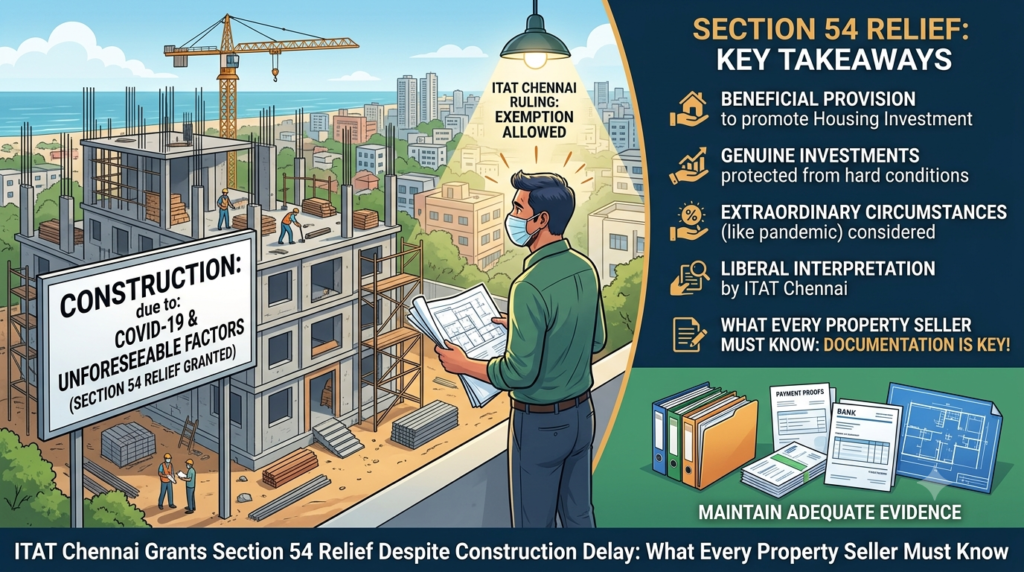
A recent decision by the Income Tax Appellate Tribunal (ITAT), Chennai, has brought significant relief to taxpayers. The Tribunal ruled that a genuine delay in completing the construction of a residential house—caused by extraordinary circumstances such as the COVID-19 pandemic—should not automatically result in the denial of the Section 54 exemption. This ruling provides valuable guidance for property owners across India, including taxpayers in Pune, PCMC, Pimpri-Chinchwad, and Maharashtra.
What Was the Case About?
The taxpayer sold a residential property in Noida and earned a long-term capital gain of approximately ₹5.59 lakh. He purchased a plot of land in Chennai and invested in constructing a residential house, claiming exemption under Section 54.
However, the construction was delayed due to the COVID-19 lockdown, labour shortages, and other unavoidable disruptions. Since the house was not completed within the prescribed three-year period, the Income Tax Department rejected his Section 54 claim during reassessment proceedings.
The taxpayer challenged the assessment before the ITAT Chennai, which ruled in his favour and directed the Assessing Officer to allow the exemption.
Why Did ITAT Allow the Section 54 Exemption?
The Tribunal observed that:
- Section 54 is a beneficial provision intended to promote investment in residential housing.
- The taxpayer had genuinely invested in purchasing land and constructing a residential house.
- The delay was caused by extraordinary circumstances beyond the taxpayer’s control.
- A liberal and purposive interpretation of the law should be adopted instead of a hyper-technical approach.
Accordingly, the Tribunal held that the exemption should not be denied merely because the construction was completed after the statutory period due to circumstances such as the COVID-19 pandemic.
Key Lessons for Taxpayers
This judgment highlights several practical points:
- Maintain complete documentation of land purchase and construction.
- Preserve invoices, contractor bills, payment proofs, and bank statements.
- Keep evidence of reasons for construction delays.
- Demonstrate a genuine intention to construct a residential house.
- Seek professional tax advice before selling or purchasing property.
Proper documentation often becomes the deciding factor during assessment proceedings.
Does This Mean Every Delay Will Be Accepted?
No.
The ruling does not imply that every delayed construction will qualify for Section 54 relief.
Each case depends upon its facts, including:
- Whether the investment was genuine.
- Whether the taxpayer acted diligently.
- Whether the delay was beyond the taxpayer’s control.
- Whether sufficient documentary evidence is available.
Taxpayers should therefore avoid assuming that every delay will automatically receive similar treatment.
Another Important Relief in the Same Case
Apart from Section 54, the Tribunal also deleted an addition made under Section 56(2)(x).
The stamp duty value of the property exceeded the purchase price by approximately 7.86%. Since the difference was within the 10% tolerance limit, the Tribunal held that no addition should be made under Section 56(2)(x). This is another important takeaway for buyers of immovable property.
Practical Tips Before Claiming Section 54
Before claiming the exemption, ensure that you:
- Understand the applicable timelines under Section 54.
- Maintain complete records of investments and construction expenses.
- Preserve approvals, plans, and correspondence with contractors.
- Consider depositing unutilised capital gains in the Capital Gains Account Scheme wherever applicable.
- Consult a Chartered Accountant before filing your Income Tax Return.
Proper planning can prevent costly litigation later.
What Does This Judgment Mean for Homeowners?
The ITAT Chennai decision reinforces that the objective of Section 54 is to encourage investment in residential housing rather than penalise genuine taxpayers facing unavoidable hardships. While every case depends on its facts, this ruling demonstrates that courts are willing to adopt a practical and equitable interpretation where the taxpayer has acted bona fide and maintained adequate evidence.
Frequently Asked Questions (FAQs)
1. Can I claim Section 54 if I purchase land and construct a house?
Yes. Section 54 permits exemption where the taxpayer constructs a residential house within the prescribed conditions, subject to compliance with the law.
2. Will a construction delay automatically cancel my Section 54 exemption?
Not necessarily. Courts may consider genuine reasons supported by evidence, especially where the delay is beyond the taxpayer’s control.
3. Is a Completion Certificate mandatory for claiming Section 54?
The law primarily requires investment in a residential house within the prescribed framework. Whether exemption is available depends on the facts and judicial interpretation applicable to each case.
4. What documents should I preserve for a Section 54 claim?
Keep the sale deed, purchase deed, construction bills, bank statements, contractor invoices, municipal approvals, and other supporting records.
5. What is the Capital Gains Account Scheme?
It is a notified scheme that allows taxpayers to temporarily park unutilised capital gains where immediate investment is not possible, subject to prescribed conditions.
6. Does this ITAT ruling apply automatically to every taxpayer?
No. Tribunal decisions are based on the facts of each case. Similar relief depends upon the taxpayer’s circumstances and supporting evidence.
7. Should I consult a Chartered Accountant before claiming Section 54?
Definitely. Professional advice helps ensure compliance with the law, proper documentation, and timely tax planning, thereby reducing the risk of disputes with the Income Tax Department.