
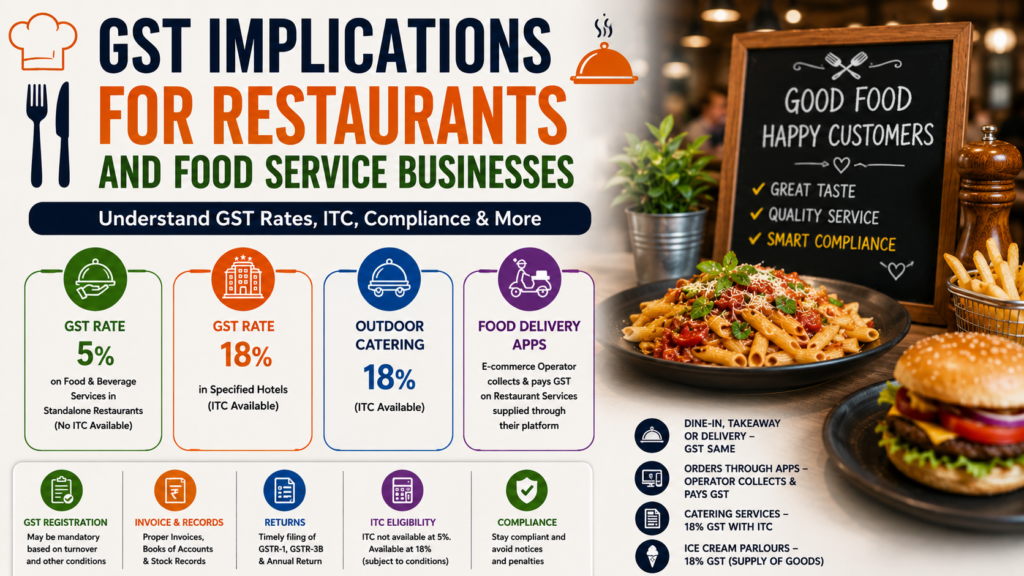
Running a restaurant involves much more than serving delicious food. Restaurant owners must also comply with various GST provisions related to tax rates, input tax credit (ITC), invoicing, registration, food delivery platforms, takeaway orders, and catering services. Understanding these rules is essential to avoid unnecessary tax demands and penalties.
Whether you operate a fine-dining restaurant, café, cloud kitchen, bakery, food truck, quick service restaurant (QSR), or a chain of outlets, knowing the GST implications can significantly improve compliance and pricing decisions. This guide explains the GST provisions applicable to restaurants and food service businesses in simple language while highlighting practical issues faced by restaurant owners.
Which Businesses Are Covered?
GST provisions discussed in this article apply to:
- Restaurants
- Cafés
- Cloud Kitchens
- Fast Food Outlets
- Fine Dining Restaurants
- Food Courts
- Food Trucks
- Bakeries serving prepared food
- Ice Cream Parlours (special treatment)
- Outdoor Caterers
- Hotel Restaurants
- Messes and Canteens
- Sweet Shops supplying prepared food
GST Rate Applicable to Restaurants
The GST rate depends upon the nature of the establishment.
| Type of Business | GST Rate | ITC Available |
|---|---|---|
| Standalone Restaurant | 5% | No |
| Restaurant in Specified Hotels (room tariff above the notified threshold) | 18% | Yes |
| Outdoor Catering | 18% | Yes |
| Ice Cream Parlours supplying manufactured ice cream | 18% | Yes (subject to conditions) |
Important Note
Most standalone restaurants charge 5% GST without Input Tax Credit (ITC). This is the most common taxation scheme applicable across India.
Understanding the 5% GST Scheme
Under this scheme:
- GST is charged at 5%.
- No Input Tax Credit is available.
- GST paid on purchases becomes part of the business cost.
- Restaurant owners cannot claim credit of GST paid on:
- Kitchen equipment
- Furniture
- Crockery
- Raw materials
- Packaging materials
- Housekeeping supplies
- Rent
- Professional services
Consequently, businesses should appropriately factor this embedded tax cost into their pricing strategy.
Restaurants Eligible for 18% GST
Certain restaurants charge GST at 18% and are entitled to claim ITC.
Typically, this applies where restaurant services are supplied in hotels having room accommodation above the threshold prescribed under GST notifications (the threshold has changed through various notifications over time and should be verified based on the applicable period).
Businesses under this category can claim ITC on eligible business expenses, thereby reducing the cascading tax burden.
GST on Dine-In, Takeaway and Home Delivery
One of the most common questions is whether GST differs based on how food is supplied.
| Nature of Supply | GST Treatment |
|---|---|
| Dine-In | Restaurant GST applicable |
| Takeaway | Same as restaurant service |
| Self Pickup | Same as takeaway |
| Home Delivery by Restaurant | Same as restaurant service |
The mode of delivery generally does not change the GST rate applicable to restaurant services.
GST on Orders Through Food Delivery Apps
Food delivery through aggregators has undergone significant GST changes.
For orders placed through e-commerce operators such as food delivery platforms:
- The e-commerce operator is generally liable to collect and deposit GST on restaurant services supplied through its platform, subject to the applicable GST provisions.
- Restaurants continue to issue documents and maintain records as prescribed.
- Sales made directly by the restaurant (walk-in or own website/app) continue to follow the normal GST provisions applicable to the restaurant.
Restaurant owners should reconcile platform reports with their books regularly to ensure proper compliance.
GST Registration for Restaurants
A restaurant is generally required to obtain GST registration when liable under the GST law.
Registration may become mandatory in cases such as:
- Turnover exceeding the prescribed threshold.
- Supply through an e-commerce operator where registration is required under the applicable provisions.
- Interstate taxable supplies, where applicable.
- Other situations requiring compulsory registration under Section 24 of the CGST Act (subject to applicable exemptions and amendments).
Restaurant owners should review the latest provisions before assuming that registration is not required.
Can Restaurants Opt for Composition Scheme?
Restaurants are among the businesses eligible for the Composition Scheme, subject to satisfying the prescribed conditions and turnover limits.
Benefits include:
- Lower tax rate under the Composition Scheme.
- Simpler compliance.
- Reduced return filing requirements.
However:
- No Input Tax Credit.
- Cannot collect tax separately from customers.
- Subject to turnover limits and other restrictions prescribed under GST law.
Businesses should evaluate whether the Composition Scheme or the regular scheme is more beneficial based on their business model.
Input Tax Credit Available to Restaurants
Restaurants Paying 5% GST
Input Tax Credit is not available.
Examples include GST paid on:
- Vegetables
- Grocery purchases
- Cooking oil
- Kitchen equipment
- Air conditioners
- Furniture
- Rent
- Consultancy
- Cleaning materials
This GST becomes a cost to the business.
Restaurants Paying 18% GST
Eligible ITC may generally be claimed on:
- Kitchen equipment
- Refrigerators
- Commercial ovens
- Furniture
- Interior work
- Professional fees
- Housekeeping services
- Security services
- Maintenance
- Advertising
- Rent (subject to eligibility)
All normal ITC conditions under Sections 16 and 17 of the CGST Act continue to apply.
GST on Catering Services
Outdoor catering is generally taxable at 18% GST with ITC, unless covered by a specific exemption or concessional notification.
Examples include:
- Wedding catering
- Corporate catering
- Industrial canteens
- Event catering
- Institutional catering
Businesses should carefully distinguish restaurant services from catering services, as the GST implications differ.
GST on Cloud Kitchens
Cloud kitchens are treated similarly to restaurants for GST purposes.
Accordingly:
- Restaurant GST provisions apply.
- Sales through food delivery platforms are governed by the e-commerce operator provisions.
- Direct orders follow the normal GST treatment applicable to the restaurant.
Cloud kitchen operators should maintain separate records for platform sales and direct sales.
GST on Ice Cream Parlours
A significant distinction exists between restaurants and ice cream parlours.
An ice cream parlour supplying pre-manufactured ice cream is generally treated as supplying goods rather than restaurant services. Accordingly, such supplies attract 18% GST, and the supplier may be eligible for ITC subject to the GST provisions.
This distinction has important pricing and compliance implications.
Common GST Compliance Requirements
Restaurant businesses should ensure timely compliance with:
- GST Registration
- Tax Invoice issuance
- E-Invoicing (where applicable)
- E-Way Bill (where applicable)
- GSTR-1
- GSTR-3B
- Annual Return (where applicable)
- Books of Accounts
- Purchase Reconciliation
- ITC Reconciliation
- GST Payment
Frequent GST Mistakes by Restaurant Owners
Some common errors include:
- Charging incorrect GST rates.
- Claiming ITC despite paying tax under the 5% restaurant scheme.
- Incorrect accounting of food delivery platform sales.
- Failure to reconcile sales with aggregator reports.
- Incorrect classification of catering and restaurant services.
- Missing mandatory GST registration.
- Incorrect HSN/SAC reporting.
- Improper maintenance of purchase records.
Periodic GST reviews can help identify and rectify such issues before departmental scrutiny.
Best Practices for Restaurant Businesses
- Review the applicable GST rate whenever your business model changes.
- Reconcile food delivery platform statements every month.
- Maintain separate records for dine-in, takeaway, delivery, and catering.
- Verify vendor GST compliance before claiming ITC where eligible.
- Periodically review pricing to account for embedded GST costs.
- Conduct regular GST health checks to identify compliance gaps.
What Should Restaurant Owners Evaluate Before Choosing a GST Scheme?
Before deciding between the Composition Scheme and the regular scheme, restaurant owners should assess:
- Annual turnover.
- Customer profile (B2B vs. retail).
- Expansion plans.
- Extent of capital investment.
- Expected input GST.
- Supply through e-commerce operators.
- Compliance capabilities.
Selecting the appropriate GST scheme at the outset can significantly impact profitability and compliance costs.
Frequently Asked Questions (FAQs)
1. Can a restaurant charging 5% GST claim Input Tax Credit?
No. Restaurants paying GST at 5% under the restaurant rate are generally not eligible to claim ITC.
2. Is GST applicable on takeaway food?
Yes. Takeaway food is generally taxed in the same manner as dine-in restaurant services.
3. Does home delivery attract a different GST rate?
No. Home delivery by the restaurant generally follows the same GST treatment as other restaurant services.
4. Can restaurants opt for the GST Composition Scheme?
Yes, subject to the prescribed turnover limits and other conditions under the GST law.
5. Who pays GST on food ordered through delivery platforms?
For restaurant services supplied through e-commerce operators, the operator is generally liable to collect and deposit GST in accordance with the applicable GST provisions.
6. Is GST applicable on catering services?
Yes. Outdoor catering is generally taxable at 18% with eligibility to claim ITC, subject to the GST law and applicable notifications.
7. Why do ice cream parlours charge 18% GST while restaurants charge 5%?
Ice cream parlours supplying pre-manufactured ice cream are generally treated as suppliers of goods rather than providers of restaurant services, resulting in a different GST treatment.
Conclusion
GST compliance for restaurants extends beyond applying the correct tax rate. Business owners must understand the differences between restaurant services and catering, the impact of the 5% scheme on input tax credit, GST treatment of food delivery platforms, registration requirements, and the implications of choosing the Composition Scheme versus the regular scheme.
Regular reconciliation of sales, accurate classification of supplies, and periodic GST reviews can help restaurant owners minimise compliance risks and manage costs effectively. As GST provisions continue to evolve through notifications and judicial decisions, businesses should stay updated to ensure ongoing compliance and informed decision-making.