
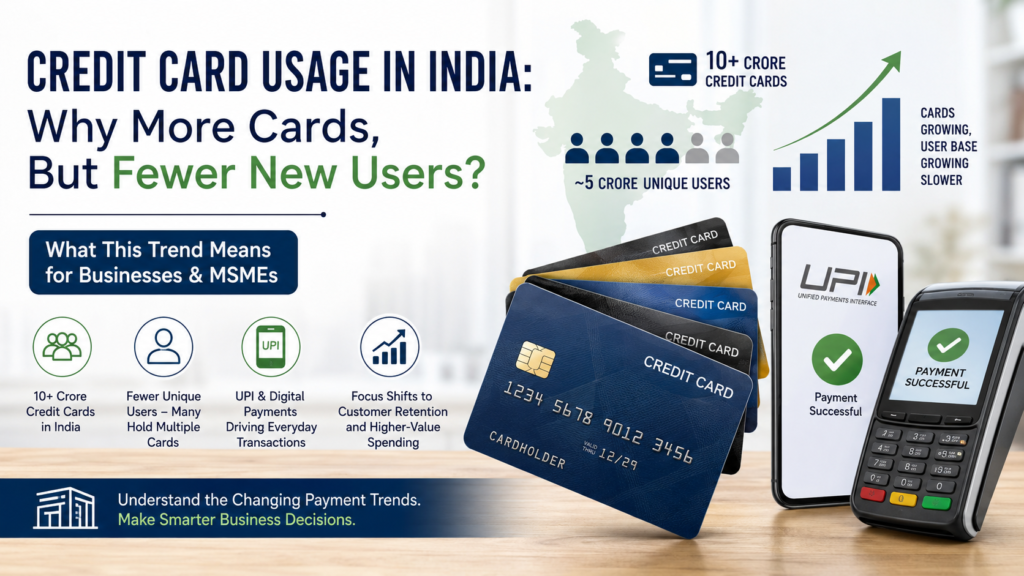
India’s credit card market has witnessed remarkable growth over the last decade, with outstanding balances and the number of cards in circulation reaching record levels. However, a recent industry report has revealed an interesting shift—while the number of credit cards continues to rise, the growth in unique credit card users has slowed significantly. Instead of expanding the customer base, banks are increasingly issuing multiple cards to existing customers.
For business owners, retailers, and MSMEs, this trend is more than just a banking statistic. It reflects changing consumer payment behaviour, evolving borrowing preferences, and the growing influence of digital payment alternatives such as UPI and small-ticket personal loans. Understanding these changes can help businesses prepare better payment strategies and improve customer experience.
India’s Credit Card Market Is Growing, But Not the Way Many Expected
India now has over 10 crore active credit cards, yet the number of unique cardholders remains around 5 crore. This indicates that many customers hold multiple credit cards instead of new consumers entering the credit card ecosystem. Banks are focusing on deepening relationships with existing customers through premium cards, reward programmes and specialised offers rather than rapidly expanding into new customer segments.
The trend also reflects the maturity of urban credit markets, where financially active customers often maintain multiple cards for travel, shopping, cashback and business expenses.
Why Isn’t the Credit Card User Base Expanding Faster?
Several structural factors continue to limit credit card penetration in India:
- UPI has become the preferred payment method for daily transactions.
- Many consumers still do not meet formal credit eligibility requirements.
- Small-ticket personal loans and Buy Now Pay Later (BNPL) options offer alternative sources of credit.
- Rural and semi-urban markets continue to have relatively low credit card adoption.
- Many first-time borrowers begin their credit journey through other loan products before obtaining a credit card.
Although India’s digital payments ecosystem is among the world’s largest, credit cards remain concentrated within a relatively small segment of consumers.
What Does This Mean for MSMEs and Retail Businesses?
Businesses should avoid assuming that credit card payments alone will drive customer convenience.
Instead, businesses should:
- Continue accepting UPI as the primary payment option.
- Maintain support for credit and debit cards for higher-value purchases.
- Offer flexible digital payment methods to suit different customer preferences.
- Monitor customer spending patterns rather than relying on one payment channel.
- Consider EMI and financing options for larger purchases where appropriate.
A diversified payment ecosystem improves customer satisfaction and reduces dependence on any single payment method.
Opportunity Still Exists for Business Growth
Although credit card penetration remains relatively low, India’s formal credit ecosystem continues to expand. Younger consumers, especially Gen Z, are entering the credit market earlier than previous generations, and a growing share of first-time credit card users now comes from semi-urban and rural regions. This presents long-term opportunities for businesses serving emerging markets.
Businesses that provide multiple payment options, digital convenience and responsible financing solutions are likely to remain better positioned as consumer behaviour continues to evolve.
Key Takeaways for Business Owners
The latest credit card data does not suggest that Indians are abandoning credit cards. Instead, it indicates that the market is entering a new phase where existing users are becoming more active while new customer acquisition is slowing.
For businesses, the focus should not be on promoting one payment method over another. Success will depend on providing customers with flexibility, convenience and a seamless payment experience across UPI, cards and other digital channels.
What Is Causing Credit Card Growth to Slow?
The slowdown is primarily due to slower expansion in new cardholders. Banks are issuing more cards to existing customers while UPI and small personal loans have emerged as strong alternatives for everyday transactions and short-term borrowing.
Frequently Asked Questions
1. Are Indians using fewer credit cards now?
No. Credit card spending remains substantial, but growth in new users has slowed while existing customers increasingly own multiple cards.
2. Why are banks issuing multiple credit cards to the same customer?
Banks aim to increase wallet share by offering specialised cards with different reward programmes, travel benefits and spending categories.
3. Has UPI reduced credit card usage?
UPI has become the preferred mode for small-value transactions, but credit cards continue to play an important role for larger purchases, rewards and short-term credit.
4. Should businesses still accept credit cards?
Yes. Businesses should continue accepting credit cards while also supporting UPI and other digital payment methods to maximise customer convenience.
5. Is India’s credit card market still expected to grow?
Yes. Industry experts believe significant growth potential remains due to low overall credit card penetration and increasing formal credit adoption in smaller cities.
6. What should MSMEs learn from this trend?
MSMEs should diversify payment options, monitor consumer payment behaviour and adopt digital payment technologies that improve customer experience.
7. Can multiple credit cards benefit consumers?
When managed responsibly, multiple credit cards can provide better rewards, category-specific benefits and improved credit utilisation. However, they also require disciplined repayment to avoid debt accumulation.