
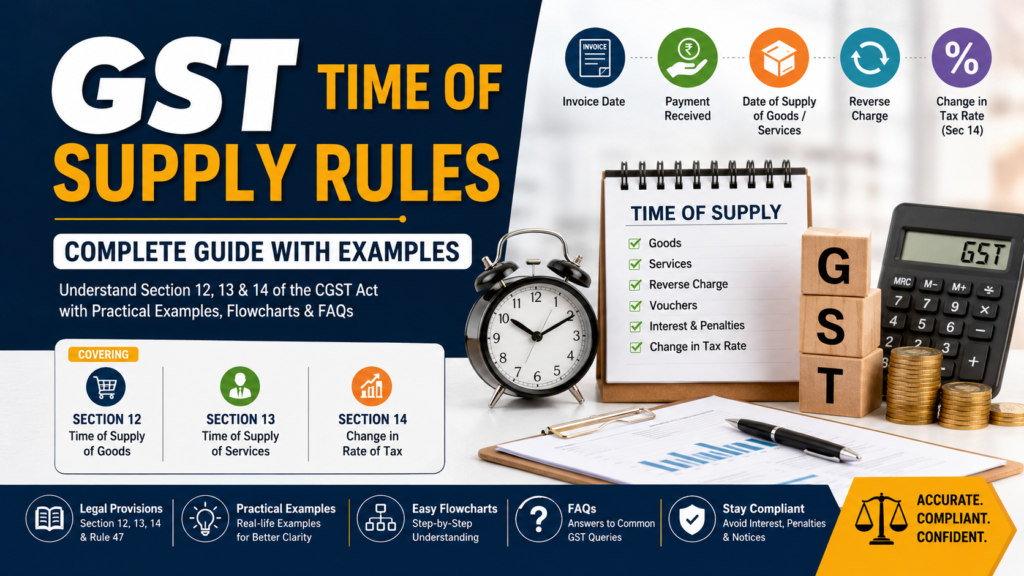
One of the most frequently misunderstood concepts under the Goods and Services Tax (GST) law is the Time of Supply. While businesses generally focus on determining the correct GST rate and value of supply, they often overlook the fact that GST liability arises based on the Time of Supply, not necessarily when payment is received or when the transaction is recorded in the books of accounts.
An incorrect determination of the Time of Supply may result in delayed payment of GST, interest liability under Section 50 of the CGST Act, incorrect return filing, and notices during departmental scrutiny or audit.
Whether you are a manufacturer, trader, service provider, contractor, freelancer, exporter, or importer, understanding the Time of Supply provisions is essential for accurate GST compliance.
In this comprehensive guide, we explain the statutory provisions under Sections 12, 13 and 14 of the CGST Act, 2017, relevant rules, practical illustrations, and common mistakes that businesses should avoid.
What is Time of Supply under GST?
Time of Supply is the point in time when a supply is deemed to have taken place for GST purposes. It determines:
- When GST becomes payable to the Government.
- The tax period in which the transaction must be reported.
- The applicable GST rate where tax rates change.
- Whether interest is payable due to delayed payment.
- The due month for reporting the transaction in GST returns.
Simply put, Time of Supply determines the date on which GST liability arises, irrespective of when the accounting entry is passed.
Legal Provisions Governing Time of Supply
The Time of Supply provisions are mainly covered under:
| Provision | Subject |
|---|---|
| Section 12 | Time of Supply of Goods |
| Section 13 | Time of Supply of Services |
| Section 14 | Change in Rate of Tax |
| Section 31 | Tax Invoice |
| Rule 47 of the CGST Rules | Time limit for issuing invoice for services |
Why is Time of Supply Important?
Correct determination of the Time of Supply helps businesses:
- Avoid interest on delayed payment of GST.
- Report transactions in the correct tax period.
- Apply the correct GST rate during tax rate changes.
- Ensure accurate reconciliation between books and GST returns.
- Minimise disputes during departmental audits.
- Improve GST compliance and cash flow planning.
Time of Supply of Goods (Section 12)
Section 12 governs the Time of Supply for taxable supplies of goods.
General Rule
As per Section 12(2), the Time of Supply is the earlier of:
- Date of issue of invoice (or the last date on which the invoice is required to be issued under Section 31), or
- Date of receipt of payment.
Therefore, the law itself considers both the invoice date and the payment date while determining the Time of Supply.
Practical Position After Notification No. 66/2017
Although Section 12 includes the date of receipt of payment, the Government issued Notification No. 66/2017 – Central Tax dated 15 November 2017, which exempts registered persons (other than notified classes, if any) from paying GST on advances received towards the supply of goods.
Practical implication
For most registered businesses today:
- GST is generally not payable on advances received for goods.
- GST becomes payable when the invoice is issued (or ought to have been issued under Section 31).
This distinction between the statutory provision and the practical effect of the notification is important during audits and professional practice.
Example 1 – Invoice issued before payment
Goods dispatched: 10 July
Invoice issued: 10 July
Payment received: 30 July
Time of Supply: 10 July
GST is payable in the July tax period.
Example 2 – Advance received for goods
Advance received: 5 July
Goods supplied and invoice issued: 25 July
Under the Act, receipt of payment is one of the determining events. However, due to Notification No. 66/2017, GST on the advance is generally not payable for most registered persons supplying goods. Accordingly, GST is discharged when the invoice is issued (or required to be issued).
When Should an Invoice for Goods be Issued?
Under Section 31:
- Where movement of goods is involved, the invoice should generally be issued before or at the time of removal of goods for supply.
- Where movement is not involved, the invoice should generally be issued at the time of delivery or when the goods are made available to the recipient.
Delaying the invoice does not defer the GST liability beyond the statutory time.
Time of Supply of Services (Section 13)
Section 13 governs the Time of Supply for services.
Unlike goods, GST on advances for services generally continues to apply, unless a specific exemption is available.
The determination depends on whether the invoice is issued within the prescribed period under Rule 47 of the CGST Rules.
Case 1 – Invoice Issued Within the Prescribed Time
Where the invoice is issued within the prescribed period, the Time of Supply is the earlier of:
- Date of issue of invoice, or
- Date of receipt of payment.
Example
Consultancy completed: 5 August
Invoice issued: 20 August
Payment received: 10 September
Time of Supply: 20 August
Case 2 – Invoice Not Issued Within the Prescribed Time
If the invoice is not issued within the time prescribed under Rule 47, the Time of Supply is the earlier of:
- Date of provision of service, or
- Date of receipt of payment.
Example
Service completed: 10 August
Invoice issued: 10 October
Payment received: 25 September
Time of Supply: 10 August
The delay in issuing the invoice does not postpone the GST liability.
Example – Advance Received for Services
Advance received: 15 June
Invoice issued: 30 June
Service completed: 20 July
Since payment was received first, the Time of Supply is 15 June, and GST becomes payable in the June tax period.
Time Limit for Issuing Invoice for Services
Under Rule 47 of the CGST Rules, the invoice should generally be issued within 30 days from the date of supply of service.
Different timelines are prescribed for certain categories such as insurers, banking companies, financial institutions and NBFCs.
Continuous Supply of Goods
Continuous Supply of Goods refers to supplies made continuously or on a recurrent basis under a contract, where invoices are issued periodically.
The invoice should be issued in accordance with the terms of the contract or as prescribed under Section 31.
Example
A manufacturer supplies industrial gases every week under a one-year contract with monthly billing.
The invoice should be issued as per the contractual billing arrangement, and the Time of Supply will be determined accordingly.
Continuous Supply of Services
Continuous Supply of Services includes services provided continuously under a contract extending beyond three months with periodic payment obligations.
Depending on the contract:
- If the due date of payment is ascertainable, the invoice should be issued on or before the due date.
- If not ascertainable, the invoice should be issued before or at the time of receipt of payment.
- If payment is linked to completion of an event, the invoice should be issued on or before completion of that event.
Typical examples include:
- Annual maintenance contracts (AMC)
- Security services
- Housekeeping contracts
- Facility management services
- Long-term consultancy agreements
Time of Supply under Reverse Charge Mechanism (RCM)
Separate rules apply where GST is payable by the recipient under the Reverse Charge Mechanism.
Reverse Charge on Goods
Time of Supply is the earliest of:
- Date of receipt of goods.
- Date of payment.
- 30 days from the supplier’s invoice.
If none of these can be determined, the date of entry in the recipient’s books of account is considered.
Example
Supplier invoice: 1 June
Goods received: 8 June
Payment: 20 June
Time of Supply: 8 June
Reverse Charge on Services
Time of Supply is the earliest of:
- Date of payment.
- 60 days from the supplier’s invoice.
If neither can be determined, the date of entry in the recipient’s books is considered.
Example
Invoice: 1 May
Payment: 25 July
Sixtieth day from invoice: 30 June
Time of Supply: 30 June
Services Received from Associated Enterprises
A special provision applies where:
- Services are received from an associated enterprise located outside India, and
- GST is payable under Reverse Charge.
The Time of Supply is the earlier of:
- Date of entry in the recipient’s books of account, or
- Date of payment.
This provision overrides the normal 60-day rule applicable to reverse charge on services.
Time of Supply for Vouchers
The GST treatment depends on whether the underlying supply is identifiable at the time of issue.
Specific Purpose Voucher
Where the goods or services are identifiable at the time of issue,
Time of Supply = Date of issue of voucher
Example:
A movie voucher redeemable only for cinema tickets.
General Purpose Voucher
Where the supply is not identifiable,
Time of Supply = Date of redemption
Example:
A shopping gift card that can be used for multiple products.
Interest, Late Fee and Penalty for Delayed Payment
Where the supplier receives:
- Interest
- Late payment charges
- Penalty for delayed payment
the Time of Supply for such additional consideration is the date of receipt of that amount.
Example
Invoice value: ₹1,00,000
Interest collected for delayed payment: ₹4,000
Interest received: 12 December
GST on ₹4,000 becomes payable in December.
Residual Provision (Sections 12(5) and 13(5))
In rare situations where the Time of Supply cannot be determined under the normal provisions:
- If a return is required to be filed, the Time of Supply is the date on which the return is filed.
- In any other case, it is the date on which the tax is paid.
These provisions act as a fallback mechanism where the standard rules cannot be applied.
Time of Supply When GST Rates Change (Section 14)
One of the most technically important provisions under GST is Section 14, which determines the applicable GST rate when there is a change in the tax rate between the date of supply, invoice and payment.
Three dates become relevant:
- Date of supply
- Date of invoice
- Date of payment
The applicable GST rate depends on the sequence of these events.
Quick Reference Table
| Supply | Invoice | Payment | Applicable GST Rate |
|---|---|---|---|
| Before rate change | Before | Before | Old rate |
| Before rate change | Before | After | Old rate |
| Before rate change | After | Before | Old rate |
| Before rate change | After | After | New rate |
| After rate change | Before | Before | Old rate |
| After rate change | After | After | New rate |
Important Note: The actual application of Section 14 depends on the statutory deeming provisions regarding the Time of Supply. Businesses should analyse each transaction carefully whenever GST rates are revised, as intermediate combinations require applying the specific rules laid down in Section 14 rather than relying only on the table above.
Quick Summary of Time of Supply Rules
| Nature of Supply | Time of Supply |
|---|---|
| Goods | Earlier of invoice (or last permissible invoice date) and receipt of payment, subject to Notification No. 66/2017 for advances on goods |
| Services (invoice issued in time) | Earlier of invoice or payment |
| Services (invoice delayed) | Earlier of provision of service or payment |
| Reverse Charge – Goods | Earliest of receipt of goods, payment or 30 days from invoice |
| Reverse Charge – Services | Earlier of payment or 60 days from invoice |
| Associated Enterprise Services | Earlier of book entry or payment |
| Voucher (specific purpose) | Date of issue |
| Voucher (general purpose) | Date of redemption |
| Interest / Late Fee / Penalty | Date of receipt |
| Residual cases | Date of return or tax payment, as applicable |
Common Mistakes Businesses Make
- Assuming GST is payable only after receiving payment.
- Ignoring the statutory provisions while relying only on practical practices.
- Forgetting that advances for services generally trigger GST liability.
- Delaying invoice issuance in the belief that GST liability will also be postponed.
- Incorrectly determining the applicable GST rate when tax rates change.
- Ignoring special provisions for reverse charge and associated enterprises.
- Reporting transactions in the wrong GST return period.
Best Practices for Businesses
- Issue invoices within the prescribed timelines.
- Maintain proper records of payment receipt dates.
- Track reverse charge transactions separately.
- Configure ERP or accounting software to determine the correct Time of Supply.
- Review GST implications whenever tax rates change.
- Reconcile invoices, payments and GST returns regularly.
- Seek professional advice for complex transactions involving continuous supplies, imports of services or changes in tax rates.
Frequently Asked Questions (FAQs)
1. What is the Time of Supply under GST?
It is the date on which GST liability arises under the CGST Act. It determines when tax becomes payable and in which GST return the transaction must be reported.
2. Is GST payable on advances received for goods?
Section 12 considers the receipt of payment while determining the Time of Supply. However, Notification No. 66/2017 generally exempts registered persons from paying GST on advances received for the supply of goods, except where otherwise notified.
3. Is GST payable on advances received for services?
Yes. In general, receipt of advance for services constitutes a relevant event for determining the Time of Supply, and GST is payable accordingly unless a specific exemption applies.
4. What happens if an invoice for services is issued after the prescribed period?
The Time of Supply shifts to the earlier of the date of provision of service or the date of receipt of payment, which may result in earlier GST liability.
5. How is the Time of Supply determined under Reverse Charge?
For goods, it is generally the earliest of receipt of goods, payment or 30 days from the supplier’s invoice. For services, it is generally the earlier of payment or 60 days from the supplier’s invoice, subject to the special rule for associated enterprises.
6. How does the Time of Supply affect the GST rate?
Where the GST rate changes, Section 14 determines whether the old rate or the new rate applies by considering the dates of supply, invoice and payment.
7. When is GST payable on interest collected for delayed payment?
GST becomes payable when the interest, late fee or penalty amount is actually received.
8. Why is determining the correct Time of Supply important?
An incorrect Time of Supply can lead to delayed payment of GST, interest liability, incorrect return filing and disputes during GST audits.
Conclusion
The Time of Supply provisions under GST are fundamental to determining when GST becomes payable, irrespective of when a transaction is recorded in the books or when payment is ultimately received. While the rules may appear straightforward, special provisions relating to advances, reverse charge, continuous supplies, associated enterprises and changes in GST rates require careful analysis.
Businesses should establish robust invoicing procedures, maintain accurate payment records and periodically review their GST processes to ensure that the correct Time of Supply is determined for every transaction. A sound understanding of Sections 12, 13 and 14 of the CGST Act not only ensures legal compliance but also helps avoid unnecessary interest, penalties and litigation.