
Introduction
With increased digitisation of the Income Tax Department, Annual Information Statement (AIS) and Form 26AS have become critical tools for return filing. However, many taxpayers in India—especially salaried individuals, freelancers, and business owners—face a common issue: mismatch between AIS and Form 26AS.
This mismatch can directly lead to income tax notices, scrutiny, or defective return issues. Understanding the difference and how to handle discrepancies is essential for accurate filing and compliance in FY 2024-25 (AY 2025-26).
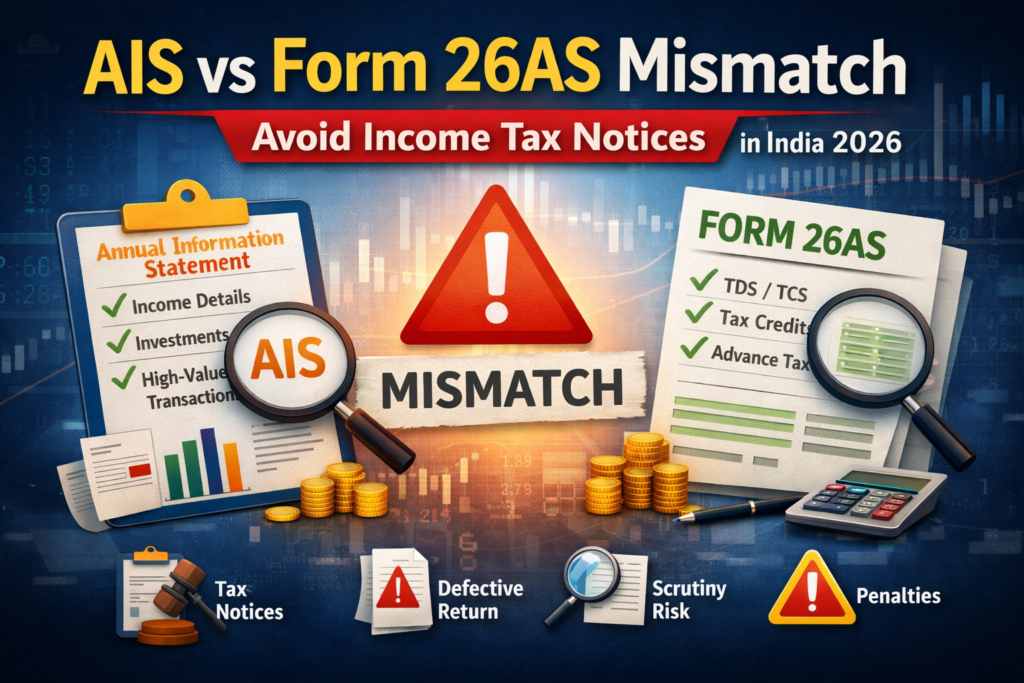
Understanding AIS vs Form 26AS
What is AIS?
AIS is a comprehensive financial statement introduced by the Income Tax Department that includes:
- Interest income
- Dividend income
- Securities transactions
- Foreign remittances
- GST turnover (in some cases)
What is Form 26AS?
Form 26AS is a consolidated tax statement reflecting:
- TDS (Tax Deducted at Source)
- TCS (Tax Collected at Source)
- Advance tax paid
- Refunds received
Key Difference:
- AIS = Detailed financial transactions + informational reporting
- 26AS = Tax credit statement (used for tax calculation)
Practical Insight:
Many taxpayers wrongly assume both should match exactly—this is incorrect. AIS is broader and may include transactions not appearing in 26AS.
Why AIS and 26AS Mismatch Happens
1. Timing Differences
- Transactions may appear in AIS before TDS is reflected in 26AS
2. Reporting by Different Entities
- Banks, mutual funds, and brokers report to AIS
- Employers and deductors report TDS in 26AS
3. Incorrect or Duplicate Reporting
- Wrong PAN reporting
- Duplicate entries by financial institutions
4. High-Value Transactions Without TDS
- Property purchase
- Credit card spends
- Mutual fund investments
5. Data Not Yet Updated
- Delay in filing TDS returns by deductor
Tip: AIS often contains “information only” entries which do not require tax payment directly.
How to Reconcile AIS and 26AS Before Filing ITR
Step-by-Step Approach:
- Download both AIS and 26AS from income tax portal
- Match TDS entries strictly with Form 16 / 16A
- Verify income entries in AIS with your books/bank statements
- Identify discrepancies:
- Missing income
- Excess reporting
- Duplicate entries
- Use AIS feedback option:
- Mark as “correct”
- “Partially correct”
- “Information not fully correct”
- “Not related to me”
Professional Tip:
Always reconcile AIS before filing return—this reduces chances of automated notices under risk management systems.
Consequences of Ignoring AIS Mismatch
- Income Tax Notice under Section 143(1)(a)
- Defective return notices
- Scrutiny cases for high-value mismatches
- Penalty for under-reporting of income
Important: Even if tax is correctly paid, mismatch can still trigger compliance notices.
What Should You Follow – AIS or 26AS?
- For tax credit (TDS) → Follow Form 26AS
- For income reporting → Consider AIS + your actual records
- Always ensure ITR reflects correct income, not blindly AIS data
WH Question
How to correct errors in AIS to avoid tax notices?
You can log in to the Income Tax portal, access AIS, and submit feedback against incorrect entries. Once feedback is submitted, the system updates the “Taxpayer Information Summary (TIS),” which should be used for accurate ITR filing. Always keep supporting documents in case of future scrutiny.
FAQs
1. Is it mandatory to match AIS with ITR?
Not exactly, but significant mismatches may trigger notices. Proper reconciliation is highly recommended.
2. What if AIS shows higher income than actual?
You should submit feedback in AIS and report correct income in ITR with proper documentation.
3. Can I ignore small mismatches in AIS?
Minor differences may not trigger issues, but repeated or large mismatches can lead to scrutiny.
4. Which is more important for filing – AIS or Form 26AS?
Both are important—26AS for tax credits and AIS for comprehensive income verification.
5. What happens if I don’t report AIS income?
You may receive automated notices for under-reporting of income.
6. How often is AIS updated?
AIS is updated periodically based on reporting by financial institutions and tax authorities.
7. Can AIS show incorrect transactions?
Yes, errors or duplicate entries can occur, which is why reconciliation and feedback are critical.
 WhatsApp