
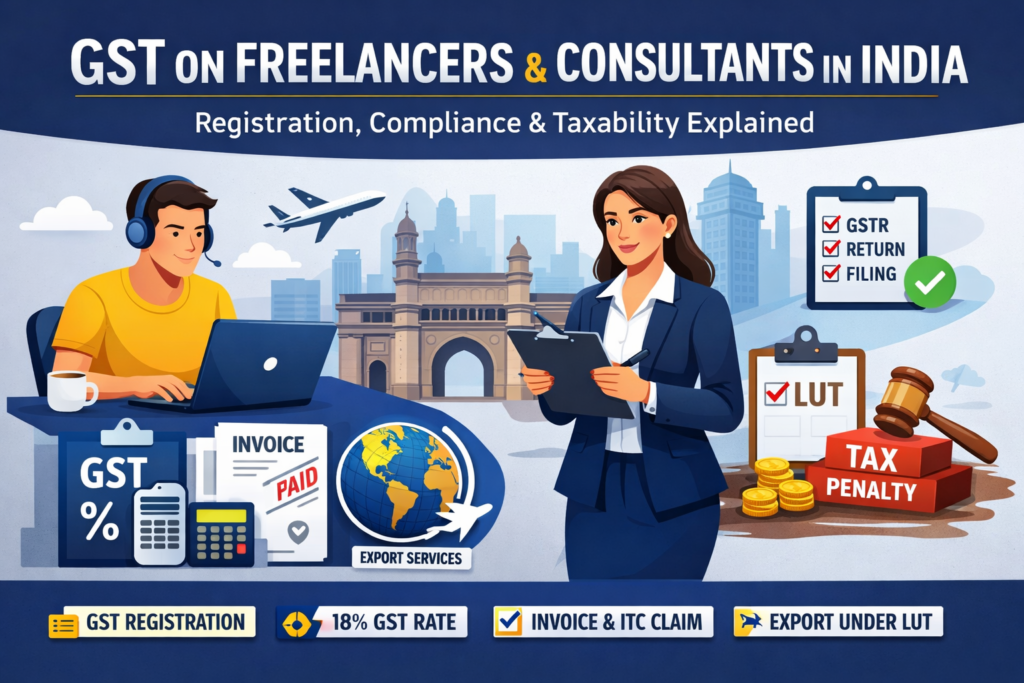
With the rapid growth of the gig economy in India, freelancers and consultants in cities like Pune, Pimpri Chinchwad (PCMC), MIDC Chakan, Bhosari, Mumbai, and across Maharashtra are increasingly facing questions around GST applicability. Whether you are a digital marketer, software developer, designer, or independent professional, understanding GST on freelance income is crucial to avoid penalties and ensure compliance. This guide explains GST registration, invoicing, rates, and practical compliance aspects specifically tailored for freelancers and consultants.
GST Registration for Freelancers – When Is It Mandatory?
Freelancers providing services are treated as “service providers” under GST law. The requirement for GST registration depends primarily on turnover and nature of services.
- Threshold Limit
- ₹20 lakh (₹10 lakh for special category states)
- Applicable on aggregate turnover across India
- Compulsory Registration Cases
- Providing interstate services
- Services supplied through online platforms
- Export of services (even if zero-rated)
- Practical Insight
- Many freelancers working with clients outside Maharashtra or India must register even if turnover is below ₹20 lakh
- Example
- A Pune-based graphic designer serving a Delhi client → GST registration mandatory
GST Rates, Invoicing & Compliance for Freelancers
Once registered, freelancers must comply with GST provisions including invoicing and return filing.
- Applicable GST Rate
- Standard rate: 18% on most professional services
- Invoicing Requirements
- GSTIN of supplier
- Invoice number & date
- Description of service
- Place of supply
- GST breakup (CGST + SGST / IGST)
- Return Filing
- GSTR-1 (Outward supplies)
- GSTR-3B (Summary return)
- Quarterly filing option available under QRMP scheme
- Input Tax Credit (ITC)
- Claim ITC on business expenses like:
- Laptop
- Software subscriptions
- Office rent
- Claim ITC on business expenses like:
- Export of Services
- Treated as zero-rated supply
- Option to:
- Export without GST under LUT
- Pay GST and claim refund
What Are the Common Challenges Faced by Freelancers Under GST?
Freelancers often struggle with compliance due to lack of clarity and procedural complexity.
Answer:
- Determining place of supply for interstate or foreign clients
- Managing GST registration despite low turnover
- Understanding export procedures and LUT filing
- Timely filing of returns to avoid penalties
- Reconciling payments and GST liability
FAQs on GST for Freelancers in India
1. Is GST applicable if I work only for foreign clients?
Yes, GST registration is mandatory. However, exports are zero-rated, and tax may not be payable if LUT is filed.
2. Do freelancers need to charge GST below ₹20 lakh turnover?
Generally no, except in cases of interstate supply or compulsory registration categories.
3. Can freelancers opt for composition scheme?
No, composition scheme is not available for service providers except limited cases under 6% scheme (with restrictions).
4. What happens if a freelancer does not register under GST?
Penalty of 10% of tax due (minimum ₹10,000) or higher in case of fraud.
5. Is GST applicable on advance received from clients?
Yes, GST is payable on advance receipts for services.
6. Can ITC be claimed on personal expenses?
No, only business-related expenses are eligible for ITC.
7. Is GST applicable on reimbursement of expenses?
Yes, if charged as part of service value, it is taxable.
 WhatsApp