
Introduction
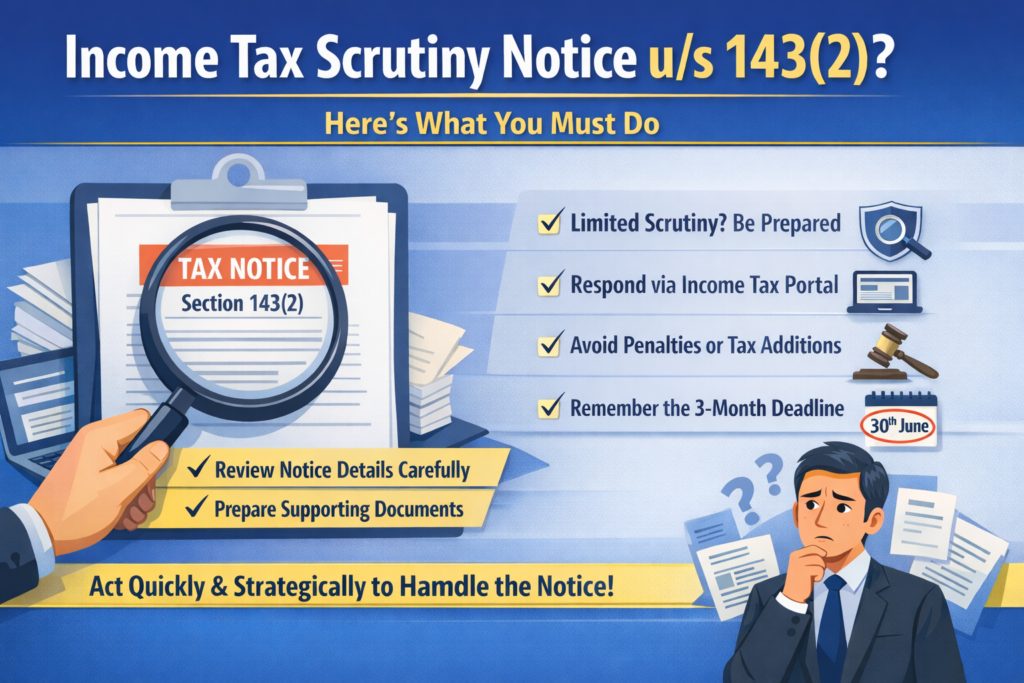
Receiving an income tax notice can be stressful, especially for salaried individuals and business owners. One of the most commonly issued notices is under Section 143(2) of the Income Tax Act. This blog explains what the notice means, why it is issued, and how you should respond to avoid penalties and scrutiny complications.
What is Section 143(2) Notice?
A notice under Section 143(2) is issued by the Income Tax Department when your return is selected for scrutiny assessment. This means the department wants to verify the correctness of your income, deductions, exemptions, and taxes paid.
The objective is not always to penalize but to ensure that taxpayers have not understated income or claimed excessive deductions. Scrutiny may be either limited (focused on specific issues) or complete (detailed verification of the entire return).
For example, if you have claimed a high deduction under Section 80C or reported significant capital gains, your return may be flagged for verification.
Reasons for Receiving Section 143(2) Notice
The selection of cases is primarily done through automated systems based on risk parameters. Common reasons include:
- High-value transactions (property, shares, mutual funds)
- Mismatch in income reported vs AIS/TIS
- Excessive deductions or exemptions claimed
- Sudden increase or decrease in income
- Non-reporting of certain income sources
In recent years, data analytics and AI-based systems have increased scrutiny accuracy, especially for professionals and businesses.
Time Limit for Issuance of Notice
The Income Tax Department must issue a Section 143(2) notice within 3 months from the end of the financial year in which the return is filed.
For example:
- If return is filed in July 2025 (FY 2025-26)
- Notice can be issued till 30th June 2026
If the notice is issued after this time limit, it becomes invalid.
How to Respond to Section 143(2) Notice?
Once you receive the notice, follow a structured approach:
- Verify Notice Details
- Check PAN, assessment year, and issuing officer
- Understand Scope of Scrutiny
- Limited scrutiny: Only specific issues
- Complete scrutiny: Full return review
- Prepare Documentation
- Income proofs (salary, business, capital gains)
- Deduction proofs
- Bank statements, invoices, agreements
- Respond Online
- Login to Income Tax portal
- Submit response under e-proceedings
- Consult a Chartered Accountant
- Proper representation reduces risk of additions/penalties
Timely and accurate response is crucial to avoid adverse assessment orders.
What Happens After Submission?
After you submit your response:
- The Assessing Officer may ask for additional clarification
- Hearings may be conducted (online/offline)
- Final assessment order is passed under Section 143(3)
If discrepancies are found, additional tax, interest, and penalties may be levied.
WH Questions
What is the purpose of Section 143(2) notice?
To verify the accuracy of the income tax return filed by the taxpayer.
Why was my return selected for scrutiny?
Due to risk parameters like high-value transactions, mismatches, or unusual claims.
How should I respond to the notice?
Through the income tax portal by submitting required documents and explanations.
When is the last date to issue 143(2) notice?
Within 3 months from the end of the financial year in which return is filed.
Can I ignore a Section 143(2) notice?
No, ignoring it can lead to best judgment assessment and penalties.
FAQs
1. Is Section 143(2) notice common?
Yes, with increased data tracking, many returns are selected for scrutiny.
2. Does receiving this notice mean I have done something wrong?
Not necessarily. It may be a routine verification.
3. Can scrutiny happen for salaried individuals?
Yes, especially if there are high deductions, capital gains, or multiple income sources.
4. What is limited scrutiny?
Verification restricted to specific issues mentioned in the notice.
5. Can I revise my return after receiving notice?
Generally, revision is allowed before the end of the relevant assessment year, but strategy should be discussed with a professional.
6. What if I fail to respond?
The department may complete assessment based on available data, often leading to higher tax liability.
7. Is personal appearance required?
Mostly proceedings are online now, but in some cases, appearance may be required.