
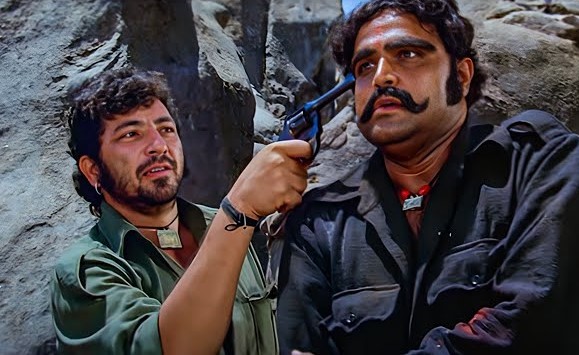
Two of Gabbar’s men return after failing to capture Jai and Veeru.
Gabbar asks quietly,
“Kitne aadmi the?”
They reply, “Do, sardar.”
Two men defeated many.
Gabbar does not shout immediately.
He diagnoses.
Tenali Explains,
“Maharaj, this is not merely a scene of anger. This is a lesson in strategic cost management.
First, observe the cost structure.
Inputs deployed: Many dacoits
Resources consumed: Weapons, time, ammunition
Expected output: Capture of two men
When resources are high and output is zero,
the issue lies in cost efficiency, not in cost capacity.
Gabbar’s question ‘Kitne aadmi the?’ was a test of standard vs actual performance.
He was verifying whether the defeat was due to:
Insufficient resources (capacity problem), or
Poor utilisation of resources (efficiency problem).
Once he heard ‘two’, the conclusion was clear:
Standards were reasonable.
Cost incurred was wasteful.
There was an adverse efficiency variance.
this is the essence of responsibility accounting.
Each unit must justify the cost it consumes.
Gabbar fixed accountability because:
Strategic cost control requires discipline.
Poor execution increases cost per successful outcome.
Repeated inefficiency destroys competitive strength.
The Strategic Costing Principle
A wise ruler must always examine three things:
Are resources aligned with strategy?
Is cost behaviour under control?
Are responsibility centres delivering expected value?
When output fails despite adequate input,
it is not fate, Maharaj. It is failure of cost management.”
And thus, even in Ramgarh’s hills,
strategic costing was silently at work!..
 WhatsApp