
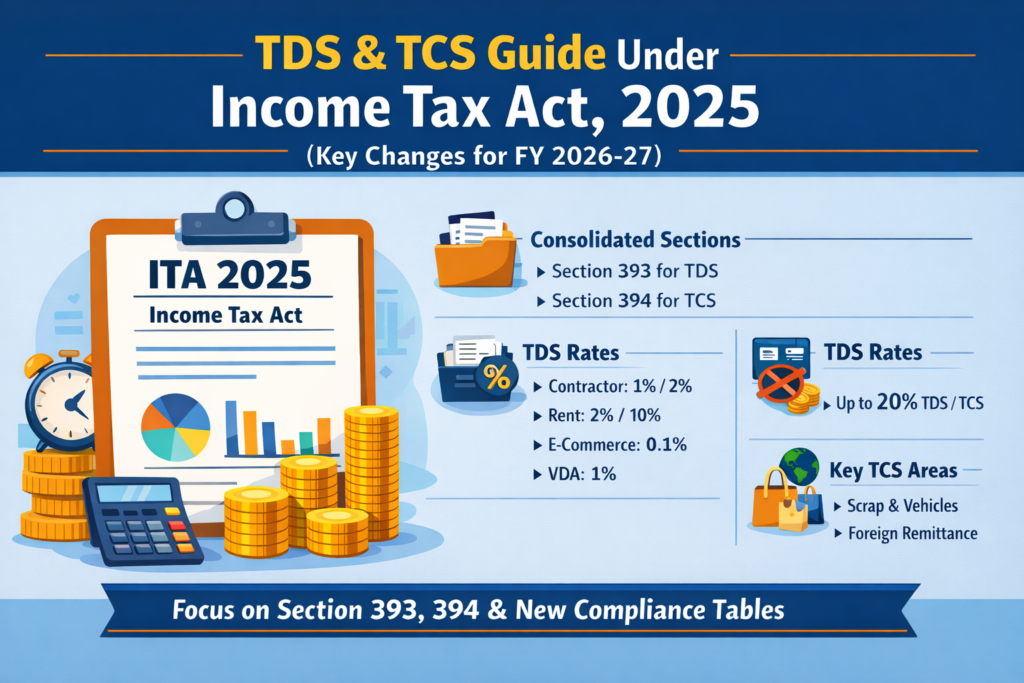
With the implementation of the Income Tax Act, 2025 (ITA 2025), the entire framework of TDS (Tax Deducted at Source) and TCS (Tax Collected at Source) has been restructured and renumbered. For businesses, professionals, and CAs in areas like Pune, PCMC, and across Maharashtra, understanding these changes is critical to ensure compliance and avoid penalties.
This guide provides a clear, updated and practical overview of TDS & TCS provisions as per ITA 2025, along with rate structures and applicability for FY 2026-27.
Major Structural Change in ITA 2025 – Section Mapping
Under ITA 2025, multiple TDS sections have been consolidated:
| Old Section (ITA 1961) | New Section (ITA 2025) | Coverage |
|---|---|---|
| 192 to 196D, 194 series | Section 393 | Most TDS provisions |
| 195, 196 (Non-resident) | Section 393(2) | Foreign payments |
| 194B, 194BB etc. | Section 393(3) | Winnings, gambling |
| 206C (TCS) | Section 394 | TCS provisions |
| 206AA / 206CC | Section 397 | Higher rate for no PAN |
Key Insight:
Instead of remembering multiple sections, professionals now need to focus on tables under Section 393 & 394.
Important TDS Rates under ITA 2025 (FY 2026-27)
As per the updated chart:
1. Business & Professional Payments
| Nature of Payment | New Section | Rate | Threshold |
|---|---|---|---|
| Contractor (Individual/HUF) | 393(1) | 1% | ₹30,000 |
| Contractor (Others) | 393(1) | 2% | ₹1,00,000 |
| Professional Fees | 393(1) | 10% | ₹50,000 |
| Technical Services | 393(1) | 2% | ₹50,000 |
Practical Tip:
Classification between technical vs professional services continues to be a major litigation area.
2. Rent, Commission & Brokerage
| Nature | Rate | Threshold |
|---|---|---|
| Rent (Plant & Machinery) | 2% | ₹50,000/month |
| Rent (Land/Building) | 10% | ₹50,000/month |
| Commission/Brokerage | 2% | ₹20,000 |
3. Key High-Impact Provisions
| Section Purpose | Rate | Threshold |
|---|---|---|
| Purchase of Goods (earlier 194Q) | 0.1% | ₹50 lakh |
| E-commerce Transactions | 0.1% | No threshold |
| Benefits/Perquisites (194R) | 10% | ₹20,000 |
| Virtual Digital Assets | 1% | No threshold |
Important:
These provisions are now under Section 393(1) Table references, simplifying structure but not reducing compliance burden.
4. Salary & Partner Payments
| Nature | Rate |
|---|---|
| Salary | Slab rates |
| Partner Remuneration (newly emphasized) | 10% |
Note:
Partner payments now clearly fall under TDS ambit via structured classification.
TCS Provisions under ITA 2025 (Section 394)
Key TCS Rates
| Transaction | Rate |
|---|---|
| Sale of Scrap | 2% |
| Sale of Motor Vehicle (above threshold) | 1% |
| Foreign Remittance (Education/Medical) | 2% |
| Foreign Remittance (Others) | 20% |
Emerging Area:
Luxury goods (watches, handbags, etc.) are now specifically covered under TCS.
Higher Rate for Non-PAN Cases (Section 397)
- If PAN not furnished:
- Higher of:
- Specified rate
- Rates in force
- 5% (for specified transactions like goods/e-commerce)
- 20% in other cases
- Higher of:
Impact:
Non-compliance with PAN can significantly increase tax burden.
What are the Key Changes in TDS under ITA 2025?
Answer:
- Consolidation of multiple sections into Section 393
- Introduction of table-based structure
- Clear segregation:
- Resident → 393(1)
- Non-resident → 393(2)
- Special incomes → 393(3)
- Continued focus on:
- Digital economy
- High-value transactions
- Data-based compliance
FAQs
1. What is the new section for TDS in Income Tax Act 2025?
TDS provisions are mainly covered under Section 393, replacing earlier multiple sections like 194C, 194J, 194Q etc.
2. Has the TDS rate changed under ITA 2025?
Mostly rates remain similar, but structure and reporting format have changed significantly.
3. What is TDS on purchase of goods in FY 2026-27?
TDS is 0.1% on purchases exceeding ₹50 lakh, now covered under Section 393.
4. Is TDS applicable on partner remuneration?
Yes, ITA 2025 clearly provides 10% TDS on partner payments.
5. What happens if PAN is not provided for TDS?
Higher TDS applies under Section 397, up to 20% in many cases.
6. What is TCS on foreign remittance under ITA 2025?
- 2% for education/medical
- 20% for other purposes
7. Are e-commerce transactions still covered under TDS?
Yes, TDS at 0.1% continues, now under Section 393.
Conclusion
The Income Tax Act, 2025 has not drastically changed TDS/TCS rates but has completely transformed the structure and presentation.
For professionals and businesses:
- Focus should shift from section memorization to table interpretation
- Compliance systems must be updated
- ERP/accounting software must align with new codes and sections
Practical takeaway:
Those who adapt early to the new section mapping and reporting framework will have a clear compliance advantage in FY 2026-27.