
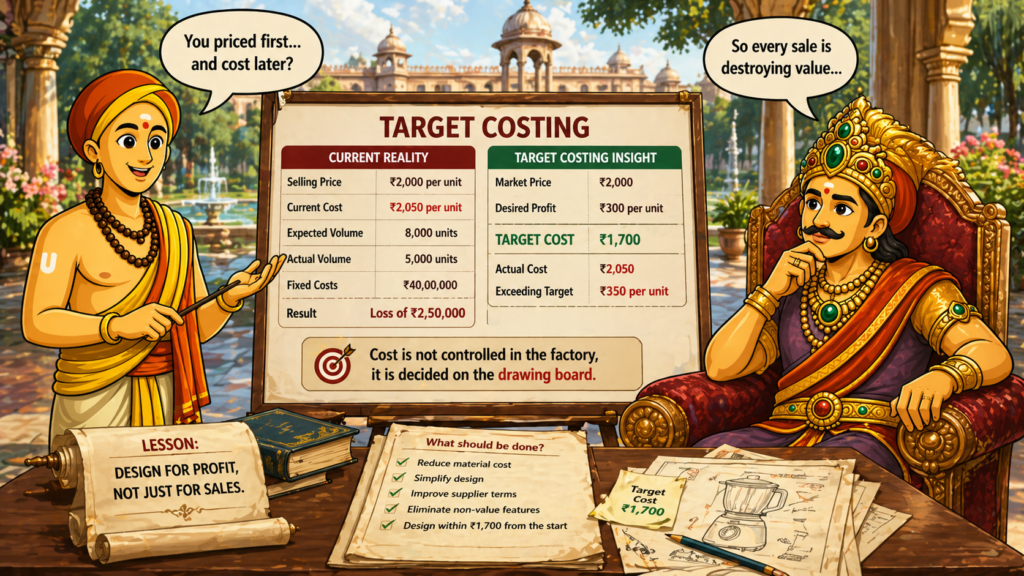
“Tenali, our new mixer grinder is selling fast. 5,000 units in a month! Yet… losses of ₹2,50,000. How?” Maharaj asked Tenali.
Tenali answered immediately, “Let’s investigate the numbers, Maharaj.
Selling Price: ₹2,000 per unit
Current Cost: ₹2,050 per unit
Expected Volume (initial plan): 8,000 units
Actual Volume: 5,000 units
Fixed Costs: ₹40,00,000
You priced first… and cost later?”
Maharaj was hesitant. “Yes. Market dictated ₹2,000. We assumed costs would fit.”
“There lies the leak. Let’s reverse the thinking,” Tenali opened his knowledge bank.
“Maharaj, here is our Target Costing Insight:
Market Price: ₹2,000
Desired Profit: ₹300 per unit
Target Cost = ₹1,700
But your actual cost is ₹2,050. You are exceeding target by ₹350 per unit.”
“So every sale is destroying value… not creating it,” realized Maharaj.
“Exactly Maharaj. Higher sales are accelerating losses.”
Maharaj was made aware by Tenali as to what his strategy should have been.
“We should have designed the product within ₹1,700 from the start. Materials, features, supplier terms.”
Tenali smiled, “Cost is not controlled in the factory, Maharaj… it is decided on the drawing board.
If price is market-driven, profit is design driven. Ignore target costing and growth becomes your biggest loss-maker.”