
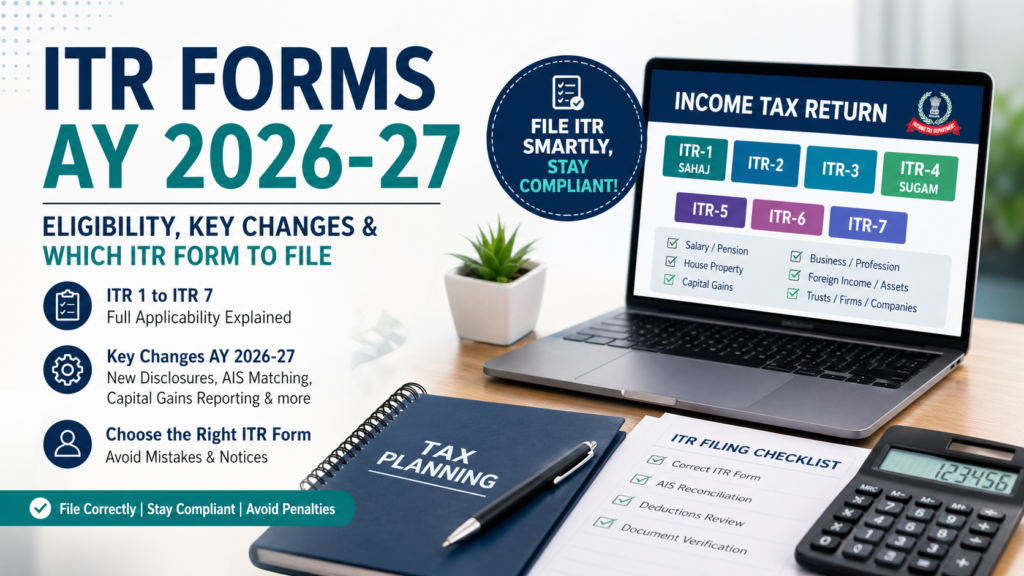
Filing your Income Tax Return (ITR) correctly is one of the most critical compliance requirements for taxpayers in India. For AY 2026-27, the government has notified updated ITR forms (ITR-1 to ITR-7) with certain changes in eligibility, disclosures, and reporting requirements. For taxpayers in Pune, PCMC, and across Maharashtra, understanding these updates is essential to avoid notices, penalties, and incorrect filings. This blog simplifies the latest ITR forms, their applicability, and key changes in a practical manner.
Overview of ITR Forms AY 2026-27
The Income Tax Department has notified all seven ITR forms, each catering to different categories of taxpayers.
ITR-1 (Sahaj)
Applicable for:
- Individuals with income up to ₹50 lakh
- Salary/Pension income
- One house property
- Other sources (interest)
ITR-2
Applicable for:
- Individuals/HUFs not having business income
- Capital gains, multiple house properties, foreign income
ITR-3
Applicable for:
- Individuals/HUFs having business or professional income
ITR-4 (Sugam)
Applicable for:
- Presumptive income (Sections 44AD, 44ADA, 44AE)
- Income up to ₹50 lakh
ITR-5, 6, 7
Applicable for:
- Firms, LLPs, companies, trusts, and institutions
These classifications remain broadly consistent, but eligibility conditions and disclosures have been refined.
Key Changes in ITR Forms for AY 2026-27
The updated forms introduce several important compliance-focused changes:
1. Enhanced Reporting of Capital Gains
- More detailed disclosure required for capital gains transactions
- Segregation based on asset type and holding period
2. Improved AIS/TIS Reconciliation
- Taxpayers are expected to match income with AIS (Annual Information Statement)
- Mismatches can trigger notices more easily
3. Additional Disclosures for Deductions
- More granular reporting under Chapter VI-A
- Specific breakup of deductions may be required
4. Business & Professional Income Transparency
- Increased reporting for expenses and income classification
- Better alignment with GST and financial data
5. Stricter Validation Rules
- System-based validations have increased
- Incorrect or incomplete filings are more likely to be rejected
These changes clearly indicate a shift towards data-driven tax scrutiny.
Eligibility Criteria – Choosing the Correct ITR Form
Selecting the correct ITR form is crucial. Filing the wrong form may result in defective return notices.
Key decision factors:
- Nature of income (salary, business, capital gains)
- Total income threshold
- Number of house properties
- Foreign assets or income
- Presumptive taxation applicability
For example:
- A salaried employee with FD interest → ITR-1
- A salaried person with stock market gains → ITR-2
- A freelancer or consultant → ITR-3 or ITR-4
Common Mistakes Taxpayers Should Avoid
- Filing ITR-1 despite having capital gains
- Ignoring AIS mismatches
- Incorrect deduction claims
- Not reporting foreign assets
- Choosing presumptive scheme incorrectly
Such errors often lead to scrutiny or notices.
What are the major changes in ITR forms for AY 2026-27?
The major changes include enhanced capital gains reporting, stricter AIS reconciliation, additional deduction disclosures, and improved validation systems.
Why is choosing the correct ITR form important?
Filing the wrong ITR form can make the return defective and may lead to penalties or notices from the tax department.
How to decide which ITR form is applicable?
The correct form depends on income type, total income, business involvement, and foreign income/assets.
When should I file my ITR for AY 2026-27?
Typically, the due date is 31st July for individuals (subject to extension if announced).
Where can taxpayers check AIS details?
AIS can be accessed through the Income Tax portal under the “Services” section.
FAQs
1. Can I file ITR-1 if I have capital gains from shares?
No, ITR-1 is not applicable if you have capital gains. You should file ITR-2.
2. Is AIS mismatch a serious issue?
Yes, mismatches can trigger automated notices and scrutiny.
3. Can professionals use ITR-4?
Yes, if they opt for presumptive taxation under Section 44ADA and meet conditions.
4. What happens if I file the wrong ITR form?
Your return may be treated as defective, requiring correction within a specified time.
5. Are deduction disclosures stricter now?
Yes, more detailed reporting is required under Chapter VI-A.
6. Is GST data linked with ITR filings?
Increasingly yes, especially for business taxpayers, as data reconciliation is being strengthened.
7. Do I need to report foreign assets in all cases?
Yes, if applicable. Non-disclosure can lead to severe penalties.
This structured understanding of ITR forms for AY 2026-27 helps taxpayers and businesses in making accurate filings, avoiding notices, and staying compliant with evolving tax regulations.