
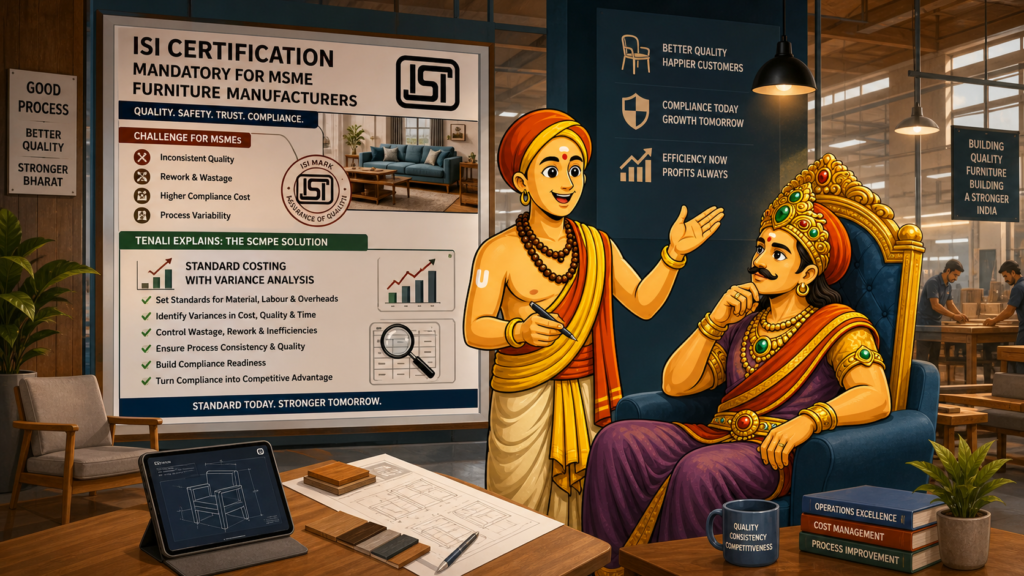
Starting 13th August, 2026, India is set to make ISI certification mandatory for furniture manufactured by MSMEs, aiming to improve product quality, safety standards, and consumer trust. (It is already mandatory for large manufacturers as on date). While the move strengthens standardization, it also creates cost, compliance, and process challenges for small manufacturers.
Tenali Explains,
“Maharaj, when a kingdom suddenly raises its quality standards, every artisan feels the pressure. Not because they lack skill, but because their processes were never designed for consistency.
You see, this ISI mandate is not just about certification. It is about process discipline. Many MSMEs operate with flexible, experience based production rather than standardized systems.
Now the real challenge is not the cost of certification… it is the hidden cost of variability; in raw material, workmanship, and quality checks.
Maharaj, this is where Standard Costing with Variance Analysis becomes the real weapon.
If MSMEs define:
Standard material specifications
Standard labour time
Standard process flow
…they can identify exactly where deviations are happening.
Instead of reacting to certification failures, they start controlling quality at the source.
Variance Analysis will tell them:
Why rework is increasing
Where material wastage is happening
Which process step is causing inconsistency
And once these are controlled… certification becomes a by-product, not a burden.
Maharaj, those who treat ISI as a compliance cost will struggle…
But those who treat it as a process optimization opportunity will dominate the market.”