
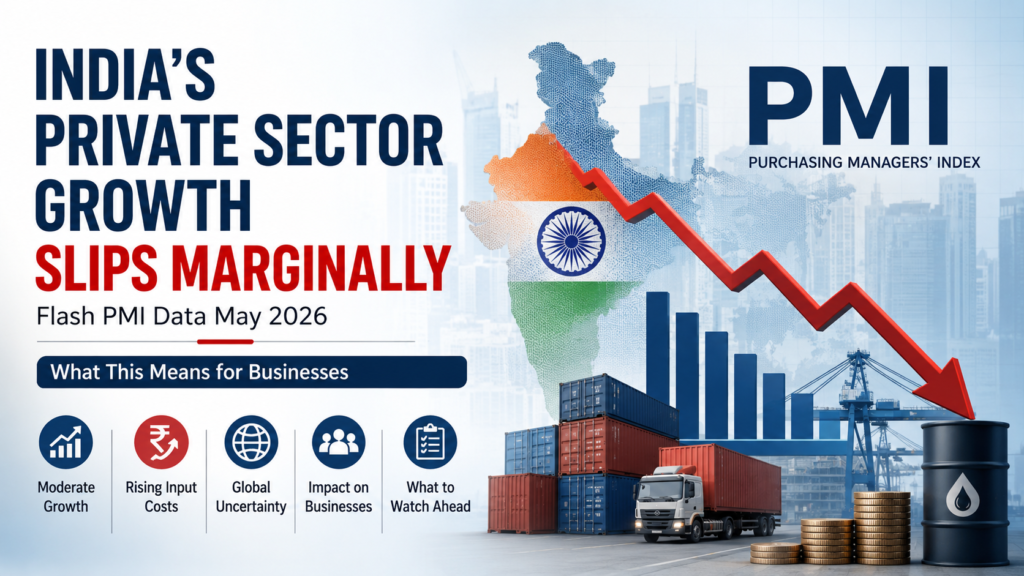
India’s private sector growth showed signs of moderation in May 2026, according to the latest flash PMI data released by HSBC and S&P Global. While the economy continues to remain in expansion mode, the pace of growth has softened slightly due to rising input costs, global geopolitical tensions, and weaker external demand. The development is important for business owners, investors, manufacturers, and service providers across India because PMI data acts as an early indicator of economic momentum.
Recent reports suggest that manufacturing activity has slowed compared to previous months, even though the services sector continues to remain relatively resilient. The impact of higher fuel costs, logistics disruptions linked to the West Asia conflict, and inflationary pressures is gradually becoming visible across industries.
What Is PMI and Why Does It Matter?
The Purchasing Managers’ Index (PMI) is one of the most closely watched economic indicators globally. It is based on surveys conducted among purchasing managers across manufacturing and services sectors. A PMI reading above 50 indicates expansion, while a reading below 50 signals contraction.
India’s PMI has remained above the 50-mark for a long period, indicating that economic activity is still growing. However, the latest flash PMI data points toward a moderation in growth momentum compared to earlier months. This slowdown is being attributed to softer domestic demand, rising raw material costs, and uncertainty in global trade conditions.
Manufacturing Sector Faces Pressure
The manufacturing sector has been one of the strongest pillars of India’s growth story over the last few years. However, recent data indicates that manufacturers are facing increasing challenges.
Higher fuel prices, elevated transportation costs, and disruptions in global supply chains are pushing up production expenses. Many businesses are also witnessing slower growth in new export orders due to weakening international demand. Reports indicate that input cost inflation has reached multi-month highs, creating pressure on profit margins.
For MSMEs and manufacturing businesses in Maharashtra, Gujarat, Tamil Nadu, and other industrial states, this environment may require tighter cost control, better inventory planning, and cautious expansion strategies.
Services Sector Continues to Support Growth
Despite pressure on manufacturing, India’s services sector continues to perform relatively better. Segments such as technology services, financial services, consulting, logistics, and domestic consumption-driven sectors are still seeing healthy demand.
Analysts note that India’s economy remains more resilient than many global economies because of strong domestic consumption and continued infrastructure spending. The services sector is helping balance the slowdown seen in manufacturing activity.
However, rising operational costs are also impacting service businesses. Companies are increasingly passing on higher costs to customers, which could influence inflation levels in the coming months.
Impact of Global Events on Indian Businesses
One of the biggest reasons behind the moderation in PMI growth is the ongoing geopolitical uncertainty in West Asia. Rising crude oil prices and supply chain disruptions are affecting transportation, imports, manufacturing costs, and inflation.
India, being a major importer of crude oil, remains vulnerable to global energy price fluctuations. Businesses dependent on imported raw materials or global trade are likely to face margin pressures if geopolitical tensions continue.
This situation also increases uncertainty for exporters, especially in sectors such as chemicals, engineering goods, textiles, and auto components.
What Businesses Should Watch in the Coming Months
Businesses should closely monitor the following indicators over the next few months:
- Crude oil prices and logistics costs
- RBI’s interest rate stance
- Inflation trends
- Export demand from global markets
- Consumer spending trends in India
- Future PMI releases
If manufacturing demand weakens further, companies may become cautious on hiring and expansion. However, if domestic consumption remains stable and inflation cools, growth momentum could improve again in the second half of FY 2026-27.
What This Means for MSMEs and Professionals
For small and medium businesses, the current environment highlights the importance of:
- Working capital management
- Cost optimisation
- Pricing strategy review
- Process efficiency improvements
- Conservative debt planning
- Diversification of customer base
Professionals such as Chartered Accountants, consultants, and financial advisors may also see increasing demand for advisory services related to cost control, profitability improvement, and cash flow management.
Frequently Asked Questions (FAQs)
What does PMI mean in economics?
PMI stands for Purchasing Managers’ Index. It measures business activity levels in manufacturing and services sectors based on surveys of purchasing managers.
Is a PMI above 50 good?
Yes. A PMI reading above 50 indicates expansion in economic activity, while a reading below 50 signals contraction.
Why did India’s private sector growth slow in May 2026?
The slowdown is linked to rising input costs, geopolitical tensions in West Asia, weaker export demand, and inflationary pressures.
Which sector is performing better currently?
The services sector is currently showing relatively stronger resilience compared to manufacturing.
How does PMI affect businesses?
PMI provides an early signal about economic conditions. Businesses use it to understand demand trends, hiring outlook, production planning, and investment decisions.
Will RBI policy be affected by slower PMI growth?
If economic growth weakens significantly, RBI may consider supportive measures. However, inflation trends will remain a major deciding factor.
Why is PMI important for investors?
Investors track PMI because it helps predict economic growth trends, corporate earnings performance, and market sentiment.