
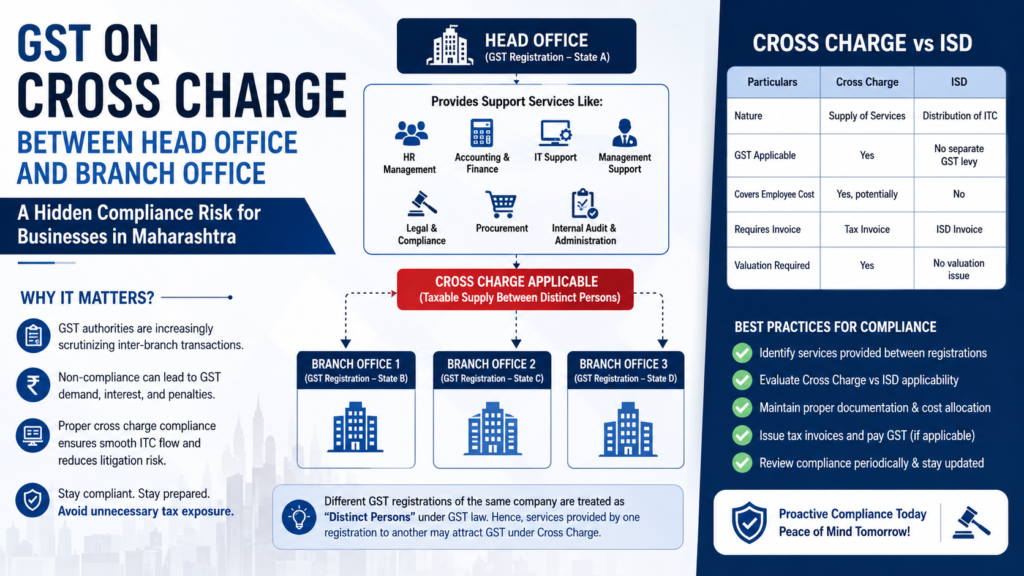
Many businesses in Maharashtra operate through multiple GST registrations across different states or business verticals. A common mistake seen during GST assessments and departmental audits is the non-compliance of “cross charge” provisions between Head Office (HO) and Branch Offices (BO). Businesses often assume that internal support activities like accounting, HR, management supervision, IT support, or administrative assistance are not taxable because no actual money is exchanged internally. However, under GST law, these transactions may still attract GST.
Cross charge compliance has become a major litigation and audit focus area, especially for companies having centralized functions at Mumbai, Pune, Nashik, Nagpur, and other commercial hubs. Understanding GST implications on cross charge is essential for avoiding penalties, interest exposure, and input tax credit disputes.
What is Cross Charge Under GST?
Cross charge refers to charging GST on services provided by one GST registration to another distinct GST registration of the same legal entity. Under GST, registrations in different states are treated as “distinct persons,” even if they belong to the same company.
For example, if the Mumbai Head Office provides accounting, HR, legal, management, or IT support to the Pune branch, such services may qualify as taxable supplies under GST.
Even when there is no actual payment between offices, GST liability can still arise because Schedule I of the CGST Act covers supplies between distinct persons made in the course or furtherance of business.
Why Cross Charge is Becoming a Major GST Litigation Area
Departmental officers are increasingly scrutinizing businesses where common expenses are incurred at Head Office level but benefit multiple branches. Common situations attracting GST notices include:
Centralized Employee Functions
Many businesses maintain centralized finance teams, HR departments, payroll teams, procurement divisions, and management staff at HO. If these services benefit branches, GST authorities may demand cross charge compliance.
Common Input Tax Credit Utilization
When Head Office avails ITC for common services like software subscriptions, consultancy, audit fees, insurance, rent, or advertisement expenses used by branches, GST authorities often question whether ISD or cross charge mechanism has been properly followed.
Salary Cost Allocation Issues
One of the biggest disputes involves salary cost allocation of HO employees rendering services to branches. Several GST investigations now examine whether employee cost attributable to branch support should be included in taxable value.
Cross Charge vs ISD – Understanding the Difference
Many taxpayers confuse Input Service Distributor (ISD) mechanism with cross charge. However, both operate differently.
| Particulars | Cross Charge | ISD |
|---|---|---|
| Nature | Supply of services | Distribution of ITC |
| GST Applicable | Yes | No separate GST levy |
| Covers Employee Cost | Yes, potentially | No |
| Requires Tax Invoice | Yes | ISD Invoice |
| Valuation Required | Yes | No valuation issue |
Businesses must carefully evaluate whether ISD alone is sufficient or whether cross charge is additionally required.
How Businesses Can Determine Cross Charge Applicability
Businesses should review the following areas:
- Centralized accounting or finance teams
- Shared management personnel
- HO-controlled IT infrastructure
- Shared legal and compliance departments
- Common procurement functions
- Shared software and ERP systems
- Marketing and branding support
- Internal audit and administration support
If these activities benefit multiple registrations, GST implications should be evaluated carefully.
Important Valuation Rules Under GST
GST valuation in cross charge cases is often complex because there may not be an actual transaction value. Rule 28 of CGST Rules generally applies.
Important valuation principles include:
- Open market value, if available
- Value of similar services
- Cost-based valuation methods
- Invoice value accepted where recipient branch has full ITC eligibility
Proper documentation and valuation methodology are essential during departmental audits.
Common Mistakes Businesses Make
Ignoring Internal Services
Many businesses believe GST applies only when invoices are raised externally. Internal support activities are often ignored completely.
Non-Maintenance of Working Papers
Businesses frequently fail to maintain allocation workings for employee costs, software usage, management time, or shared expenses.
Wrong Reliance on ISD
Some companies distribute ITC through ISD but completely ignore taxable service component under cross charge provisions.
No Documentation for Branch Support
Absence of agreements, SOPs, timesheets, or cost allocation basis weakens the taxpayer’s position during scrutiny.
Practical Example of Cross Charge
Suppose a company’s Mumbai Head Office handles:
- HR management
- Payroll processing
- Accounting
- Internal audit
- IT support
for branches located in Pune, Ahmedabad, and Bengaluru.
Even though branches belong to the same company, these services may constitute taxable supply between distinct persons. HO may need to raise GST invoices on branches for the proportionate value of services rendered.
GST Department’s Current Focus Areas
Recent GST investigations increasingly examine:
- Employee cost allocation
- HO expense distribution
- ERP and software expense sharing
- Shared management services
- Cross-state branch operations
- Common vendor contracts
- Input tax credit distribution mismatch
Businesses with large multi-state operations are facing higher scrutiny, especially during GST audits and DGGI investigations.
How Businesses in Maharashtra Can Reduce GST Litigation Risk
Businesses should adopt structured compliance practices such as:
- Performing periodic cross charge reviews
- Creating cost allocation methodologies
- Maintaining internal documentation
- Reviewing employee role mapping
- Evaluating ISD vs cross charge applicability
- Reconciling common ITC usage
- Conducting GST health checks for branch transactions
A proactive review can significantly reduce future GST disputes and interest liabilities.
What Happens if Cross Charge is Ignored?
Non-compliance may result in:
- GST demand with interest
- Penalties during audit
- ITC disputes at branch level
- Extended litigation
- DGGI investigations
- Reversal of excess ITC claims
Since these disputes usually involve multiple financial years, exposure amounts can become substantial.
What is cross charge in GST?
Cross charge refers to GST applicability on services provided between different GST registrations of the same legal entity treated as distinct persons under GST law.
Why is cross charge important for businesses?
Improper cross charge compliance can lead to GST notices, interest liability, penalties, and ITC disputes during audits.
How is cross charge different from ISD?
ISD only distributes eligible input tax credit, whereas cross charge involves actual taxable supply of services between distinct persons.
When should a business raise cross charge invoices?
Cross charge invoices may be required when one GST registration provides administrative, managerial, technical, or support services to another registration.
Can employee salary cost be included in cross charge?
Yes, GST authorities increasingly examine whether employee cost attributable to branch support should form part of taxable valuation.
FAQs
Is cross charge mandatory under GST?
It depends on the nature of activities performed between distinct registrations. Businesses must evaluate factual applicability carefully.
Does cross charge apply even without payment?
Yes. GST may still apply because supplies between distinct persons under Schedule I can be taxable even without consideration.
Can a company use only ISD and avoid cross charge?
Not always. ISD covers ITC distribution, but service components may still require cross charge compliance.
Is GST payable on HO employee salaries allocated to branches?
This is a litigative area. However, GST authorities increasingly scrutinize employee cost allocations during audits.
Which businesses are most affected by cross charge provisions?
Companies having multi-state GST registrations, centralized operations, shared management functions, and common support departments are most affected.
Can improper cross charge affect ITC claims?
Yes. Incorrect treatment may lead to denial or dispute of input tax credit during assessments.
How can businesses prepare for GST audits related to cross charge?
Businesses should maintain proper documentation, valuation workings, cost allocation basis, agreements, and internal compliance reviews.