
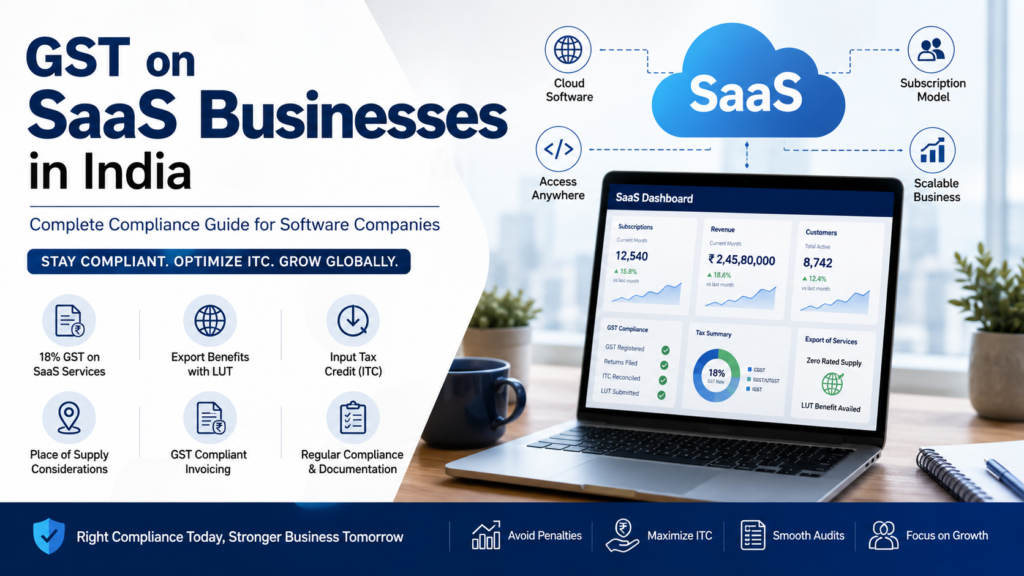
The Software as a Service (SaaS) industry has witnessed remarkable growth in India. From startup founders developing subscription-based software to established technology companies serving global clients, SaaS businesses are becoming a major contributor to the digital economy. However, GST compliance for SaaS companies remains a complex area due to issues such as place of supply, export of services, foreign currency receipts, and taxation of subscription-based revenue.
Understanding the GST implications applicable to SaaS businesses is essential for avoiding tax disputes, optimizing Input Tax Credit (ITC), and ensuring smooth business operations.
What Is a SaaS Business Under GST?
Software as a Service (SaaS) refers to software applications delivered over the internet on a subscription basis. Instead of purchasing software outright, customers access the software through cloud-based platforms.
Examples include:
- Accounting software
- CRM platforms
- HR management systems
- Project management tools
- ERP solutions
- Online productivity applications
Under GST, SaaS is generally treated as a supply of services rather than a supply of goods.
This classification significantly impacts GST rates, place of supply provisions, invoicing requirements, and export benefits.
GST Rate Applicable to SaaS Services
Most SaaS services attract GST at 18%.
The GST liability generally arises when subscription fees are charged to customers, whether monthly, quarterly, or annually.
Businesses should ensure proper classification of services while preparing invoices and filing GST returns.
Incorrect classification can lead to notices, interest liability, and compliance challenges during GST audits.
GST on SaaS Services Supplied to Indian Customers
When SaaS services are provided to customers located within India, GST is generally applicable at 18%.
The nature of tax depends upon the location of supplier and recipient:
- CGST + SGST for intra-state transactions
- IGST for inter-state transactions
The supplier must issue GST-compliant tax invoices and report the transactions in regular GST returns.
Subscription-based revenue models should be carefully monitored to ensure accurate tax computation and timely payment of GST.
Export of SaaS Services and Zero-Rated Benefits
Many Indian SaaS companies generate a significant portion of their revenue from overseas customers.
Where prescribed GST conditions are satisfied, SaaS services supplied to foreign customers may qualify as export of services.
Key conditions generally include:
- Supplier located in India
- Recipient located outside India
- Place of supply outside India
- Payment received in convertible foreign exchange or permitted modes
- Supplier and recipient not merely establishments of the same person
Exports are treated as zero-rated supplies under GST.
This allows eligible businesses to:
- Export under LUT without payment of IGST
- Claim refund of unutilized Input Tax Credit
- Improve working capital efficiency
Proper documentation becomes critical while claiming export benefits.
Place of Supply Challenges for SaaS Companies
One of the most litigated areas for SaaS businesses is determining the correct place of supply.
In digital businesses, customers may:
- Register from one country
- Make payments from another country
- Access software from multiple locations
Incorrect determination of place of supply can result in disputes regarding export eligibility and tax liability.
SaaS companies should maintain robust customer onboarding records, contractual documentation, billing information, and payment evidence to support their GST position.
Input Tax Credit Available to SaaS Businesses
SaaS companies generally incur significant expenditure on:
- Cloud hosting services
- Software subscriptions
- Professional consultancy
- Marketing expenses
- Office rentals
- Employee-related facilities
Subject to GST provisions and eligibility conditions, businesses may claim Input Tax Credit on eligible inward supplies.
Regular reconciliation of vendor invoices with GST returns helps avoid ITC mismatches and future litigation.
An effective ITC management process can significantly reduce the overall tax cost of a growing SaaS business.
GST Compliance Checklist for SaaS Startups
Technology startups often focus heavily on product development and customer acquisition while overlooking GST compliance.
Every SaaS business should periodically review:
- GST registration requirements
- Place of supply determination
- Export documentation
- LUT filings
- Invoice compliance
- ITC reconciliation
- GST return filings
Early compliance planning can prevent substantial tax exposure as the business scales.
Common GST Mistakes Made by SaaS Businesses
Many SaaS companies unknowingly commit compliance errors that later become subjects of departmental scrutiny.
Some common mistakes include:
- Treating all foreign customers as exports without verifying conditions
- Failure to obtain LUT before exporting without payment of tax
- Incorrect place of supply determination
- Claiming ineligible ITC
- Inadequate contractual documentation
- Errors in subscription invoicing
A proactive GST review can help identify and rectify these issues before they result in notices or penalties.
What Documents Should SaaS Exporters Maintain?
SaaS exporters should preserve customer agreements, invoices, payment realization records, LUT copies, customer location evidence, onboarding documents, and correspondence establishing the nature of services. Proper documentation is often the strongest defense during GST audits and refund proceedings.
How Can SaaS Companies Improve GST Efficiency?
Businesses should integrate GST considerations into their customer onboarding, invoicing, and finance systems. Regular GST health checks, automation of compliance processes, and timely reconciliation of returns can significantly reduce compliance risks while maximizing available tax benefits.
FAQs
Is GST applicable on SaaS services in India?
Yes. SaaS services are generally taxable under GST and typically attract GST at 18%.
Is SaaS treated as goods or services under GST?
SaaS is generally treated as a supply of services for GST purposes.
Can SaaS exports be made without payment of GST?
Yes. Eligible exporters may furnish a Letter of Undertaking (LUT) and export services without payment of IGST.
Can SaaS companies claim Input Tax Credit?
Yes. Eligible ITC can generally be claimed on business-related inward supplies subject to GST conditions.
What is the biggest GST risk for SaaS companies?
Incorrect determination of place of supply and wrongful treatment of transactions as exports are among the most significant GST risks.
Is GST registration mandatory for SaaS startups?
Registration requirements depend upon turnover, nature of supply, and other statutory provisions applicable to the business.
What records should SaaS businesses maintain for GST compliance?
Businesses should maintain contracts, invoices, customer location records, payment receipts, GST returns, LUT documentation, and ITC reconciliation records.