
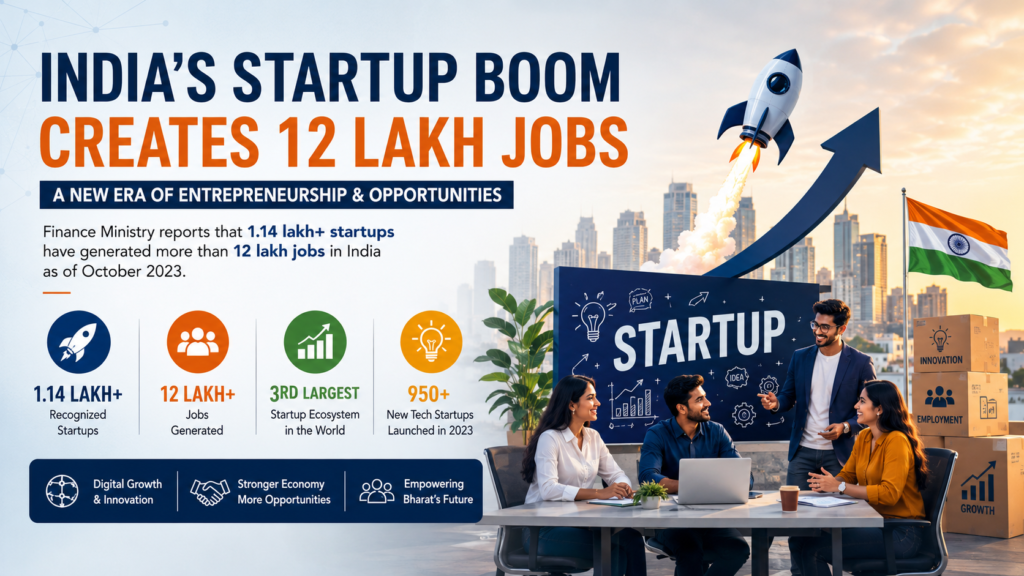
India’s startup ecosystem continues to make headlines, and for good reason. According to the Finance Ministry, more than 1.14 lakh government-recognized startups have generated over 12 lakh jobs across the country. Even during a period marked by global economic uncertainty, funding challenges, and geopolitical disruptions, Indian entrepreneurship has demonstrated remarkable resilience.
For small business owners in Maharashtra and across India, this development is more than just a startup success story. It highlights changing business trends, new market opportunities, and lessons that traditional businesses can adopt to remain competitive in a rapidly evolving economy.
India’s Startup Ecosystem Is Becoming a Major Employment Engine
The Department of Economic Affairs reported that startups recognized under the Startup India initiative created over 12 lakh jobs as of October 2023. India also retained its position as the world’s third-largest startup ecosystem, with more than 950 technology startups launched during 2023.
This achievement is significant because startups are no longer concentrated only in major metropolitan cities. Increasingly, entrepreneurs from Tier-2 and Tier-3 cities are building innovative businesses, creating local employment opportunities and contributing to regional economic development.
For local businesses, this means stronger local economies, higher purchasing power, and expanding customer bases.
What Is Driving Startup Growth in India?
Several factors have contributed to this growth:
- Increased digital adoption by businesses and consumers
- Government initiatives supporting entrepreneurship
- Improved ease of doing business
- Availability of startup funding and incubation support
- Growing acceptance of technology-based business models
- Expansion of digital commerce platforms such as ONDC
The Finance Ministry also highlighted that the Open Network for Digital Commerce (ONDC) crossed 63 lakh transactions by November 2023, demonstrating the increasing importance of digital marketplaces for businesses of all sizes.
Key Lessons for Micro and Small Business Owners
Many business owners assume that startup success is only relevant for technology companies. However, the principles driving startup growth can be applied to traditional businesses as well.
Businesses can benefit by:
- Adopting digital tools for sales and operations
- Improving customer experience
- Using data for decision-making
- Exploring online marketplaces
- Focusing on operational efficiency
- Developing new products and services based on customer needs
The most successful startups are not necessarily those with the largest investments. They are often the businesses that solve real customer problems efficiently and adapt quickly to changing market conditions.
Why This Matters for Maharashtra’s Business Community
Maharashtra continues to be one of India’s leading entrepreneurial hubs. The growth of startups creates indirect opportunities for:
- Manufacturers
- Service providers
- Logistics businesses
- Professional consultants
- Technology vendors
- Local suppliers
As startups expand, they create demand throughout the business ecosystem. Small enterprises that position themselves as reliable partners can benefit significantly from this growth trend.
What does the Finance Ministry’s report reveal?
The report states that more than 1.14 lakh recognized startups have generated over 12 lakh jobs in India as of October 2023.
Why is startup growth important for the economy?
Startups drive innovation, create employment opportunities, attract investment, and improve productivity across industries.
How can traditional businesses benefit from the startup ecosystem?
Traditional businesses can become suppliers, service providers, technology partners, or customers of growing startups.
When did India become the world’s third-largest startup ecosystem?
India has maintained its position among the top startup ecosystems globally, with continued growth despite global economic challenges.
Where are new startup opportunities emerging?
Increasingly, startup activity is expanding beyond major cities into Tier-2 and Tier-3 locations, creating opportunities across India.
FAQs
1. How many startups are recognized under Startup India?
The Finance Ministry report cited over 1.14 lakh recognized startups as of October 2023.
2. How many jobs have Indian startups created?
More than 12 lakh direct jobs have been created by recognized startups.
3. Is startup growth limited to technology companies?
No. Startups operate in sectors such as manufacturing, healthcare, agriculture, logistics, education, and professional services.
4. Can small businesses collaborate with startups?
Yes. Many startups require suppliers, consultants, manufacturers, distributors, and operational partners.
5. What role does digitalization play in startup success?
Digital tools help businesses improve efficiency, reach more customers, reduce costs, and make better decisions.
6. What is ONDC and why is it important?
ONDC is an open digital commerce network designed to create broader market access for businesses and consumers. It crossed 63 lakh transactions by November 2023.
7. What is the biggest takeaway for small business owners?
The biggest lesson is that adaptability, innovation, and customer-focused decision-making are becoming more important than business size in determining long-term success.
Conclusion
India’s startup ecosystem has moved beyond being a niche segment of the economy. With more than 12 lakh jobs created and continued expansion into smaller cities, startups are reshaping how businesses operate and grow. For micro and small business owners, the message is clear: businesses that embrace innovation, digital transformation, and continuous improvement will be better positioned to thrive in the next phase of India’s economic growth.