
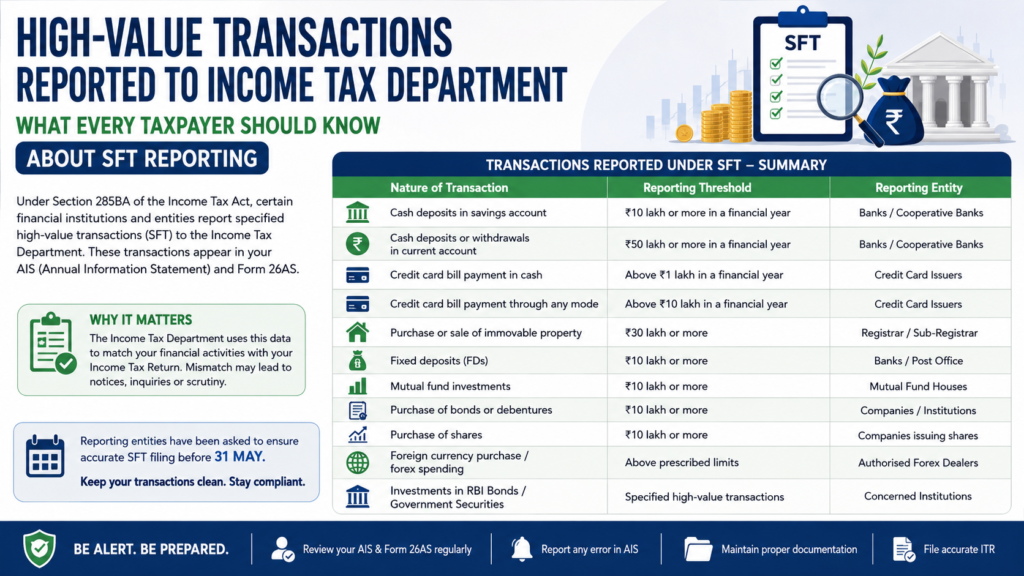
The Income Tax Department is increasingly using technology, AIS (Annual Information Statement), and data analytics to track high-value financial transactions of taxpayers. Many people are surprised when they receive income tax notices for transactions they never disclosed in their Income Tax Return. In most cases, these transactions are already reported to the department through SFT reporting by banks, mutual funds, registrars, property authorities, and other financial institutions.
As the Income Tax Department has recently reminded reporting entities to ensure accurate SFT filing before the 31 May deadline, taxpayers in Pune, Pimpri-Chinchwad, and across India should also understand which of their transactions are automatically reported to the department.
What is SFT Reporting in Income Tax?
Statement of Financial Transactions (SFT) is a reporting system under Section 285BA of the Income Tax Act. Certain entities like banks, mutual funds, registrars, companies, and financial institutions are required to report specified high-value transactions of taxpayers to the Income Tax Department.
These transactions later appear in:
- AIS (Annual Information Statement)
- Form 26AS
- Compliance monitoring systems of the department
The department then compares this data with your Income Tax Return (ITR), declared income, and tax profile.
Summary Table: Transactions Reported to Income Tax Department Under SFT
| Nature of Transaction | Reporting Threshold | Reporting Entity |
|---|---|---|
| Cash deposits in savings account | ₹10 lakh or more in a financial year | Banks / Cooperative Banks |
| Cash deposits or withdrawals in current account | ₹50 lakh or more in a financial year | Banks / Cooperative Banks |
| Credit card bill payment in cash | Above ₹1 lakh in a financial year | Credit Card Issuers |
| Credit card bill payment through any mode | Above ₹10 lakh in a financial year | Credit Card Issuers |
| Purchase or sale of immovable property | ₹30 lakh or more | Registrar / Sub-Registrar |
| Fixed deposits (FDs) | ₹10 lakh or more | Banks / Post Office |
| Mutual fund investments | ₹10 lakh or more | Mutual Fund Houses |
| Purchase of bonds or debentures | ₹10 lakh or more | Companies / Institutions |
| Purchase of shares | ₹10 lakh or more | Companies issuing shares |
| Foreign currency purchase / forex spending | Above prescribed limits | Authorised Forex Dealers |
| Investments in RBI Bonds / Government Securities | Specified high-value transactions | Concerned Institutions |
Why Taxpayers Should Be Careful About SFT Transactions
Many taxpayers assume that if TDS is deducted properly, there will be no issue. However, the Income Tax Department now monitors overall financial behaviour through SFT reporting.
If your reported transactions are significantly higher than your declared income, it may trigger:
- Income tax notices
- AIS mismatch alerts
- Scrutiny assessments
- Requests for source of funds explanation
This is particularly important for salaried employees, business owners, investors, and property buyers.
Cash Deposits in Savings Accounts
Banks may report cash deposits aggregating to ₹10 lakh or more in savings accounts during the financial year.
This is especially relevant for:
- Traders dealing in cash
- Small businesses
- Individuals depositing unaccounted cash
Frequent large cash deposits inconsistent with declared income may attract scrutiny.
Cash Deposits or Withdrawals in Current Accounts
Cash deposits or withdrawals exceeding ₹50 lakh in current accounts may be reported by banks and cooperative banks.
Business owners should ensure proper accounting records and GST reconciliation for such transactions.
Credit Card Bill Payments
Credit card companies may report:
- Cash payments exceeding ₹1 lakh against credit card bills
- Total payments exceeding ₹10 lakh through any mode during the year
Luxury spending patterns beyond declared income levels often become a scrutiny trigger.
Purchase or Sale of Immovable Property
Property transactions valued at ₹30 lakh or more may be reported by registrars and sub-registrars.
Even if the agreement value appears lower, stamp duty valuation and actual transaction details may still be tracked by the department.
This provision is important for:
- Real estate investors
- Joint property buyers
- Land transactions
- Redevelopment deals
Fixed Deposits (FDs)
Banks and post offices may report fixed deposits aggregating to ₹10 lakh or more in a financial year.
Large FD investments without sufficient disclosed income may raise compliance questions.
Mutual Fund Investments
Mutual fund houses may report investments of ₹10 lakh or more in a financial year.
The Income Tax Department can match these investments with:
- Capital gains disclosures
- Dividend income
- Declared savings and investments
Share Transactions
Large share investments or share buybacks may also be reported in specified situations.
Frequent high-value trading activity inconsistent with ITR disclosures may trigger inquiry notices.
Foreign Currency Transactions
Foreign exchange purchases exceeding prescribed limits through authorised dealers may be reported.
This includes:
- Foreign travel spending
- Forex card loading
- International remittances
How to Check Your SFT Transactions
Taxpayers can review reported transactions through:
- AIS (Annual Information Statement)
- Form 26AS
- Income Tax portal
It is advisable to verify AIS before filing ITR to avoid mismatch notices later.
What if Incorrect Transactions Appear in AIS?
Sometimes banks or reporting entities may incorrectly report transactions due to:
- Wrong PAN mapping
- Duplicate entries
- Incorrect transaction classification
In such cases, taxpayers should:
- Review AIS carefully
- Submit feedback on the portal
- Maintain supporting documents
- Seek professional tax assistance if required
Important Precautions for Taxpayers
To avoid unnecessary notices from the Income Tax Department:
- Avoid unexplained cash transactions
- Ensure ITR reflects actual financial activity
- Match income with investments and spending patterns
- Review AIS annually before return filing
- Maintain proper documentation for large transactions
Increasing Use of AI-Based Tax Monitoring
The Income Tax Department is rapidly expanding AI-driven compliance systems. High-value transactions are now automatically compared with:
- Income tax returns
- GST filings
- TDS records
- Property registrations
- Banking data
As a result, financial transparency has become more important than ever for taxpayers.
Frequently Asked Questions (FAQs)
What is SFT in income tax?
SFT stands for Statement of Financial Transactions, where specified entities report high-value transactions to the Income Tax Department.
Can cash deposits trigger income tax notice?
Yes. Large cash deposits inconsistent with declared income may trigger scrutiny or notices.
Are property purchases reported to Income Tax Department?
Yes. Property transactions above prescribed limits are generally reported through SFT provisions.
Can I check transactions reported against my PAN?
Yes. You can check them in AIS and Form 26AS on the Income Tax portal.
Is mutual fund investment reported to Income Tax Department?
Yes. High-value mutual fund investments may be reported by fund houses.
What happens if AIS shows incorrect transactions?
You can submit feedback on the Income Tax portal and maintain supporting evidence for correction.
Are credit card payments monitored by Income Tax Department?
Yes. High-value credit card bill payments may be reported under SFT provisions.