
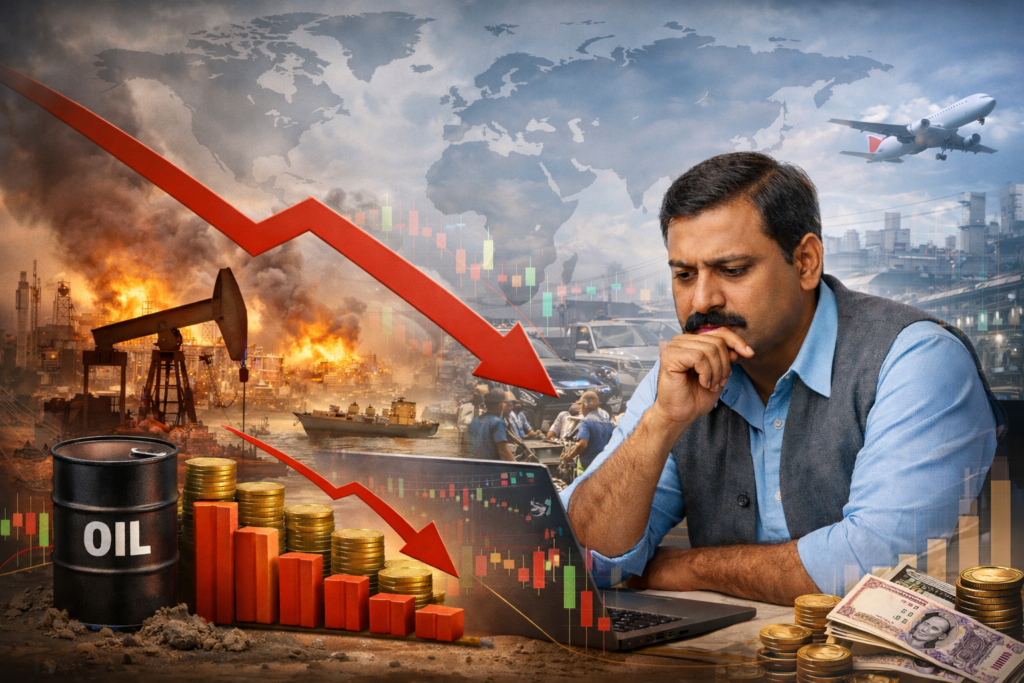
The recent escalation of geopolitical tensions in West Asia has started impacting global economic stability. According to a report published by The Hindu (April 2026), the International Monetary Fund is expected to revise downward its global growth forecast due to prolonged uncertainty arising from the conflict. For businesses in India, especially MSMEs in industrial hubs like Pune and PCMC, this development is not just global news—it has direct implications on demand, costs, and financial planning.
Global Growth Slowdown: What’s Driving the IMF’s Concern?
The IMF’s decision to cut growth projections stems from rising geopolitical risks and their ripple effects across global supply chains and energy markets.
- The West Asia conflict has pushed crude oil prices upward, increasing global inflationary pressure.
- Trade disruptions and uncertainty are affecting investor sentiment and capital flows.
- Developed economies are likely to witness slower consumption, impacting exports from emerging markets like India.
For Indian businesses, particularly those dependent on exports or imported raw materials, this creates a dual challenge—higher costs and uncertain demand.
Impact on Indian MSMEs and Local Businesses
The slowdown in global growth may not hit immediately but will gradually influence business operations in India.
- Rising Input Costs: Increase in fuel and logistics costs directly affects manufacturing and service delivery.
- Export Pressure: Reduced demand from global markets can impact sectors like auto components, textiles, and engineering goods.
- Credit Tightening: Banks and NBFCs may adopt cautious lending practices amid global uncertainty.
For MSMEs in regions like Chinchwad and Pimpri, which are heavily export-linked manufacturing zones, this could lead to margin pressure and working capital challenges.
Strategic Business Response in Uncertain Times
In such a macroeconomic environment, businesses must shift focus from aggressive expansion to resilience and cost efficiency.
- Strengthening cash flow management becomes critical.
- Diversification of customer base (domestic + international) reduces dependency risk.
- Negotiating long-term contracts with suppliers can stabilize input costs.
Businesses that proactively adapt to these conditions will be better positioned to sustain profitability despite global headwinds.
WH Questions
What is the IMF’s latest outlook on global growth?
The IMF is expected to lower global growth projections due to rising geopolitical tensions and economic uncertainty caused by the West Asia conflict.
Why does the West Asia conflict affect global economies?
Because the region is critical for oil supply, disruptions lead to higher energy prices, inflation, and reduced economic activity worldwide.
How will this impact Indian businesses?
Indian businesses may face higher costs, reduced export demand, and tighter financing conditions.
When will the impact be visible in India?
The effects are likely to unfold gradually over the next few quarters as global economic slowdown transmits to domestic markets.
Where will the biggest impact be seen?
Export-oriented sectors and fuel-dependent industries such as logistics, manufacturing, and aviation.
FAQs
1. Will this IMF forecast directly impact Indian GDP?
Not directly, but it influences external demand and investor sentiment, which indirectly affects India’s growth trajectory.
2. Which sectors in India are most vulnerable?
Auto components, textiles, chemicals, and engineering goods due to export dependency and fuel costs.
3. Should MSMEs be worried about liquidity issues?
Yes, especially if working capital cycles lengthen due to delayed payments or reduced orders.
4. How can businesses hedge against rising costs?
By locking in prices through contracts, optimizing supply chains, and reducing operational inefficiencies.
5. Is this slowdown temporary or long-term?
It depends on the duration of the conflict. Prolonged instability can have medium-term economic consequences.
6. What role do banks play during such global slowdowns?
Banks may tighten credit norms, making it important for businesses to maintain strong financial discipline.
7. Can domestic demand offset global slowdown?
To some extent, yes. India’s strong domestic consumption can cushion the impact, but export-driven sectors may still feel pressure.
This development underscores a critical lesson for businesses: global events increasingly shape local outcomes. Staying informed and financially agile is no longer optional—it is essential for survival and growth.