
Receiving an income tax notice can be unsettling, especially for salaried individuals, business owners, and professionals in Pune. However, not all notices indicate a problem—they are often issued for verification, correction, or additional information. With increasing use of AIS (Annual Information Statement) and data analytics by the Income Tax Department, notices have become more frequent but also more systematic.
Understanding the nature of the notice and responding correctly within the stipulated time is critical. Ignoring a notice can lead to penalties, interest, or even scrutiny proceedings. This guide explains the types of notices, reasons, and step-by-step response strategy to help taxpayers handle them confidently.
Types of Income Tax Notices You May Receive
The Income Tax Department issues different notices depending on the situation. Identifying the section mentioned in the notice is the first step toward proper compliance.
- Section 143(1) – Intimation Notice
Issued after processing of return for arithmetical errors or mismatches. - Section 139(9) – Defective Return
Sent when the filed return is incomplete or incorrect. - Section 143(2) – Scrutiny Notice
Issued for detailed examination of your return. - Section 148 – Income Escaping Assessment
Applicable when income is suspected to be unreported. - Section 245 – Adjustment Notice
For adjusting refunds against outstanding demand.
Each notice comes with a response deadline, usually ranging from 15 to 30 days.
Why Do You Receive an Income Tax Notice?
Most notices arise due to data mismatches or incomplete disclosures. With AIS and Form 26AS integration, even small discrepancies are flagged.
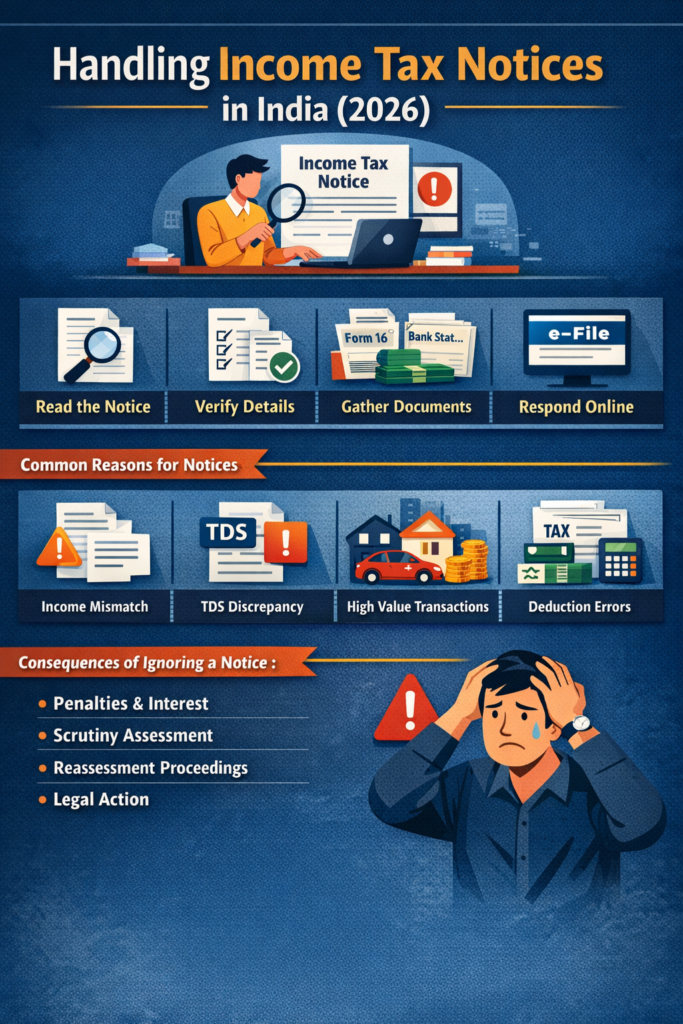
Common reasons include:
- Mismatch between ITR and AIS/Form 26AS
- Incorrect claim of deductions under Chapter VI-A
- High-value transactions (property, shares, cash deposits)
- Non-reporting of interest or capital gains
- TDS mismatch or non-reporting
For example, if bank interest is reflected in AIS but not declared in your return, the system automatically triggers a notice.
Step-by-Step Process to Respond to a Tax Notice
Handling a notice properly ensures faster resolution and avoids escalation.
Step 1: Read the Notice Carefully
Check the section, assessment year, and reason mentioned.
Step 2: Verify the Details
Compare notice details with your ITR, AIS, and Form 26AS.
Step 3: Collect Supporting Documents
Gather Form 16, bank statements, investment proofs, and transaction records.
Step 4: Respond Online
Log in to the income tax portal and submit your response under “e-Proceedings”.
Step 5: Revise Return if Required
If errors are found, file a revised return within the allowed time.
Step 6: Seek Professional Help
For scrutiny or complex notices, consult a Chartered Accountant.
Consequences of Ignoring an Income Tax Notice
Ignoring notices can lead to serious consequences:
- Penalty under Section 271 or other provisions
- Interest on unpaid tax
- Best judgment assessment by department
- Scrutiny or reassessment proceedings
- Prosecution in extreme cases
Timely compliance helps avoid unnecessary complications.
What should you do immediately after receiving an income tax notice?
You should first verify the authenticity of the notice on the income tax portal, carefully read the section and reason mentioned, and then compare it with your filed return and AIS data. Based on the issue, submit an appropriate response online or file a revised return within the deadline.
FAQs
1. Is receiving an income tax notice a serious issue?
Not always. Many notices are routine communications for verification or minor corrections.
2. How can I check if the notice is genuine?
Log in to the income tax portal and verify the notice under the “e-Proceedings” section.
3. Can I ignore a notice if the amount involved is small?
No. Ignoring any notice can lead to penalties and further legal action.
4. What is the time limit to respond to a notice?
Typically 15–30 days, but it varies depending on the section mentioned.
5. Can I revise my return after receiving a notice?
Yes, if the issue relates to errors in the original return and the time limit permits.
6. Do I need a CA for responding to notices?
For simple notices, you can respond yourself. However, for scrutiny or reassessment, professional help is advisable.
7. What if I miss the deadline to respond?
You may face penalties or adverse assessment, but in some cases, condonation or late response options may be available.