
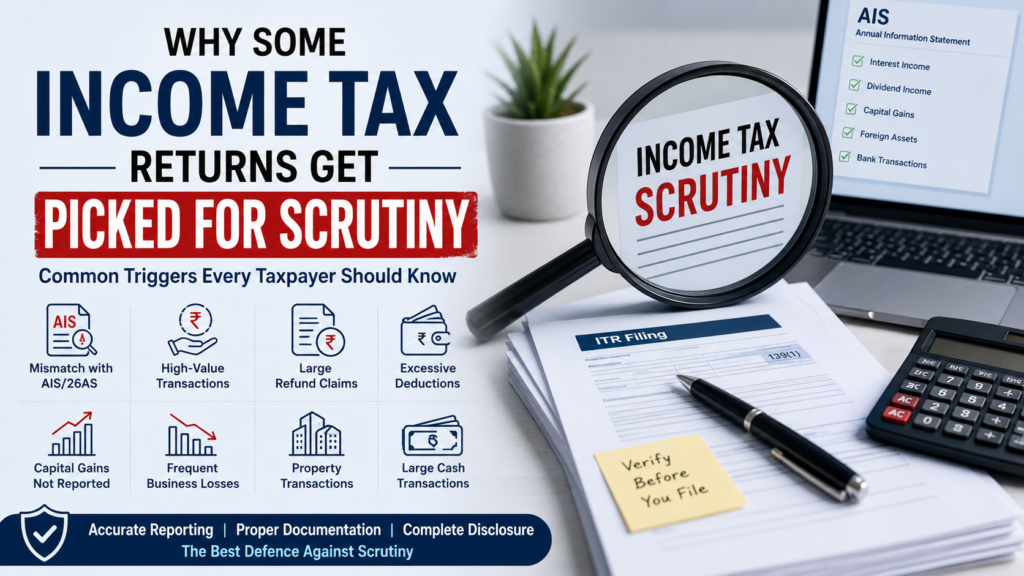
Income Tax Return (ITR) filing is not just about submitting your return before the due date. The Income Tax Department uses advanced data analytics, Artificial Intelligence, Annual Information Statements (AIS), Tax Deducted at Source (TDS) data, and information received from banks, mutual funds, registrars, and other reporting entities to verify the accuracy of returns filed by taxpayers.
Many taxpayers assume that filing an ITR automatically closes the tax compliance process. However, certain returns are selected for scrutiny assessment to verify whether the income reported and taxes paid are correct. Understanding the common reasons behind scrutiny can help taxpayers avoid unnecessary notices and litigation.
What Is Income Tax Scrutiny?
Scrutiny assessment is a detailed examination of a taxpayer’s return by the Income Tax Department. The objective is to verify:
- Accuracy of income reported
- Legitimacy of deductions and exemptions claimed
- Correctness of tax computation
- Consistency between return data and information available with the department
Selection for scrutiny does not automatically mean tax evasion or wrongdoing. In many cases, the department simply seeks clarification or supporting documents.
How Does the Income Tax Department Select Returns for Scrutiny?
The department relies heavily on technology-driven risk assessment systems. Returns are compared with data available through:
- Annual Information Statement (AIS)
- Form 26AS
- TDS and TCS returns
- Statement of Financial Transactions (SFT)
- GST records
- Property registration databases
- Securities transaction records
- Foreign asset reporting information
Any mismatch or unusual transaction may increase the chances of a return being selected for scrutiny.
Common Reasons Why an ITR May Be Picked for Scrutiny
1. Significant Mismatch Between AIS and ITR
The most common trigger is a mismatch between income reported in the ITR and information appearing in AIS or Form 26AS.
Examples include:
- Interest income not reported
- Dividend income omitted
- Capital gains not disclosed
- Rental income underreported
Even small omissions can trigger automated alerts.
2. High-Value Financial Transactions
The department receives information regarding specified high-value transactions through SFT reporting.
Examples include:
| Transaction Type | Potential Reporting Trigger |
|---|---|
| Large cash deposits | Above prescribed limits |
| Purchase of property | High-value immovable property transactions |
| Mutual fund investments | Significant investments |
| Credit card payments | Large annual spending |
| Purchase of shares or securities | High-value investments |
| Foreign travel expenditure | Significant overseas spending |
If spending patterns do not align with declared income, scrutiny risk increases.
3. Large Refund Claims
Returns claiming unusually high refunds often receive additional attention.
The department may verify:
- TDS claims
- Tax payments
- Exemptions claimed
- Losses carried forward
- Deduction eligibility
Taxpayers should ensure supporting documents are available before claiming substantial refunds.
4. Excessive Deduction Claims
Claiming deductions is perfectly legal, but unusually high deductions compared to income levels may attract scrutiny.
Common areas include:
- Section 80C deductions
- Section 80D medical insurance deductions
- House rent allowance claims
- Home loan interest deductions
- Donations under Section 80G
Maintaining proper documentary evidence is essential.
5. Capital Gains Not Properly Reported
Many taxpayers assume that tax has already been deducted on investments and therefore fail to disclose transactions.
The department closely tracks:
- Share transactions
- Mutual fund redemptions
- Property sales
- Bond transfers
- Cryptocurrency transactions (where applicable)
Non-reporting or incorrect reporting of capital gains is a frequent reason for notices.
6. Frequent Business Losses
Business owners or professionals consistently reporting losses while continuing operations may attract attention.
The department may seek clarification regarding:
- Business viability
- Expense claims
- Related-party transactions
- Loss computation methodology
7. Sudden Increase or Decrease in Income
A significant variation in income compared to previous years may trigger risk-based verification.
Examples include:
- Income dropping sharply despite unchanged lifestyle
- Large increase in expenses
- Significant reduction in profit margins
- Major capital introduction without explanation
Such cases may require supporting evidence.
8. Property Transactions
Real estate transactions remain a major focus area for tax authorities.
Common scrutiny triggers include:
- Sale consideration lower than stamp duty value
- Non-reporting of property sale
- Claiming incorrect exemptions under Sections 54 or 54F
- Mismatch in property transaction records
Proper documentation and reporting are critical.
9. Cash Transactions
Despite increasing digitisation, large cash transactions continue to attract scrutiny.
Examples include:
- Large cash deposits
- Cash withdrawals inconsistent with declared income
- Cash-intensive business operations
- Significant cash purchases
Taxpayers should maintain proper records explaining the source and use of cash.
What Happens If Your Return Is Selected for Scrutiny?
The process generally involves:
- Receipt of notice from the Income Tax Department.
- Submission of supporting documents and explanations.
- Verification of income, deductions, and transactions.
- Assessment by the tax officer.
- Passing of an assessment order.
Responding promptly and accurately is crucial.
How Can Taxpayers Reduce Scrutiny Risk?
To minimise the chances of receiving a notice:
- Match ITR data with AIS and Form 26AS before filing.
- Report all income sources.
- Disclose capital gains accurately.
- Maintain documentary evidence for deductions.
- Verify TDS credits.
- Report foreign assets and income wherever applicable.
- Ensure consistency between lifestyle, investments, and declared income.
- Review high-value transactions before filing the return.
What Should You Do Before Filing Your ITR?
Before submitting your return:
- Download and review AIS.
- Verify Form 26AS.
- Reconcile bank interest income.
- Check dividend income.
- Verify capital gains statements.
- Review property transactions.
- Confirm deduction documentation.
- Match TDS with employer and deductor records.
A thorough review can significantly reduce future compliance issues.
Frequently Asked Questions (FAQs)
What does scrutiny of an income tax return mean?
Scrutiny is a detailed examination of a taxpayer’s return by the Income Tax Department to verify the correctness of income, deductions, exemptions, and tax calculations.
Does receiving a scrutiny notice mean I have done something wrong?
No. A scrutiny notice does not necessarily indicate tax evasion. It may simply mean the department requires additional information or verification.
Can salaried employees also receive scrutiny notices?
Yes. Salaried taxpayers can receive notices if there are mismatches in income reporting, deduction claims, capital gains disclosures, or high-value transactions.
Is AIS important while filing an ITR?
Yes. AIS contains financial information available with the Income Tax Department. Taxpayers should reconcile their return with AIS before filing.
Can high-value credit card spending trigger scrutiny?
Yes. Significant spending that appears disproportionate to declared income may attract the department’s attention.
Are property transactions closely monitored by the tax department?
Yes. Property purchases and sales are among the most scrutinised transactions due to extensive third-party reporting mechanisms.
How long should taxpayers preserve supporting documents?
As a good compliance practice, taxpayers should retain tax-related documents, investment proofs, and transaction records for at least 6 years from the end of the relevant assessment year.