
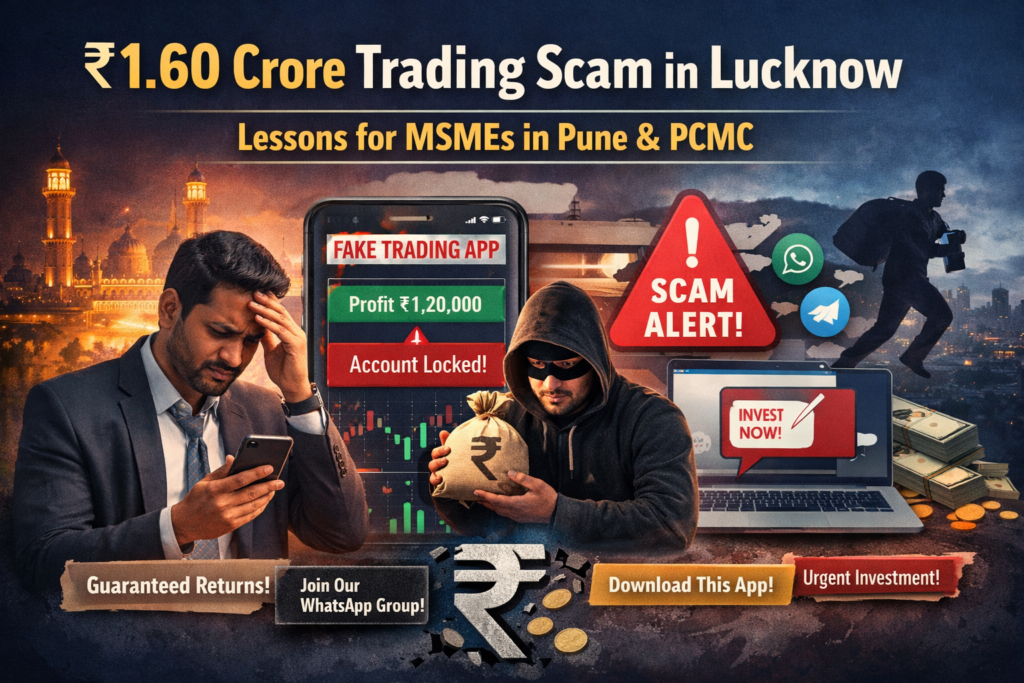
A recent cyber fraud case reported by The Times of India (April 2026) highlights a serious concern for businesses and individuals alike—online trading scams. A man in Lucknow was duped of over ₹1.60 crore after being lured with promises of high returns through a fake trading platform.
For MSMEs and business owners in industrial hubs like Pune, PCMC, and across Maharashtra, this is not just isolated news. With increasing digital adoption in finance and investments, such scams are becoming more sophisticated, directly impacting working capital, savings, and financial stability.
How the ₹1.60 Crore Trading Scam Happened
The victim was approached by fraudsters posing as representatives of a reputed trading platform. They gradually built trust by offering attractive returns and convincing investment narratives.
Once confidence was established:
- The victim transferred large sums in phases
- Fake dashboards or assurances were likely used to show “profits”
- Withdrawals were blocked after significant investment
- Fraudsters eventually disappeared
This pattern is not isolated. Similar scams across India show identical structures:
- WhatsApp/Telegram groups
- Fake trading apps
- Initial small profits to gain trust
- Pressure to invest larger amounts
Why Trading Scams Are Increasing in 2026
India is witnessing a surge in digital investment frauds due to:
1. Easy Access to Retail Trading
Low entry barriers in stock and crypto trading platforms attract first-time investors.
2. Social Media & Messaging Platforms
Fraudsters operate through WhatsApp groups, fake ads, and influencer-style promotions.
3. Lack of Verification Awareness
Many investors do not verify whether platforms are registered with Securities and Exchange Board of India (SEBI).
4. Psychological Manipulation
Scammers exploit greed and urgency—“limited-time opportunity”, “guaranteed returns”, etc.
5. Increasing Cybercrime Networks
Recent cases show organized inter-state rackets running such scams professionally.
Impact on Small Businesses & Professionals
For MSMEs, such frauds are not just personal losses—they can disrupt entire business operations:
- Loss of working capital or emergency funds
- Cash flow crisis affecting vendor payments
- Increased debt burden
- Loss of financial confidence in digital tools
In some reported cases, victims invested funds from multiple bank accounts, including family accounts, amplifying the financial damage.
Practical Red Flags Every Business Owner Must Watch
To prevent such losses, businesses must identify early warning signs:
- Platforms promising guaranteed or unusually high returns
- Requests to download unknown trading apps
- Investment advice via WhatsApp groups or unknown advisors
- Pressure to invest quickly or increase investment
- Withdrawal restrictions with excuses like “tax”, “charges”, or “upgrade fees”
Preventive Measures for MSMEs (Highly Practical)
Verification Steps
- Check SEBI registration of brokers/advisors
- Avoid apps not listed on official app stores
Financial Discipline
- Never invest business funds in unverified schemes
- Maintain approval hierarchy for large transfers
Cyber Awareness
- Train staff handling banking transactions
- Avoid sharing OTPs, credentials, or remote access
Immediate Action if Scammed
- Report to National Cyber Crime Portal (www.cybercrime.gov.in)
- Call helpline 1930 immediately
- Inform bank for transaction freeze
WH Question
Q: How do trading scams typically trap even financially aware individuals?
Answer:
Trading scams rely on a combination of trust-building (fake profits, professional communication), psychological pressure (urgency, exclusivity), and technological mimicry (real-looking apps/websites). Even financially literate individuals fall victim when emotional triggers override verification processes.
FAQs
1. Are all online trading apps safe to use?
No. Only platforms registered with SEBI and available through verified channels should be used.
2. Can money lost in such scams be recovered?
Recovery is difficult but possible if reported immediately. Early reporting helps authorities freeze accounts.
3. Why do scammers allow initial profit withdrawal?
This is a trust-building tactic to encourage larger investments later.
4. Is it safe to follow stock tips on WhatsApp groups?
No. Most such groups are unregulated and often part of fraud networks.
5. What is the biggest mistake victims make?
Ignoring verification and continuing to invest even after facing withdrawal issues.
6. Are MSMEs more vulnerable to such scams?
Yes, especially when owners invest surplus business funds without structured financial advice.
7. What is the safest approach to business investments?
Stick to regulated advisors, diversify investments, and avoid “too good to be true” opportunities.
Final Takeaway
The Lucknow ₹1.60 crore scam is a strong reminder that financial fraud today is not about lack of intelligence. It is about lack of verification. For MSMEs in Pune, PCMC, and across India, safeguarding capital is as important as earning returns. A single wrong investment decision can wipe out years of business effort.