
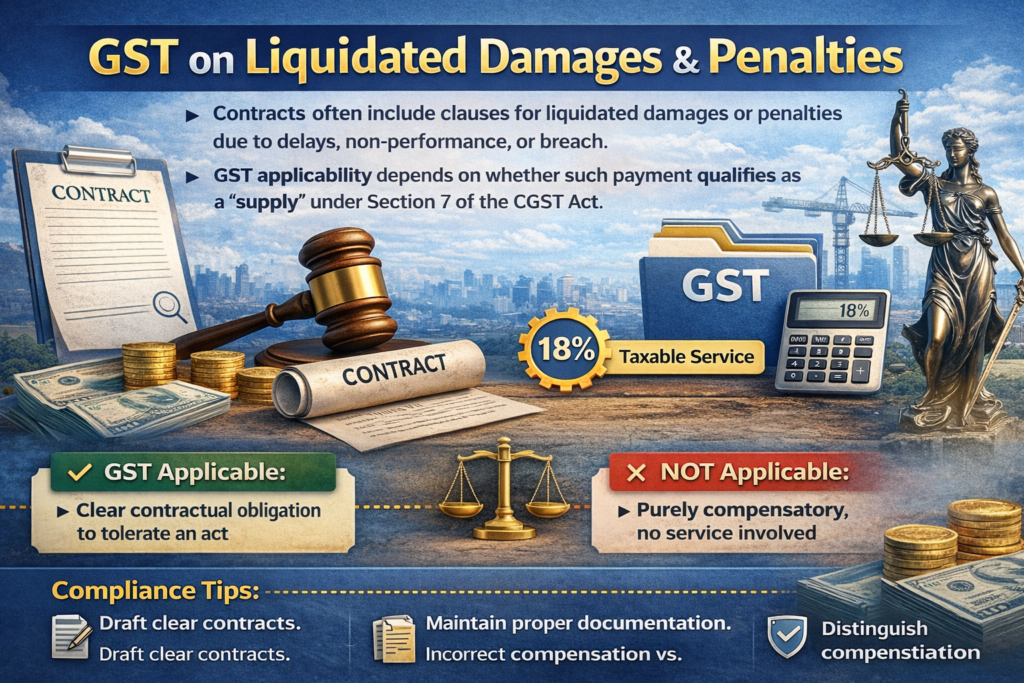
In industrial hubs like Pune, PCMC, and across Maharashtra, contracts often include clauses for liquidated damages, penalties, or compensation for breach or delay. A critical GST question arises—whether such recoveries attract GST or not. Misinterpretation can lead to unnecessary tax payments or litigation. This blog explains the GST treatment of liquidated damages and penalties, recent legal position, and practical compliance approach for businesses.
Liquidated damages refer to pre-agreed compensation payable by one party to another for breach of contract—such as delay in delivery, non-performance, or failure to meet quality standards. Under GST, the key issue is whether such damages qualify as a “supply” under Section 7 of the CGST Act.
Earlier, tax authorities treated such recoveries as consideration for “tolerating an act” under Schedule II, thereby attracting GST. However, courts and advance rulings have clarified that mere compensation for breach does not automatically qualify as a supply unless there is a clear contractual obligation to tolerate the act for a consideration.
Example:
- Delay penalty deducted from contractor → generally NOT taxable
- Agreement to allow breach for a fee → taxable
Recent judicial trends and CBIC clarifications emphasize substance over form. GST is applicable only when:
- There is an explicit agreement to tolerate an act
- The payment is made as consideration for such tolerance
- The activity qualifies as a supply under Section 7
Otherwise, liquidated damages are treated as compensation (not consideration), and GST is not applicable. This distinction is crucial for industries like construction, manufacturing, and service contracts in Pune and PCMC.
WH Question
What is the GST applicability on liquidated damages received for breach of contract?
GST is not applicable if the payment is purely compensatory in nature and not linked to any supply or obligation to tolerate an act. However, if the contract explicitly provides for a service of tolerating non-performance against consideration, GST becomes applicable.
FAQs
- Is GST applicable on penalty for delay in supply of goods?
Generally no, if it is compensatory and not a consideration for any service. - Can ITC be claimed on GST paid on such penalties?
ITC eligibility depends on the nature of expense and business use. If wrongly paid, ITC may be disputed. - What is the GST rate if applicable?
If treated as a service of tolerating an act, GST is applicable at 18%. - How should such transactions be shown in GST returns?
If taxable, report under outward supply. If non-taxable, disclose as non-GST supply in books for clarity. - What documents should be maintained?
Maintain contracts, debit notes, and justification showing compensatory nature to defend non-taxability. - Are court-awarded damages taxable under GST?
No, as they are purely compensatory and not linked to any supply. - What is the key factor to determine GST applicability?
Whether the payment is for a “supply” (tolerating an act) or merely compensation for breach.