
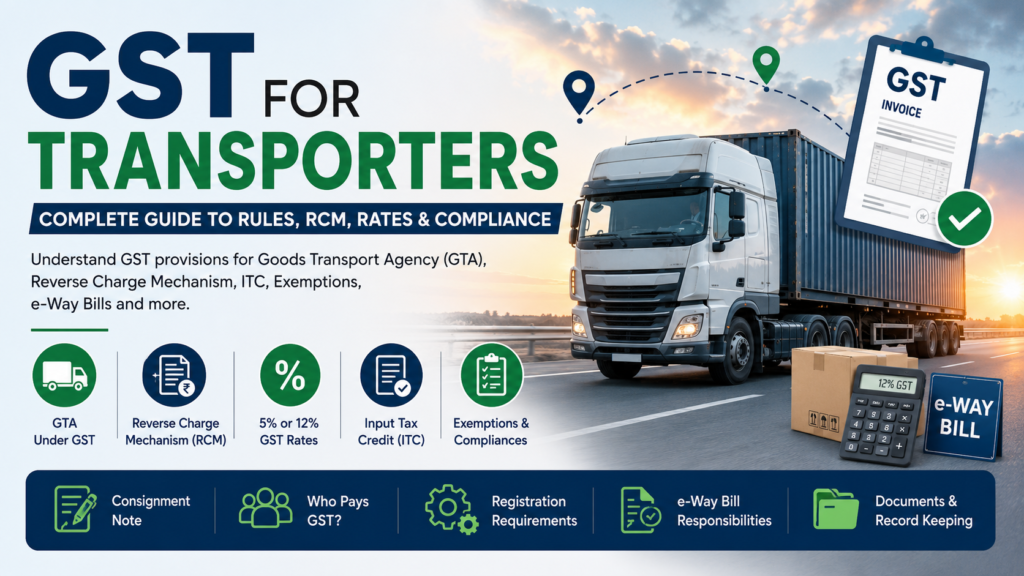
The transportation and logistics sector plays a crucial role in India’s supply chain. Every day, manufacturers, traders, wholesalers, retailers, and e-commerce businesses rely on transporters to move goods across the country. However, GST provisions applicable to transporters are unique and often misunderstood due to special concepts such as Goods Transport Agency (GTA), Consignment Note, Reverse Charge Mechanism (RCM), Forward Charge, and Input Tax Credit (ITC).
Many businesses assume that every transporter is liable to charge GST, while others believe that all freight charges are covered under Reverse Charge. Both assumptions are incorrect. The GST treatment depends on several factors, including whether the transporter qualifies as a GTA, whether a consignment note is issued, the category of the recipient, and the taxation option exercised by the GTA.
This guide explains the GST rules applicable to transporters in simple language and covers the key compliance requirements for transporters as well as businesses availing transportation services.
Who is a Goods Transport Agency (GTA)?
Under GST law, not every transporter is a Goods Transport Agency (GTA).
A person is treated as a GTA only when both of the following conditions are satisfied:
- The person provides transportation of goods by road.
- The transporter issues a Consignment Note (CN), Lorry Receipt (LR), Goods Receipt (GR), or a similar document accepting responsibility for the goods.
If no consignment note is issued, the transporter is not regarded as a GTA under GST.
This distinction is important because most GST provisions relating to freight, Reverse Charge, GST rates, and ITC apply only to GTAs.
What is a Consignment Note?
A Consignment Note is a document issued by a transporter acknowledging receipt of goods for transportation and accepting responsibility for their delivery.
Generally, it contains:
- Consignment note number
- Date
- Name of consignor
- Name of consignee
- Description of goods
- Origin and destination
- Vehicle details
- Freight amount
- Person liable to pay freight
The issuance of a consignment note signifies that the transporter has taken responsibility for the goods during transit. If a transporter merely provides a vehicle without issuing a consignment note, they are generally not regarded as a GTA under GST.
Difference Between a GTA and an Ordinary Transporter
| Particulars | Goods Transport Agency (GTA) | Ordinary Transporter |
|---|---|---|
| Issues Consignment Note | Yes | No |
| Covered under GTA provisions | Yes | No |
| RCM may apply | Yes | Not applicable |
| Forward Charge option available | Yes | Not applicable |
| Transport service generally exempt | No (subject to GST provisions) | Yes, being transport of goods by road by a person other than a GTA or courier agency |
GST Rates Applicable to GTA Services
A GTA has two taxation options.
| GST Rate | ITC Availability | Remarks |
|---|---|---|
| 5% | ITC on goods and services used in supplying the GTA service is not available | Frequently opted where input GST is relatively low. |
| 12% | Full ITC available on eligible inward supplies | Suitable where the GTA incurs significant GST-bearing expenses. |
A GTA opting to pay GST under the Forward Charge mechanism must exercise the option in the prescribed manner, and the option generally remains applicable for the entire financial year.
Reverse Charge Mechanism (RCM) on GTA Services
One of the most distinctive features of GST for transporters is the Reverse Charge Mechanism (RCM).
Under RCM, the liability to pay GST shifts from the GTA to the recipient of the service, subject to specified conditions.
RCM generally applies where GTA services are supplied to specified recipients such as:
- Factory registered under the Factories Act
- Society registered under any law
- Co-operative society
- Registered person under GST
- Body corporate
- Partnership firm (including LLP)
- Casual taxable person
Where RCM applies:
- The GTA issues an invoice without charging GST.
- The recipient pays GST directly to the Government.
- The recipient may claim Input Tax Credit (ITC), subject to fulfilment of the conditions prescribed under the CGST Act.
Important: RCM does not apply where the GTA has exercised the option to pay GST under the Forward Charge mechanism.
Forward Charge Mechanism
Instead of allowing the recipient to pay tax under RCM, a GTA may opt to discharge GST under the Forward Charge mechanism.
In such cases:
- The GTA charges GST on the invoice.
- The GTA deposits GST with the Government.
- The GTA files GST returns.
- The recipient claims ITC, subject to eligibility.
Businesses should verify whether their transporter has opted for Forward Charge before determining their GST liability.
Input Tax Credit (ITC) for GTAs
The availability of ITC depends upon the taxation option exercised by the GTA.
Where GTA pays GST at 5%
The GTA cannot avail Input Tax Credit on goods and services used in supplying the GTA service.
Examples include:
- Vehicle repair and maintenance services
- Office rent
- Professional fees
- Security services
- Office equipment
- Other eligible inward supplies used for providing GTA services
Where GTA pays GST at 12%
The GTA may avail full ITC on eligible inward supplies used in the course or furtherance of business, subject to the provisions of the CGST Act.
Businesses with substantial GST-bearing expenses often evaluate whether the 12% option is more tax-efficient.
GST Registration for Transporters
GST registration requirements depend upon the nature of transportation services provided and the applicable GST provisions.
Generally:
- A transporter providing only exempt transportation services may not require registration solely for such exempt supplies.
- A GTA opting to pay GST under the Forward Charge mechanism is generally required to obtain GST registration.
- Aggregate turnover and other provisions relating to compulsory registration under the CGST Act should also be be evaluated before determining registration liability.
Transporters should review their specific business model before concluding whether GST registration is mandatory.
Important GST Exemptions for Transporters
GST law provides exemptions for certain transportation services.
Some important exemptions include:
1. Transport of goods by road by a person other than:
- A Goods Transport Agency (GTA), or
- A courier agency.
2. Transportation of specified goods by a GTA, including:
- Agricultural produce
- Milk
- Salt
- Food grain including flour, pulses and rice
- Organic manure
- Newspapers and magazines registered with the Registrar of Newspapers
- Relief materials meant for victims of natural or man-made disasters
- Defence or military equipment (subject to the applicable notification and conditions)
3. Freight-based exemptions
GST exemption is also available where:
- Consideration charged for transportation of goods on a consignment transported in a single carriage does not exceed ₹1,500, or
- Consideration charged for transportation of all goods for a single consignee does not exceed ₹750.
Businesses should verify whether these exemptions apply before determining GST liability.
GST on Individual Truck Owners
Many truck owners transport goods independently without issuing a consignment note.
Such transporters are generally not regarded as GTAs.
Accordingly:
- Their services fall under the exemption applicable to transportation of goods by road by a person other than a GTA or courier agency.
- GST is generally not applicable on such services.
However, once a transporter begins issuing consignment notes, the GST treatment changes and the transporter may qualify as a GTA.
Invoicing Requirements
A GTA should issue a tax invoice containing all particulars prescribed under GST law.
Where GST is payable under Reverse Charge, the invoice should appropriately indicate that tax is payable by the recipient under RCM.
Proper invoicing helps avoid disputes during GST audits and assessments.
e-Way Bill Responsibilities
Transporters play a significant role in e-Way Bill compliance.
Their responsibilities may include:
- Carrying the e-Way Bill during transportation.
- Updating vehicle details where required.
- Updating Part B of the e-Way Bill in applicable cases.
- Ensuring that the e-Way Bill remains valid throughout transportation.
- Maintaining transporter records.
An unregistered transporter may also enrol on the GST portal and obtain a Transporter ID (TRANSIN) for e-Way Bill purposes.
Failure to comply with e-Way Bill provisions may result in detention of goods, seizure of vehicles, penalties, and litigation.
Documents Every Transporter Should Maintain
For smooth GST compliance, transporters should maintain:
- Consignment Notes
- Freight invoices
- e-Way Bills
- Vehicle details
- Proof of delivery
- Customer agreements
- Payment records
- Freight receipts
- Vehicle movement records, wherever maintained
Proper documentation helps during departmental audits and assessments.
Practical Examples
Example 1 – Individual Truck Owner
ABC Traders hires an individual truck owner for transporting goods.
The truck owner does not issue a consignment note.
GST Position
- Not a GTA
- Transport service generally exempt
- No GST applicable on freight
Example 2 – GTA under Reverse Charge
XYZ Manufacturing Ltd., a registered company, hires Fast Logistics.
Fast Logistics issues a consignment note and has not opted for Forward Charge.
Freight: ₹1,00,000
GST Position
- Service qualifies as GTA service.
- Reverse Charge applies.
- GTA issues invoice without GST.
- XYZ Manufacturing Ltd. pays GST under RCM.
- Eligible ITC may be claimed by the company.
Example 3 – GTA under Forward Charge
Fast Logistics has opted to pay GST under Forward Charge.
Freight: ₹1,00,000
GST @12% = ₹12,000
Invoice Value = ₹1,12,000
The GTA collects GST, deposits it with the Government, and the recipient claims eligible ITC.
Common GST Mistakes Made by Businesses
Some common errors include:
- Assuming every transporter is a GTA.
- Ignoring whether a consignment note has been issued.
- Incorrectly applying Reverse Charge.
- Paying GST under RCM despite the GTA opting for Forward Charge.
- Wrong ITC claims.
- Ignoring freight exemptions.
- Incorrect invoicing.
- Non-compliance with e-Way Bill provisions.
- Failure to maintain proper documentation.
Periodic GST reviews can help prevent notices and disputes.
Compliance Checklist for Businesses
Before accounting for freight expenses, businesses should verify:
- Whether the transporter is a GTA.
- Whether a consignment note has been issued.
- Whether the GTA has opted for Forward Charge.
- Whether Reverse Charge applies.
- Whether any exemption is available.
- Whether the invoice contains the required GST particulars.
- Whether the e-Way Bill requirements have been complied with.
- Whether ITC can be claimed.
Following this checklist can significantly reduce GST compliance risks.
What Should Businesses Check Before Paying Freight Charges?
Before making payment to a transporter, businesses should verify whether the transporter qualifies as a Goods Transport Agency, whether a consignment note has been issued, whether GST is payable under Reverse Charge or Forward Charge, whether any exemption is available, and whether the freight invoice complies with GST requirements. Performing these checks helps avoid incorrect tax payments and future disputes during departmental audits.
Frequently Asked Questions (FAQs)
1. Is every transporter treated as a Goods Transport Agency (GTA)?
No. A transporter becomes a GTA only when they transport goods by road and issue a consignment note. Transporters who do not issue a consignment note are generally not regarded as GTAs.
2. Who is liable to pay GST on freight charges?
It depends on the facts of the transaction. In many cases, GST is payable by the recipient under the Reverse Charge Mechanism. However, if the GTA has opted to pay GST under the Forward Charge mechanism, the GTA collects and pays the tax.
3. Can a GTA claim Input Tax Credit?
Yes. A GTA paying GST at 12% under the Forward Charge mechanism can claim eligible ITC. A GTA paying GST at 5% cannot avail ITC on goods and services used in supplying the GTA service.
4. Is GST registration compulsory for every transporter?
No. Registration depends on factors such as the nature of services provided, applicable exemptions, aggregate turnover, and whether the GTA has opted to pay GST under the Forward Charge mechanism.
5. Are freight charges always covered under Reverse Charge?
No. Reverse Charge applies only in specified cases. If the GTA has opted to pay GST under the Forward Charge mechanism, GST is payable by the GTA and not by the recipient.
6. Is GST applicable on transportation of agricultural produce?
Transportation of agricultural produce by a GTA is generally exempt, subject to the applicable notification and conditions.
7. What documents should transporters maintain for GST compliance?
Transporters should maintain consignment notes, freight invoices, e-Way Bills, proof of delivery, vehicle records, customer agreements, payment records, and other supporting documents relevant to transportation services.