
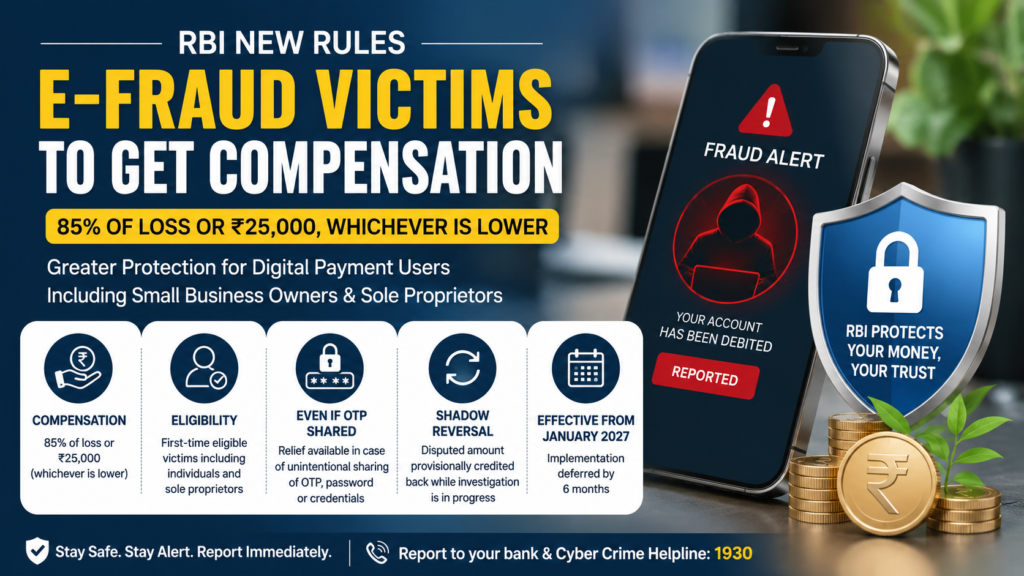
Online banking and UPI payments have made financial transactions faster than ever, but they have also led to a sharp rise in cyber frauds. From fake investment schemes to phishing links and fraudulent UPI requests, thousands of Indians lose money every day. To strengthen consumer confidence in digital payments, the Reserve Bank of India (RBI) has introduced a significant customer protection framework that will provide compensation to eligible victims of digital payment frauds. The scheme is expected to come into effect from January 2027, after being deferred by six months.
For individuals, sole proprietors, and small business owners who rely heavily on digital transactions, this is an important development that could reduce financial hardship caused by cyber fraud.
What Is the New Digital Fraud Compensation Scheme?
Under the new framework, eligible victims of online financial fraud will receive compensation equal to:
- 85% of the financial loss, or
- ₹25,000,
whichever is lower.
The compensation is intended to provide immediate financial relief in cases involving relatively small-value frauds, which constitute a large share of reported banking fraud incidents.
Who Can Benefit?
According to the announced framework:
- It is available to first-time victims of eligible digital payment fraud.
- The benefit is designed as a one-time compensation.
- Protection extends to individual customers as well as sole proprietors, bringing small businesses under the coverage.
A Major Relief: Even If You Shared an OTP
One of the most notable aspects of the new framework is that compensation may still be available even if the customer unintentionally disclosed confidential information such as:
- One-Time Password (OTP)
- Password
- Other authentication credentials
This represents a significant shift from traditional banking practices, where sharing credentials often resulted in customers bearing the entire loss. The relief applies only where the fraud was unintentional and subject to the RBI’s framework.
Introduction of ‘Shadow Reversal’
The RBI has also introduced a Shadow Reversal mechanism.
Under this process:
- When a customer reports a disputed fraudulent transaction, the disputed amount can be provisionally reflected back in the customer’s account while the investigation is underway.
- This reduces immediate financial stress and improves customer confidence during the resolution process.
Why This Matters for Small Businesses
Small businesses increasingly depend on:
- UPI collections
- Internet banking
- Mobile banking
- QR code payments
- Digital payment gateways
A cyber fraud can disrupt daily operations and working capital. This new framework offers several advantages:
- Reduces financial impact of smaller frauds.
- Builds confidence in digital payment systems.
- Encourages faster reporting of fraudulent transactions.
- Extends protection to sole proprietors who form a major part of India’s MSME ecosystem.
Continue Following Safe Banking Practices
Although compensation provides relief, prevention remains the best protection.
Businesses and individuals should continue to:
- Never share OTPs or passwords.
- Verify payment requests before approving them.
- Avoid clicking suspicious links.
- Enable transaction alerts.
- Report fraud immediately to the bank and cybercrime authorities.
- Regularly update banking applications and mobile devices.
What compensation will eligible digital fraud victims receive?
Eligible first-time victims can receive 85% of the financial loss or ₹25,000, whichever is lower, subject to the RBI framework.
When will the compensation scheme become effective?
The RBI has deferred implementation by six months, and the scheme is expected to come into effect from January 2027.
Who is eligible for the compensation?
The framework covers first-time eligible victims of digital payment fraud, including individual customers and sole proprietors, subject to the conditions prescribed by the RBI.
Will victims receive compensation even if they shared an OTP?
Yes. The framework is designed to provide limited relief even where customers unintentionally disclosed credentials such as OTPs or passwords, provided the fraud was unintentional and other eligibility conditions are satisfied.
What is Shadow Reversal?
Shadow Reversal is a mechanism that provisionally restores the disputed amount to the customer’s account while the fraud investigation is in progress.
FAQs
1. Is the compensation available for every fraud incident?
No. The announced framework provides a one-time benefit for eligible first-time victims.
2. What is the maximum compensation amount?
The maximum compensation is ₹25,000, even if the financial loss exceeds that amount.
3. Does the scheme cover UPI fraud?
The framework applies to eligible digital payment frauds, which can include UPI-related frauds, subject to RBI guidelines and bank procedures.
4. Are sole proprietors covered?
Yes. The RBI has extended the protection framework to sole proprietors, recognising their increasing use of digital payment systems.
5. Should I still report fraud immediately?
Absolutely. Prompt reporting remains essential for investigation, recovery efforts, and determining eligibility under the compensation framework.
6. Does this mean customers no longer need to be careful?
No. The compensation is limited and intended as relief—not a replacement for safe digital banking practices. Users should continue following all cybersecurity precautions.
7. Why has the implementation been postponed?
The RBI has deferred implementation by six months to facilitate a smoother rollout of the new consumer protection framework.