
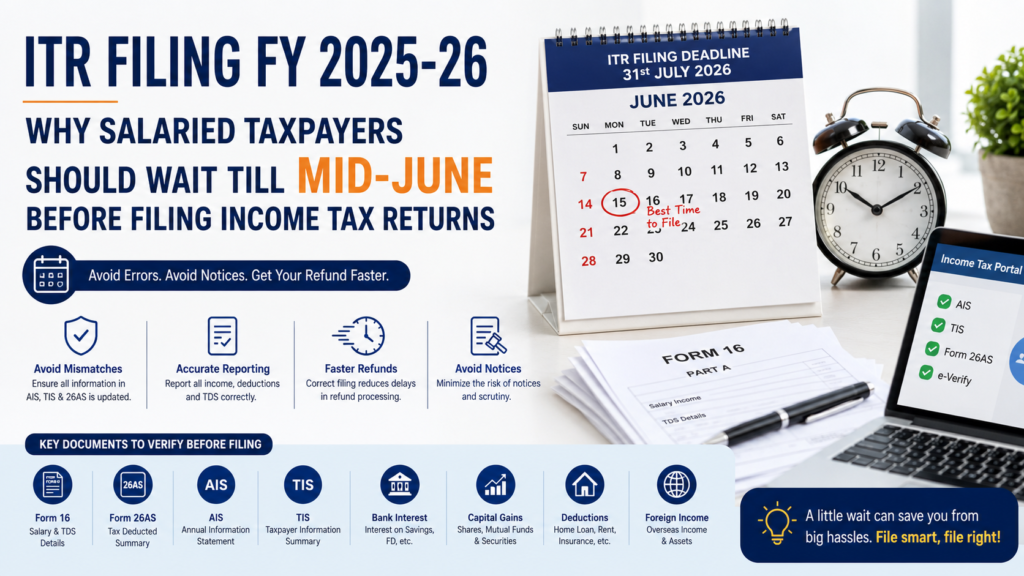
The Income Tax Return (ITR) filing season for FY 2025-26 (AY 2026-27) has begun, and many salaried taxpayers are eager to file their returns as early as possible. While early filing is generally considered a good compliance practice, filing too soon can sometimes create avoidable complications.
The Income Tax Department, employers, banks, mutual fund houses, and other reporting entities continue to upload financial information during the initial weeks of the filing season. As a result, tax experts often recommend that salaried taxpayers wait until mid-June or later before submitting their ITR to ensure that all relevant information is reflected correctly in their tax records.
For taxpayers in Pune, Pimpri-Chinchwad, and across India, understanding the right timing can help avoid notices, defective returns, and lengthy refund delays.
Why Filing Too Early Can Be Risky
The Income Tax Department compiles information from multiple sources and displays it in Form 26AS, Annual Information Statement (AIS), and Taxpayer Information Summary (TIS).
These statements may not be fully updated immediately when the ITR utilities become available. Various reporting entities continue uploading and correcting data during the initial weeks of the filing season.
If taxpayers file before these details are updated, there may be mismatches between the filed return and the information eventually available with the department.
Such mismatches can trigger scrutiny, notices, or the need to file a revised return.
Key Documents That Should Be Verified Before Filing
Before filing an ITR, salaried taxpayers should carefully verify the following documents:
| Document | Purpose |
|---|---|
| Form 16 | Salary income and TDS details |
| Form 26AS | Tax deducted and deposited against PAN |
| AIS (Annual Information Statement) | Comprehensive financial transactions |
| TIS (Taxpayer Information Summary) | Summarized tax information |
| Bank Interest Certificates | Savings and FD interest income |
| Capital Gain Statements | Share, mutual fund, and securities transactions |
| Rent Receipts & Home Loan Certificates | Tax deduction claims |
| Foreign Income Statements | Overseas income and assets reporting |
Any discrepancy between these records and the ITR may lead to future compliance issues.
Importance of Checking AIS and TIS
Many taxpayers still rely solely on Form 16 while filing their returns. However, AIS and TIS have become equally important.
These statements contain information relating to:
- Bank interest income
- Dividend income
- Mutual fund transactions
- Share trading activities
- Property transactions
- Foreign remittances
- High-value financial transactions
Since these details are uploaded by various reporting entities, some entries may appear or get updated after the filing season begins.
Waiting until mid-June allows sufficient time for most reporting entities to complete their reporting obligations.
Common Mistakes Made by Early Filers
Taxpayers who rush to file their returns often make mistakes such as:
- Missing bank interest income.
- Ignoring dividend income.
- Omitting capital gains from mutual funds.
- Claiming incorrect deductions.
- Reporting incorrect TDS figures.
- Failing to reconcile AIS with Form 16.
These errors may require filing a revised return later, increasing compliance burden and creating unnecessary confusion.
How Waiting Can Help Faster Refund Processing
Many taxpayers believe that filing immediately guarantees a faster refund. However, a refund can be delayed if the return contains incorrect or incomplete information.
A properly reconciled return generally has a smoother processing cycle compared to a return that requires corrections or explanations later.
Therefore, spending a few extra days reviewing all tax records can often save significant time and effort in the long run.
Suggested Checklist Before Filing Your ITR
Follow this simple checklist:
- Collect Form 16 from your employer.
- Download and verify Form 26AS.
- Review AIS and TIS carefully.
- Check all bank interest income.
- Verify dividend income.
- Review mutual fund and share transactions.
- Reconcile TDS figures.
- Verify deduction claims under eligible sections.
- Ensure bank account details are correct.
- Keep supporting documents ready.
What Happens If You Already Filed Early?
If you have already filed your return and later discover missing information in AIS or Form 26AS, you may file a revised return within the prescribed timeline under the Income-tax Act.
However, preventing errors at the initial stage is always preferable to correcting them later.
Frequently Asked Questions (FAQs)
1. Should salaried taxpayers file ITR immediately after the utility is released?
Not necessarily. It is advisable to wait until Form 26AS, AIS, and TIS are fully updated before filing.
2. What is the ideal time for salaried taxpayers to file ITR?
Generally, mid-June onwards is considered safer as most financial information gets reflected by then.
3. Is Form 16 alone sufficient for filing ITR?
No. Taxpayers should also verify Form 26AS, AIS, TIS, bank interest income, and capital gains data.
4. Can AIS contain information not shown in Form 16?
Yes. AIS may include bank interest, dividends, securities transactions, property transactions, and other financial activities.
5. What if my AIS contains incorrect information?
You can submit feedback through the Income Tax Portal and maintain supporting documentation.
6. Can filing too early delay my refund?
Yes, if the return contains mismatches or missing information that requires further verification.
7. Do mutual fund redemptions and share transactions need to be reported?
Yes. Capital gains arising from such transactions must be reported appropriately in the ITR.
Conclusion
Early filing is beneficial only when all financial information has been accurately reported and reconciled. For most salaried taxpayers, waiting until mid-June before filing the ITR for FY 2025-26 can help ensure that Form 26AS, AIS, and TIS are properly updated.
A few extra days of verification can significantly reduce the risk of notices, revised returns, and refund delays. Before filing your return, review all available tax records carefully and ensure that every source of income has been correctly reported.